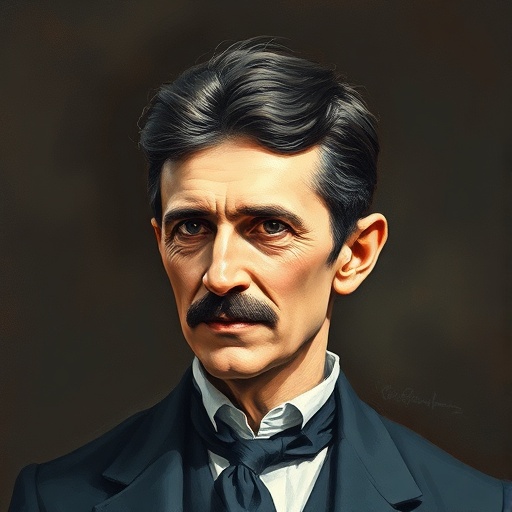
Nikola Tesla — "I see no reason why a man should not be able to transmit his thoughts to another…"
I see no reason why a man should not be able to transmit his thoughts to another across the ocean.
I see no reason why a man should not be able to transmit his thoughts to another across the ocean.
Click any product to generate a realistic preview. Up to 3 at a time.
* Initial load can take up to 90 seconds — revising the preview in another color is nearly instant.
"The gift of mental power comes from God, Divine Being, and if we concentrate our minds on that truth, we become in tune with this great power. My Mother had taught me to seek all truth in the Bible."
"The time will come when the forces of the universe will be brought under the control of man."
"Anti-social behavior is a trait of intelligence in a world full of conformists."
"The peril of a clash is aggravated by a more or less predominant sense of combativeness, posed by every human being. To resist this inherent fighting tendency the best way is to dispel ignorance of th…"
"In no way can we get such an overwhelming idea of the grandeur of Nature than when we consider, that in accordance with the law of the conservation of energy, throughout the Infinite, the forces are i…"
Serbian-American inventor and electrical engineer whose alternating-current designs powered the modern electrical grid; died poor and largely forgotten. Closely associated with George Westinghouse (his AC-power business partner) and Mihajlo Pupin (fellow Serbian-American physicist at Columbia). For an intellectual contrast, see Thomas Edison, American inventor and direct-current advocate — Edison's direct-current power-distribution scheme was displaced by Tesla-Westinghouse AC in the 1890s 'War of Currents'. Edison ran a public-relations campaign electrocuting animals to discredit AC — the most famous engineering-ethics rivalry in American history. Tesla's AC won and powers nearly every electrical grid on Earth.
Found in 1 providers: grok
1 source checked
Tesla is saying that distance should pose no fundamental barrier to transmitting human thought or ideas between people. He saw no scientific reason why the mind — or the information it generates — couldn't be conveyed wirelessly across vast distances like an ocean. In modern terms, he was previewing wireless communication, the internet, and brain-computer interfaces: technology that collapses geography and lets minds connect instantly regardless of physical separation.
Tesla spent his career proving that invisible forces could carry energy and information across distance. His AC system, radio wave experiments, and the Wardenclyffe Tower — his grand vision of a global wireless broadcast network — all reflected this conviction. He genuinely believed electromagnetic fields could bridge any gap between human minds. This quote captures his core philosophy: that nature imposes no real ceiling on what technology can transmit, a belief that drove his most ambitious and financially ruinous projects.
Tesla made statements like this in the late 1800s and early 1900s, when the telegraph had just proven long-distance electrical communication was real and Marconi was racing to achieve transatlantic radio. Spiritualism was culturally mainstream, and the line between wireless communication and telepathy seemed genuinely blurry to many. Society was confronting the possibility that electricity might unlock entirely new modes of human connection, making Tesla's speculation feel less like fantasy and more like imminent engineering.
AI-generated insights based on extensive research and information for context. Factual errors? Email [email protected].
Your cart is empty