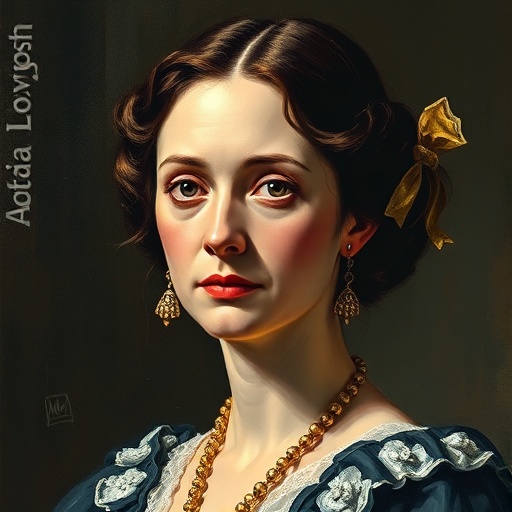
Ada Lovelace — "I shall, in due time, be a poetical scientist."
I shall, in due time, be a poetical scientist.
I shall, in due time, be a poetical scientist.
Click any product to generate a realistic preview. Up to 3 at a time.
* Initial load can take up to 90 seconds — revising the preview in another color is nearly instant.
"I believe myself to possess a most singular combination of qualities exactly fitted to make me pre-eminently a discoverer of the hidden realities of nature."
"The Analytical Engine has no pretensions whatever to originate anything. It can do whatever we know how to order it to perform."
"I have a peculiar way of looking at things, which is sometimes a disadvantage, but sometimes a great advantage."
"I am convinced that the future of knowledge lies in the development of machines that can assist the human mind."
"The Analytical Engine is the embodiment of the abstract science of operations."
Found in 1 providers: deepseek
1 source checked
The speaker declares a future identity that fuses creative imagination with rigorous scientific thinking. Rather than treating poetry and science as opposites, the quote insists they reinforce each other. 'In due time' signals patient self-confidence, not boasting. It's a rejection of the idea that analytical minds must be cold or purely logical—arguing instead that vision, metaphor, and wonder belong inside scientific work, not outside it.
Ada was the literal daughter of Romantic poet Lord Byron, making this claim biographical as much as philosophical. Her mother, fearing she'd inherit Byron's volatility, pushed her toward mathematics to suppress any poetic tendencies. Ada refused that trade-off. Her famous notes on Babbage's Analytical Engine—containing the first published algorithm—demonstrate it: she envisioned the machine composing music and manipulating symbols, a leap of imagination no pure logician had made.
The 1840s saw Romanticism and Industrial rationalism hardening into rival camps—poets celebrated feeling, engineers celebrated mechanical precision, and most intellectuals chose one side. Ada wrote this as Babbage struggled to fund his Analytical Engine, at a moment when 'computing' was still a human job title. Her insistence on uniting poetry and science was genuinely countercultural, arriving just as Victorian society was enforcing strict boundaries between artistic and scientific identity.
AI-generated insights based on extensive research and information for context. Factual errors? Email [email protected].
Your cart is empty