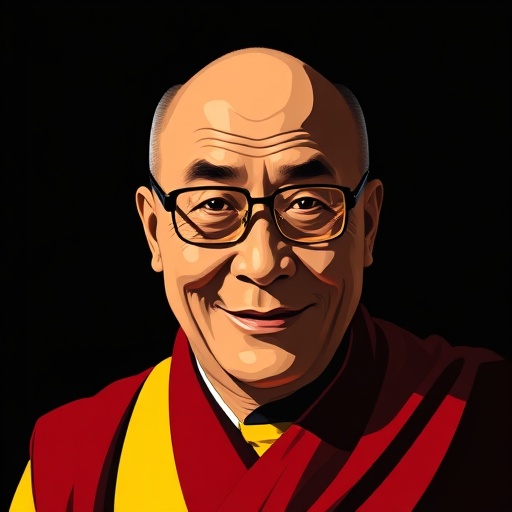
Dalai Lama (14th) — "I think I am a very good cook. My specialty is Tibetan food."
I think I am a very good cook. My specialty is Tibetan food.
I think I am a very good cook. My specialty is Tibetan food.
Click any product to generate a realistic preview. Up to 3 at a time.
* Initial load can take up to 90 seconds — revising the preview in another color is nearly instant.
"I think the most important thing is to be kind to others. That is the true meaning of happiness."
"I am a professional laugher."
"The 21st century should be a century of dialogue, not violence."
"I joke sometimes that I am the longest-serving refugee."
"Love and compassion are necessities, not luxuries. Without them, humanity cannot survive."
Found in 1 providers: grok
1 source checked
The quote reveals disarming, unpretentious self-confidence about something completely ordinary — cooking. Rather than claiming mastery of meditation or philosophy, the Dalai Lama takes pride in a domestic skill. It signals that genuine satisfaction comes from everyday competence, not only grand spiritual achievement. His specific mention of Tibetan food ties personal identity to cultural heritage, suggesting that who we are shows up in small, daily acts as much as in public roles.
Tenzin Gyatso has lived in exile in Dharamsala, India since fleeing Tibet in 1959, separated from his homeland for over six decades. Mastering Tibetan cuisine is a direct, tangible way he maintains connection to a culture under existential threat. Known widely for warmth, humor, and self-deprecating wit, this remark is characteristic — he frequently uses lighthearted personal disclosures to disarm audiences and model that spiritual leadership doesn't require solemnity or distance from ordinary human pleasures.
Since China's annexation of Tibet in 1950 and the Dalai Lama's 1959 exile, Tibetan culture has faced sustained suppression, with language, religion, and customs systematically restricted inside Tibet. For the global Tibetan diaspora spanning India, Nepal, and the West, preserving food, music, and dress became acts of cultural resistance. In this context, the Dalai Lama cooking Tibetan food isn't trivial — it embodies the diaspora's core effort to keep a civilization alive outside its geographic homeland.
AI-generated insights based on extensive research and information for context. Factual errors? Email [email protected].
Your cart is empty