What it means
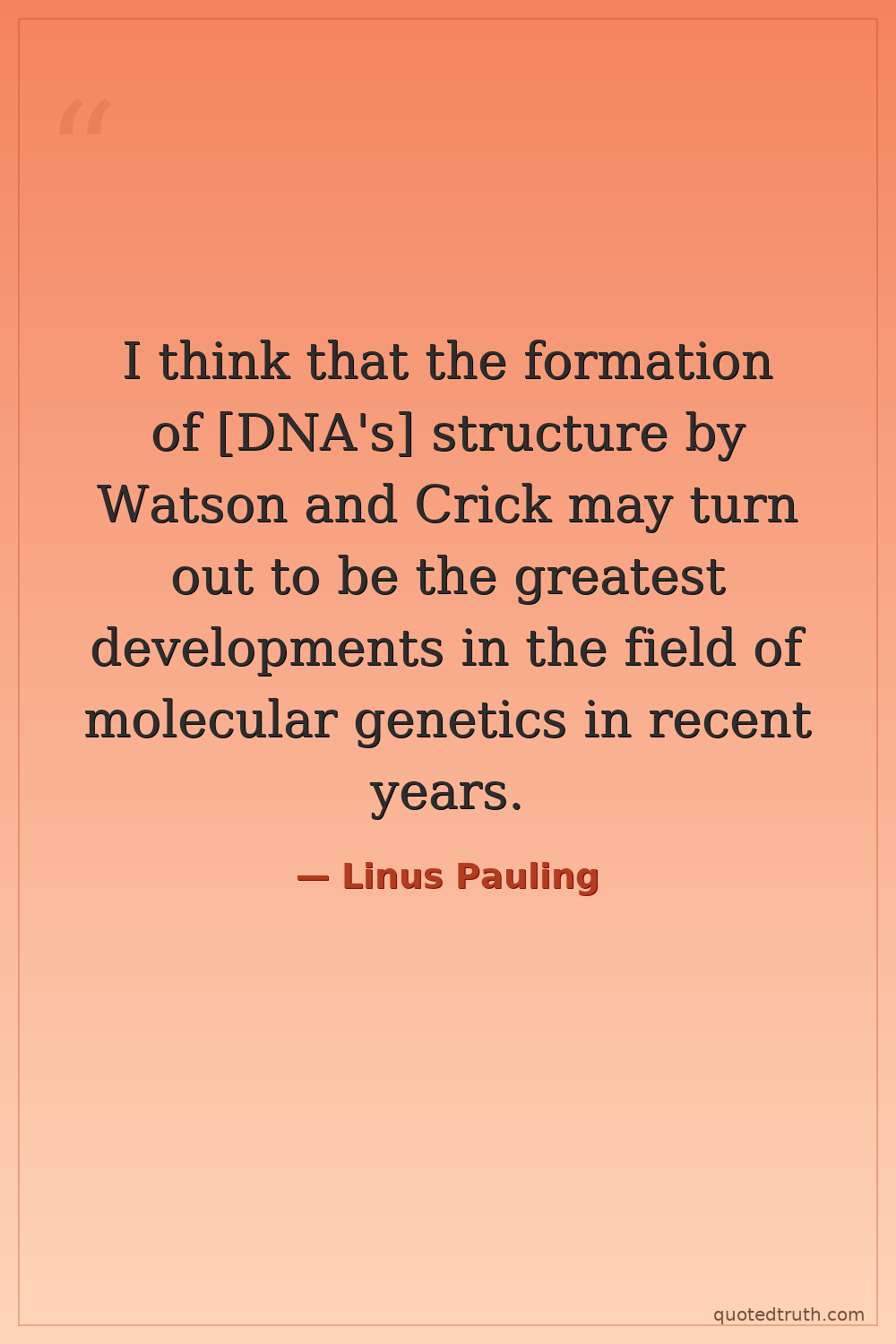
Pauling is acknowledging that Watson and Crick's discovery of DNA's double-helix structure represents a landmark breakthrough in understanding heredity and molecular biology. He recognizes that decoding DNA's physical architecture unlocks the mechanism by which genetic information is stored, copied, and transmitted — a foundational insight that would reshape biology, medicine, and our understanding of life itself.
Relevance to Linus Pauling
This reflects Pauling's deep investment in molecular biology and structural chemistry. Pauling himself had proposed a triple-helix model for DNA just months before Watson and Crick's 1953 announcement — and was wrong. His gracious acknowledgment of their superior model demonstrates his scientific integrity and commitment to empirical truth over ego, consistent with his reputation as one of chemistry's most rigorous thinkers.
The era
In the early 1950s, the race to determine DNA's structure was one of science's fiercest competitions, involving Pauling, Watson, Crick, Franklin, and Wilkins. The Cold War era intensified scientific nationalism, making international collaborative breakthroughs symbolically powerful. Watson and Crick's 1953 Nature paper ignited the molecular biology revolution, directly enabling the genetic research, biotechnology, and genomics that define modern medicine and life sciences.
AI-generated insights based on extensive research and information for context. Factual errors? Email [email protected].