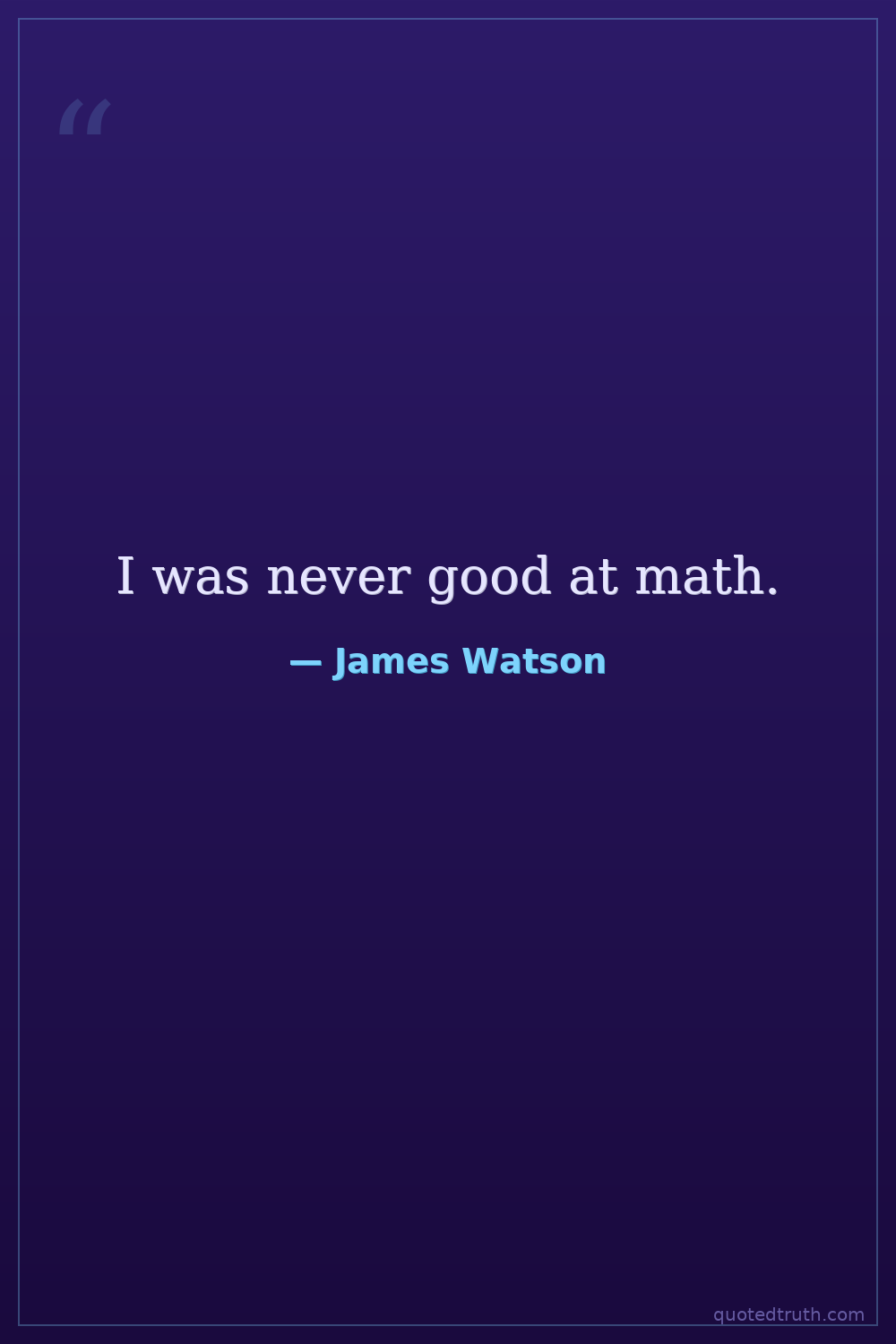
James Watson — "I was never good at math."
I was never good at math.
I was never good at math.
Click any product to generate a realistic preview. Up to 3 at a time.
* Initial load can take up to 90 seconds — revising the preview in another color is nearly instant.
"I'm not a very good speaker."
"I'm a Darwinian. I believe in natural selection."
"I’m not a racist in a conventional way. I’ve never been a racist. I’ve never been anti-Semitic. I’m not prejudiced."
"I never learned how to do experiments properly."
"If you're really stupid, I would say, just become a politician."
Found in 1 providers: grok
1 source checked
This quote acknowledges mathematical weakness while implying that great intellectual achievement doesn't require universal aptitude. It humanizes scientific genius by admitting a gap in traditional academic skill. In modern terms, it challenges the assumption that STEM success demands math mastery, suggesting that curiosity, intuition, and collaboration can compensate for technical deficiencies. It also carries a note of pride—declaring a limitation without apology, confident the rest speaks for itself.
Watson co-discovered DNA's double helix through model-building and biological intuition rather than mathematical derivation—his partner Francis Crick handled the mathematical physics. Watson's Nobel-winning insight relied on spatial reasoning, strategic collaboration, and leveraging Rosalind Franklin's X-ray data, not equations. His career at Cold Spring Harbor and his provocative memoir The Double Helix reinforce a self-image as a bold, instinct-driven scientist who succeeded despite—perhaps because of—rejecting conventional academic thoroughness.
In the mid-20th century, post-war science was increasingly mathematical—physics dominated, and biology was seen as a soft science until molecular biology emerged. Watson and Crick's 1953 discovery helped establish biology's new quantitative era, yet Watson's admission underscores that the revolution came partly from visual and structural thinking, not pure math. Today, with STEM culture equating mathematical ability with scientific worth, Watson's candor challenges that gatekeeping assumption.
AI-generated insights based on extensive research and information for context. Factual errors? Email [email protected].
Your cart is empty