What it means
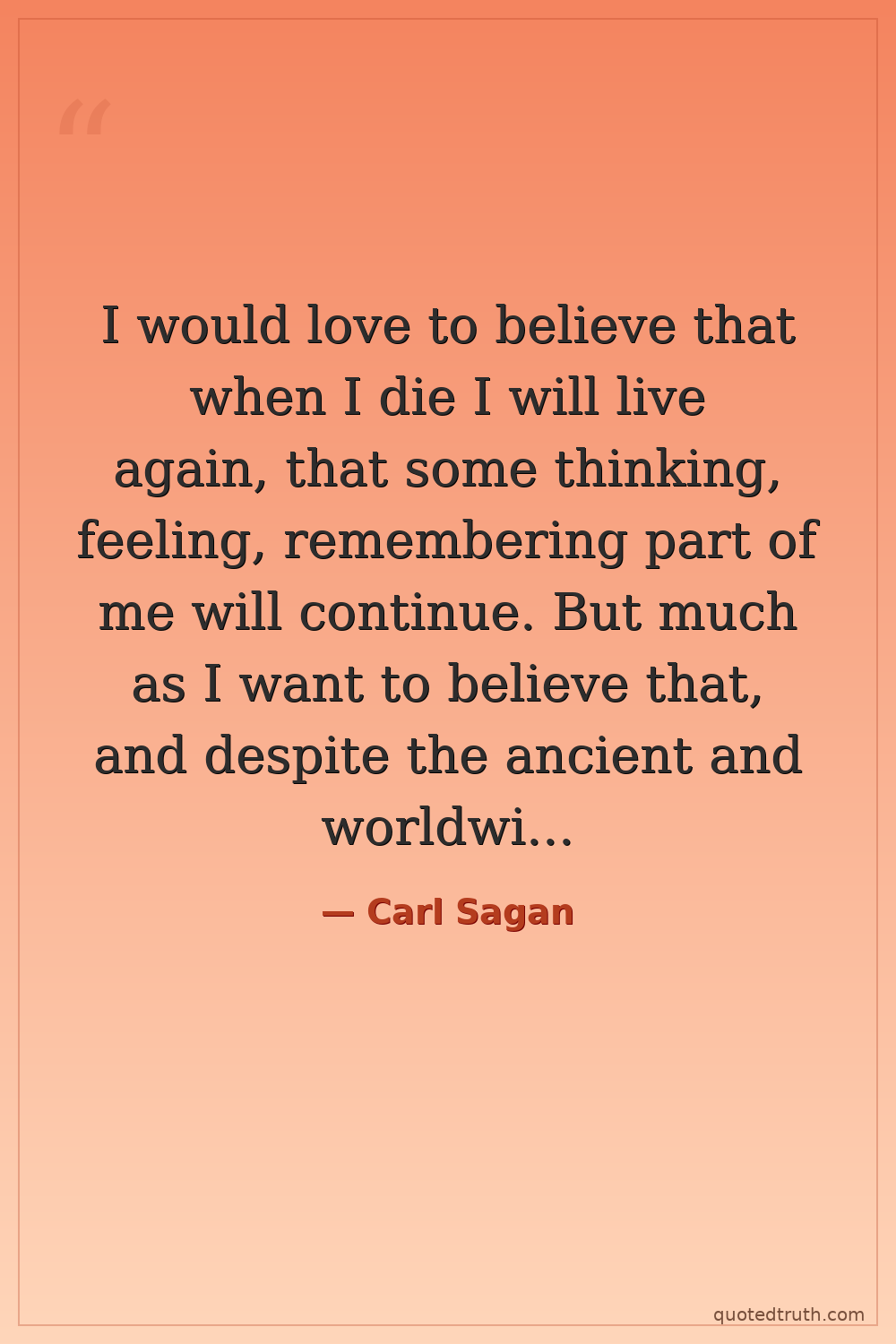
Honest longing meets intellectual discipline: Sagan admits he deeply wants consciousness to survive death, but acknowledges that desire alone is not evidence. Worldwide religious traditions promise an afterlife, and he understands their emotional pull. Yet he refuses to let personal hope override reason. The absence of evidence, even for something he craves, demands intellectual honesty. Wanting something to be true—no matter how fervently—does not make it so.
Relevance to Carl Sagan
Sagan built his career on the principle that evidence must precede belief, most explicitly in 'The Demon-Haunted World.' Diagnosed with myelodysplasia in 1994, he wrote this while dying, making the honesty especially striking—he refused false comfort even facing death. His wife Ann Druyan confirmed he died without pretending otherwise. His SETI work showed he could hold cosmic wonder alongside rigorous skepticism, never confusing hope with fact.
The era
Written in the mid-1990s, Sagan's era saw the New Age movement at its commercial peak—near-death experience books like Raymond Moody's 'Life After Life' sold millions, angel titles topped bestseller lists, and televised psychics commanded mass audiences. Religious fundamentalism was resurging politically. Meanwhile, neuroscience was beginning to map consciousness to brain activity, challenging dualist notions of a separable soul. Sagan's words pushed back against a culture actively marketing immortality.
AI-generated insights based on extensive research and information for context. Factual errors? Email [email protected].