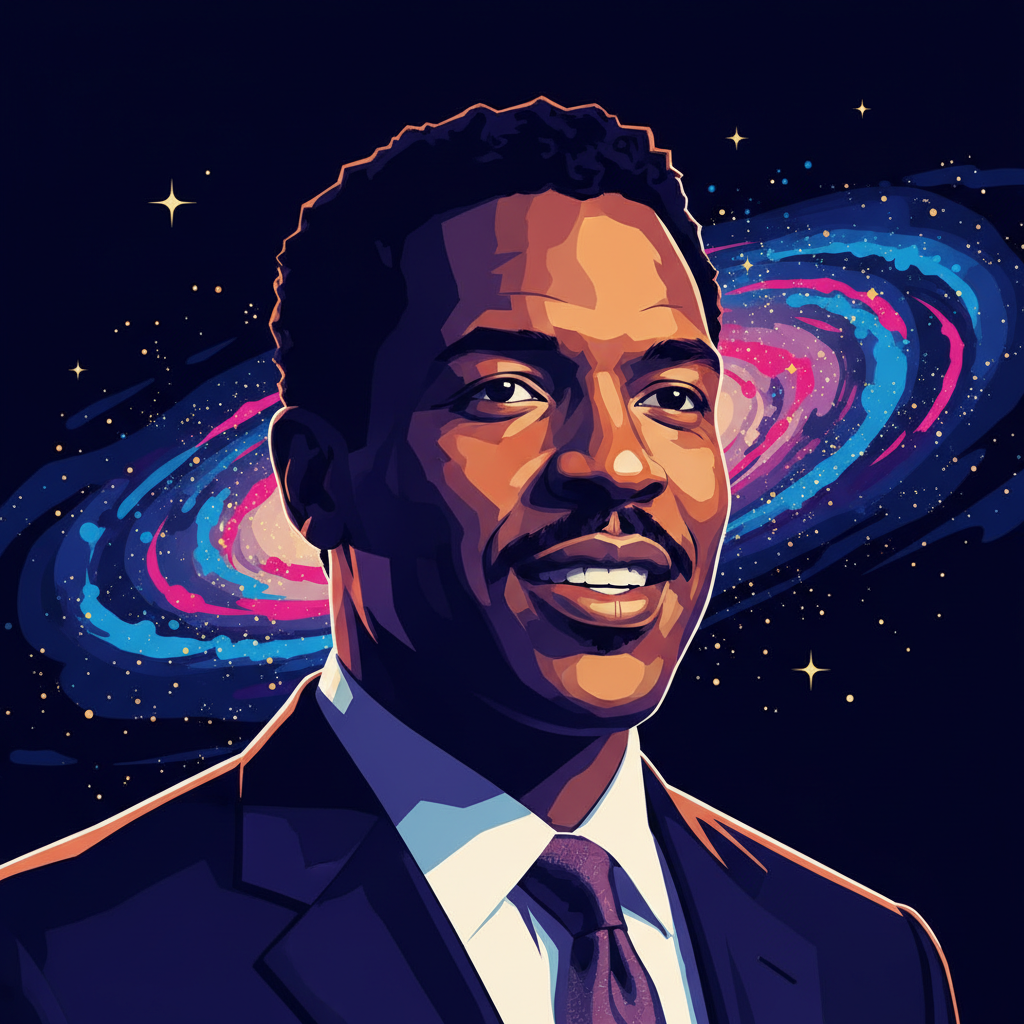
Neil deGrasse Tyson — "I would say, if you're not failing, you're not trying hard enough."
I would say, if you're not failing, you're not trying hard enough.
I would say, if you're not failing, you're not trying hard enough.
Click any product to generate a realistic preview. Up to 3 at a time.
* Initial load can take up to 90 seconds — revising the preview in another color is nearly instant.
"I'm not a fan of people who think they have all the answers. The universe is too vast and complex for anyone to have all the answers."
"The universe is a symphony, and we are the audience."
"I think it's important to have a sense of humor about the universe. It's a pretty absurd place, after all."
"I'm not a vegetarian, but I do believe that we should be more mindful of where our food comes from, and how it's produced."
"I'm not a fan of people who say, 'I believe in science.' Science is not a belief system. Science is a method."
American astrophysicist, Hayden Planetarium director, and Cosmos: A Spacetime Odyssey host who carries the Carl Sagan public-science mantle. Closely associated with Bill Nye (fellow science communicator) and Brian Greene (theoretical physicist and string-theory popularizer). For an intellectual contrast, see Ken Ham, founder of Answers in Genesis and the Creation Museum — Ham's career has been organized around defending biblical 6-day creationism — exactly the science-education position Tyson's mainstream-science communication is structured to refute.
Found in 1 providers: grok
1 source checked
Failure is proof you're pushing your limits. If every attempt succeeds, your goals aren't ambitious enough. Real progress — in science, career, or life — requires venturing into territory where outcomes aren't guaranteed. Failure isn't the opposite of success; it's a required step toward it. This reframes failure not as something to avoid, but as evidence you're genuinely challenging yourself and growing.
Tyson grew up in the Bronx navigating skepticism about whether a Black man could thrive in elite astrophysics, a field with real institutional barriers. As director of the Hayden Planetarium and host of Cosmos, he champions bold scientific inquiry. Space exploration — his lifelong subject — is defined by high-stakes missions where failure is routine: from shuttle disasters to early SpaceX explosions treated as data, not defeats.
Tyson speaks in an era shaped by Silicon Valley's fail-fast philosophy, SpaceX's iterative rocket testing where early explosions were celebrated as learning, and Carol Dweck's growth mindset entering mainstream education. Yet social media simultaneously amplifies public failure and shame. The tension between a culture that romanticizes entrepreneurial risk-taking and one that punishes visible mistakes makes this message both timely and necessary.
AI-generated insights based on extensive research and information for context. Factual errors? Email [email protected].
Your cart is empty