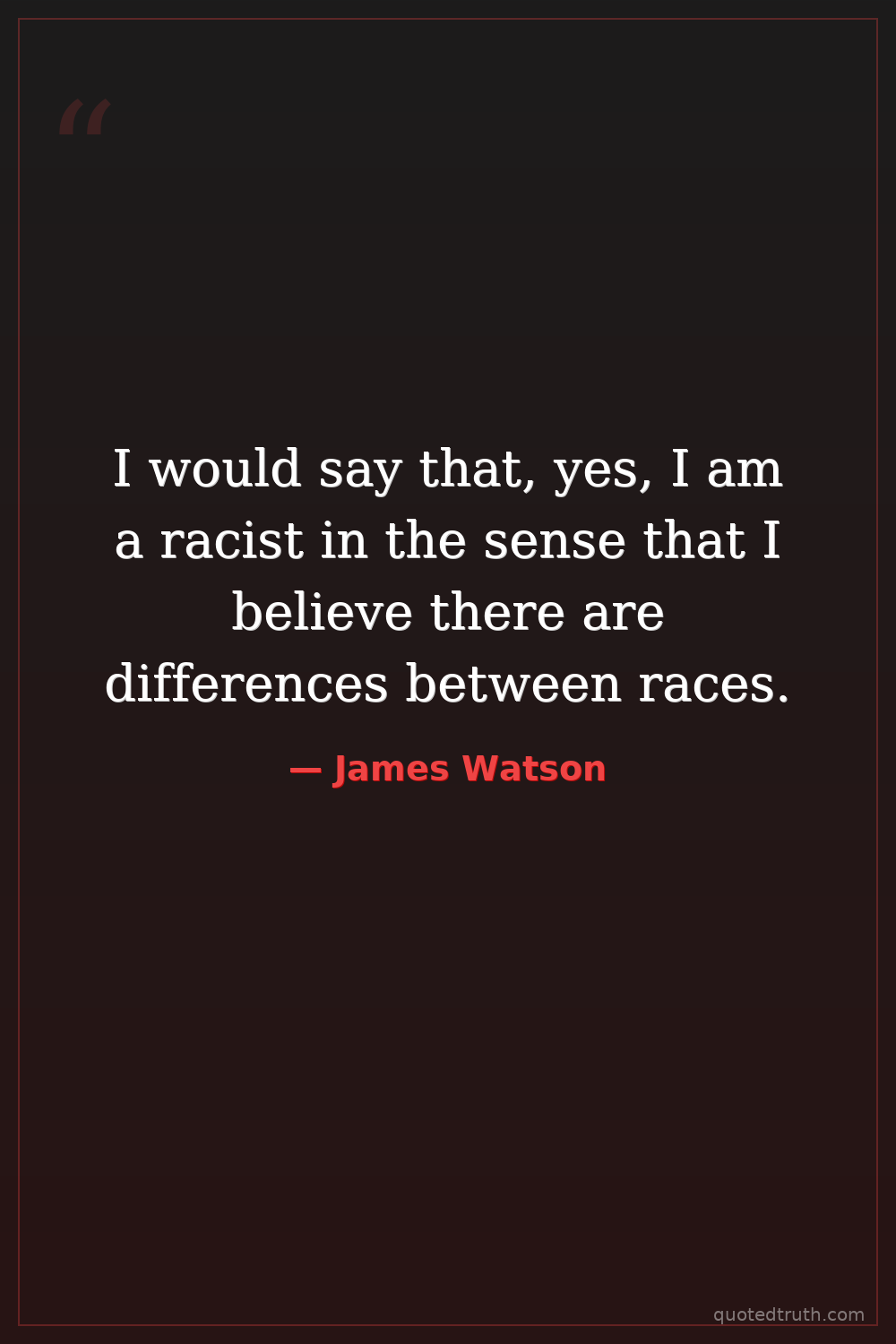
James Watson — "I would say that, yes, I am a racist in the sense that I believe there are diffe…"
I would say that, yes, I am a racist in the sense that I believe there are differences between races.
I would say that, yes, I am a racist in the sense that I believe there are differences between races.
Click any product to generate a realistic preview. Up to 3 at a time.
* Initial load can take up to 90 seconds — revising the preview in another color is nearly instant.
"I don't think there's any such thing as a politically correct scientist."
"We have to cure stupidity."
"If you're really stupid, I would call that a disease."
"If you could find the gene which determines sexuality and a woman decides she doesn't want a homosexual child, well, let her."
"If you're not having fun, you're doing something wrong."
Found in 1 providers: grok
1 source checked
Watson is openly admitting that he holds racist views, defining racism as the belief that meaningful biological differences exist between human racial groups. He is not denying the label but redefining it on his own terms, framing his position as an empirical claim about human variation rather than prejudice. The statement equates accepting group-level differences with being a racist, a conflation many scientists and ethicists strongly reject.
Watson co-discovered DNA's double helix in 1953 with Crick and Franklin's data, winning the 1962 Nobel Prize and later leading the Human Genome Project. Despite that stature, he repeatedly made public claims linking race to intelligence, prompting Cold Spring Harbor Laboratory to strip his honorary titles in 2019. This quote captures the unrepentant stance that ended his scientific career and isolated him from the genetics community he helped found.
By the 2000s and 2010s, modern genomics had shown human populations share roughly 99.9% of their DNA and that race is a poor proxy for genetic variation. Watson made these remarks as the Human Genome Project's findings were being weaponized in debates over IQ, ancestry testing, and diversity. Institutions were increasingly willing to sanction prominent figures for racist statements, reflecting a cultural shift toward holding scientists publicly accountable for views once tolerated.
AI-generated insights based on extensive research and information for context. Factual errors? Email [email protected].
Your cart is empty