Epictetus — "If a man has a bad character, he is bad for himself; if he has a good character,…"
If a man has a bad character, he is bad for himself; if he has a good character, he is good for himself.
If a man has a bad character, he is bad for himself; if he has a good character, he is good for himself.
Click any product to generate a realistic preview. Up to 3 at a time.
* Initial load can take up to 90 seconds — revising the preview in another color is nearly instant.
"What would it be like to be a donkey? To be driven by a stick, to carry burdens, to have no choice? It would be a simple life, wouldn't it?"
"If your mind is not polluted by these things, you will always be healthy."
"If you wish to improve, be content to be thought foolish and stupid with regard to external things. Don't wish to be thought to know anything; and if you are thought to be somebody by others, distrust…"
"How long are you going to wait before you demand the best for yourself?"
"We are not to be like sheep, who, when they have filled themselves, stand and gaze, and bring nothing home but their pasture; but we should rather be like bees, which both fly and collect, and bring h…"
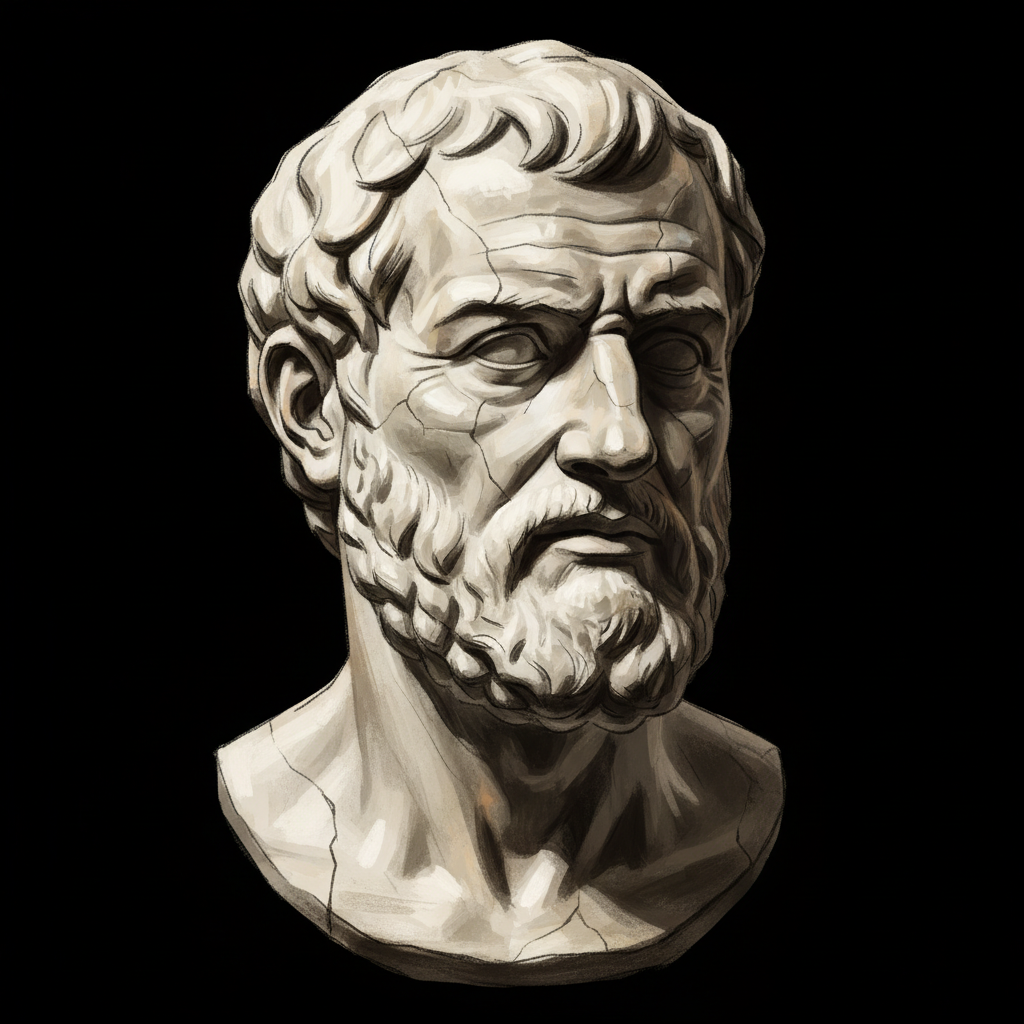
Greek Stoic philosopher and former slave whose Discourses (recorded by his student Arrian) shaped Marcus Aurelius and the modern Stoic revival. Closely associated with Seneca (earlier Roman Stoic) and Marcus Aurelius (his student-by-text on the imperial throne). For an intellectual contrast, see Epicurus, Greek philosopher of pleasure-as-tranquility — the Stoic-Epicurean rivalry was the central philosophical debate of the Hellenistic and Roman world for 400 years — Epicurean materialist hedonism is the precise alternative the Stoic discipline-of-acceptance was built against.
The standard scholarly entry points to Epictetus's work: A.A. Long (UC Berkeley, Classics) — Epictetus: A Stoic and Socratic Guide to Life (2002); Pierre Hadot (Collège de France) — Philosophy as a Way of Life (1995); Anthony R. Birley (Manchester, Roman historian) — Marcus Aurelius (1987) — the standard biography of Epictetus's most famous student. These are the works graduate seminars cite when teaching Epictetus.
Your cart is empty