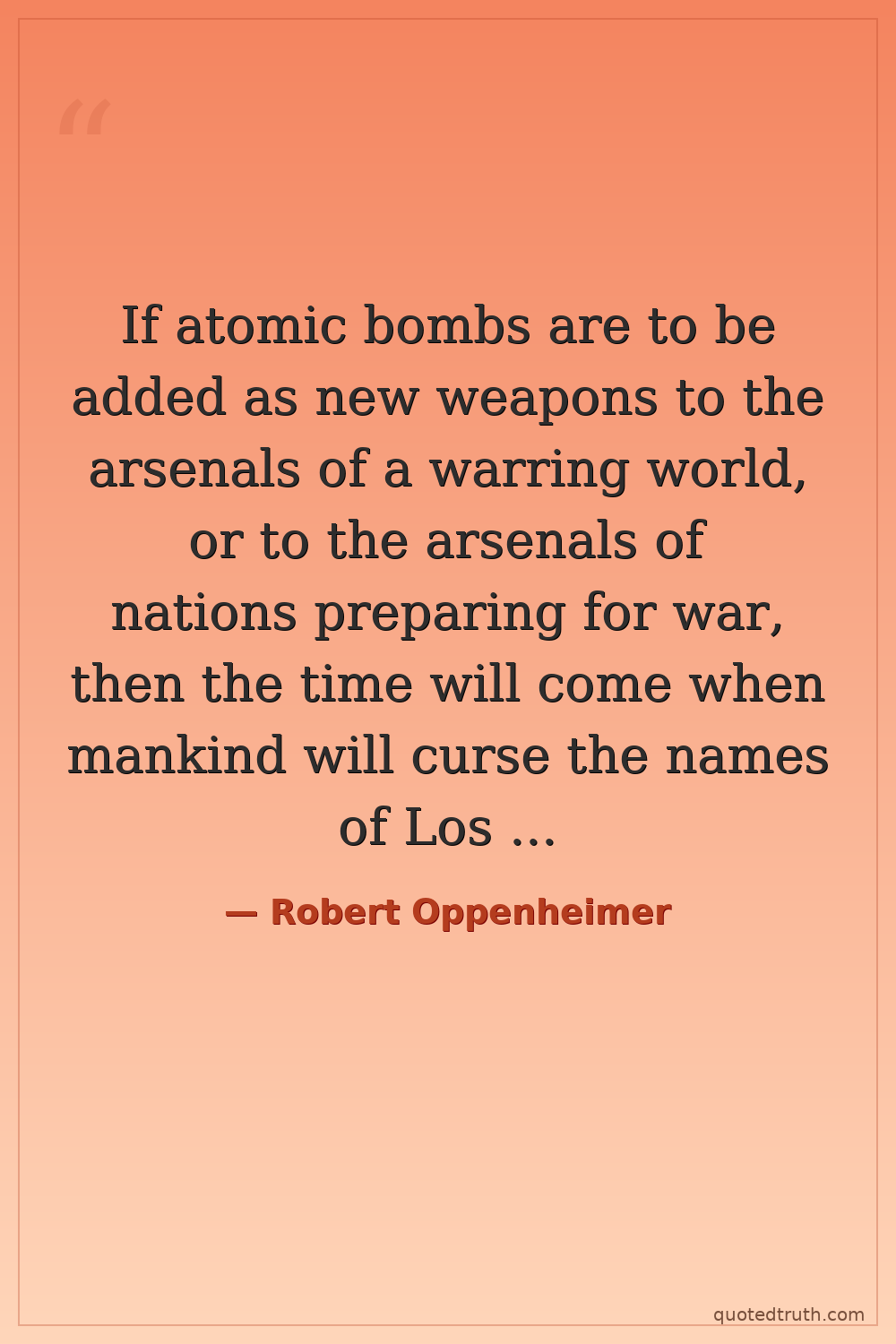
What it means
The quote warns that normalizing atomic bombs as standard military weapons—kept by nations at war or preparing for war—guarantees a future in which humanity looks back with rage and grief at where these weapons were born and first used. It is a moral prophecy: failure to contain nuclear arms now means future generations will condemn the people and places that made mass destruction routine rather than exceptional.
Relevance to Robert Oppenheimer
Oppenheimer directed the Manhattan Project at Los Alamos, making him personally responsible for the weapon he feared. After Hiroshima and Nagasaki killed over 100,000 civilians, he resigned as lab director, opposed the hydrogen bomb, and lobbied for international nuclear controls. He famously quoted the Bhagavad Gita at Trinity: 'Now I am become Death.' This quote captures his defining tension—creator haunted by creation, warning the world against repeating what he could not undo.
The era
Spoken in late 1945, when the US held a nuclear monopoly but the USSR was racing to close the gap, achieving it in 1949. The Baruch Plan for UN-supervised international nuclear governance was proposed but collapsed by 1946 as Cold War mistrust hardened. This was a narrow window for containment that closed permanently. By the 1980s, the two superpowers held over 70,000 warheads combined—the cursed arsenal Oppenheimer had explicitly warned against.
AI-generated insights based on extensive research and information for context. Factual errors? Email [email protected].