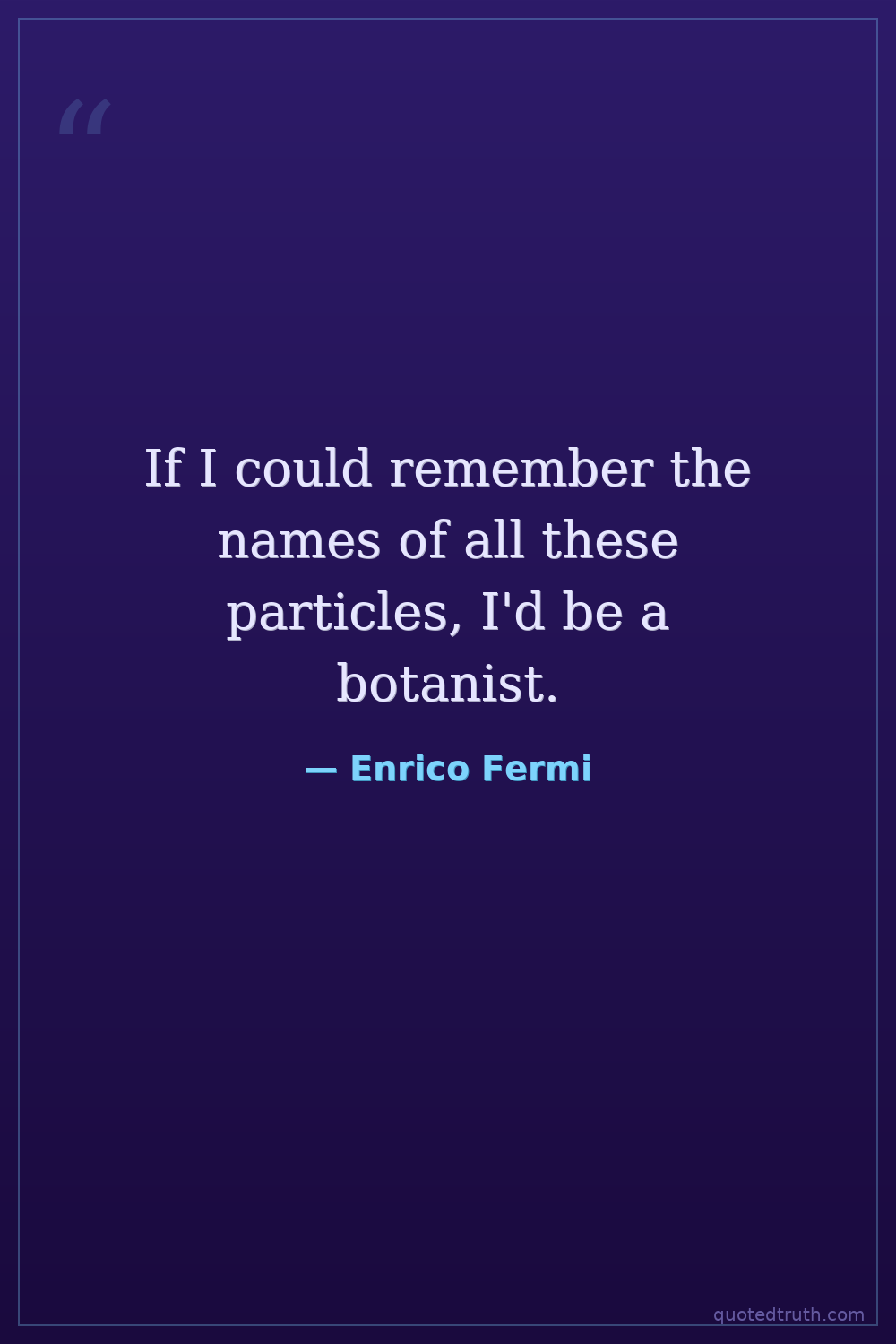
Enrico Fermi — "If I could remember the names of all these particles, I'd be a botanist."
If I could remember the names of all these particles, I'd be a botanist.
If I could remember the names of all these particles, I'd be a botanist.
Click any product to generate a realistic preview. Up to 3 at a time.
* Initial load can take up to 90 seconds — revising the preview in another color is nearly instant.
"The main point is to be honest with yourself, and to admit when you are wrong."
"I have always believed that physics should be simple and beautiful."
"I have never been interested in making money. I have always been interested in doing physics."
"The future is uncertain, but it is also full of possibilities."
"The world is full of magic things, patiently waiting for our senses to grow sharper."
Found in 2 providers: grok,gemini
2 sources checked
Physics in the mid-20th century produced a flood of newly discovered subatomic particles, each demanding its own name. Fermi jokes that keeping track of them all feels less like doing fundamental science and more like cataloguing plants — a botanist's task. The quip cuts at a real tension: physics should reveal underlying principles, not accumulate names. True understanding means grasping why things behave as they do, not reciting an ever-growing list.
Fermi was legendarily practical — famous for Fermi estimation, building the first nuclear reactor (Chicago Pile-1, 1942), and solving problems through physical intuition rather than abstraction. He distrusted complexity for its own sake. As particle physics exploded with new discoveries at Brookhaven and Chicago accelerators, his frustration was genuine: he wanted to understand nature's deep structure, not memorize a taxonomy. The joke captures his directness, his wit, and his instinct to seek simplicity beneath apparent chaos.
The late 1940s and early 1950s saw accelerators unlock a 'particle zoo' — dozens of newly discovered hadrons including mesons, hyperons, and kaons, with no organizing theory to unify them. Fermi worked at the University of Chicago during this flood of post-Manhattan Project discoveries. Physicists were excited but overwhelmed; it would take Gell-Mann's quark model in 1964 to impose order. Fermi's quip voiced a generation's exasperation that experimental abundance was outpacing theoretical understanding.
AI-generated insights based on extensive research and information for context. Factual errors? Email [email protected].
Your cart is empty