What it means
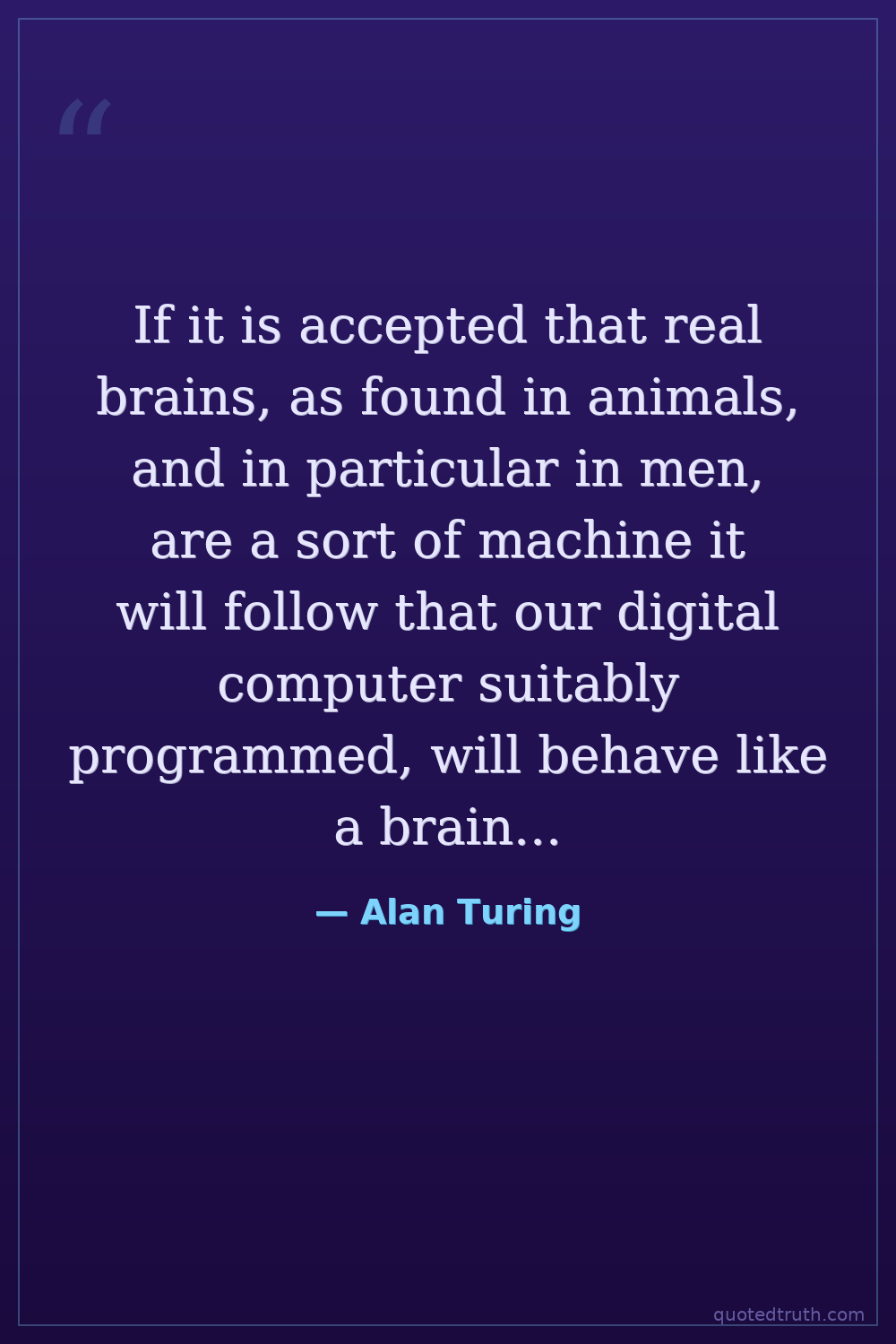
The quote makes a logical if-then argument: brains in animals and humans operate as biological machines. If that's true, then a properly programmed digital computer should be capable of replicating brain behavior — including thought. It strips away mysticism around consciousness and frames intelligence as a mechanical, reproducible process. This is the core premise that makes artificial intelligence philosophically possible: mind as computation, not magic.
Relevance to Alan Turing
Turing's 1936 universal Turing machine proved computation was substrate-neutral. His 1950 paper Computing Machinery and Intelligence formalized this view, introducing the Imitation Game as a behavioral measure of machine thinking. He was a committed materialist who believed intelligence was algorithmic, not spiritual. His wartime codebreaking at Bletchley Park showed machines could perform tasks previously requiring human judgment, reinforcing his conviction that brains and computers were functionally equivalent.
The era
Written around 1950, this quote emerged as the first electronic computers — ENIAC, Manchester Baby, the ACE — were proving their computational power. Behaviorism dominated psychology, treating minds as stimulus-response systems. Post-WWII governments invested heavily in automation for Cold War advantage. Turing had just proposed the Imitation Game test. Most philosophers and scientists still dismissed machine thinking as category error, making Turing's materialist premise a genuinely provocative challenge to the intellectual mainstream.
AI-generated insights based on extensive research and information for context. Factual errors? Email [email protected].