What it means
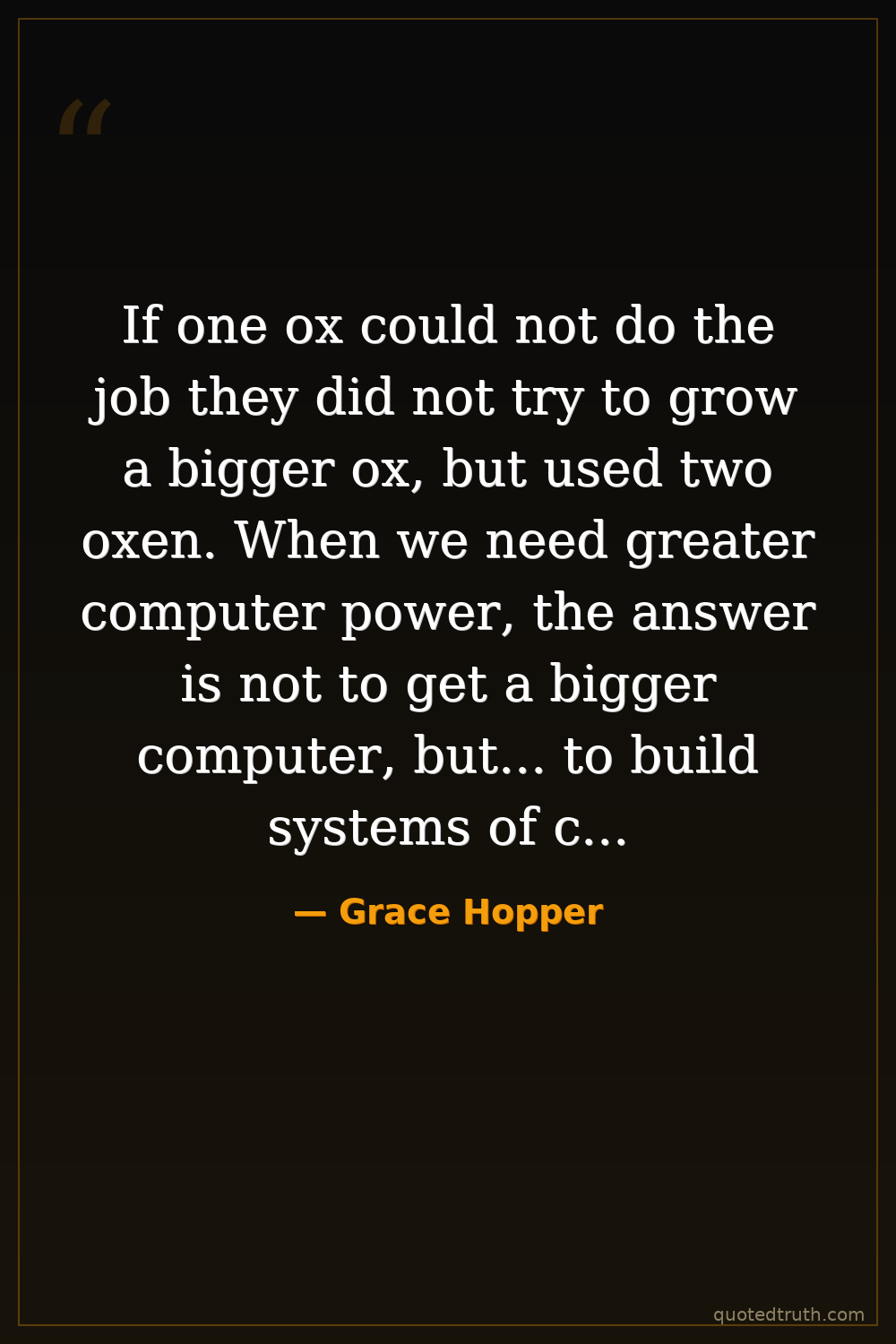
Rather than scaling a single resource to its breaking point, multiply smaller units working in parallel. When farmers faced a load one ox couldn't pull, they added a second — they didn't breed a mythical giant. Hopper applies this to computing: instead of chasing ever-larger monolithic machines, build networks of cooperating computers. This scale-out principle underlies modern cloud infrastructure, distributed databases, and parallel processing architectures.
Relevance to Grace Hopper
Hopper invented the first compiler and coined the term 'debugging,' both rooted in making computing practical and collaborative. She worked on UNIVAC I and early COBOL standardization, favoring systems that scale through coordination rather than brute hardware force. A Navy rear admiral who commanded large coordinated operations, she naturally thought in parallel structures. This quote mirrors her career-long belief that smart architecture beats raw power.
The era
From the 1940s to 1980s, computing was dominated by massive mainframes — room-sized machines costing millions, owned by governments and corporations. The prevailing assumption was that bigger meant better; IBM's System/360 line epitomized this orthodoxy. Hopper's parallel-computing vision challenged that consensus before minicomputers and networked workstations proved her right. Her thinking anticipated the internet, MapReduce, and cloud computing by decades — radical in an era of monolithic iron.
AI-generated insights based on extensive research and information for context. Factual errors? Email [email protected].