James Watson — "If there were a gene for stupidity, and you could get rid of it, would you not w…"
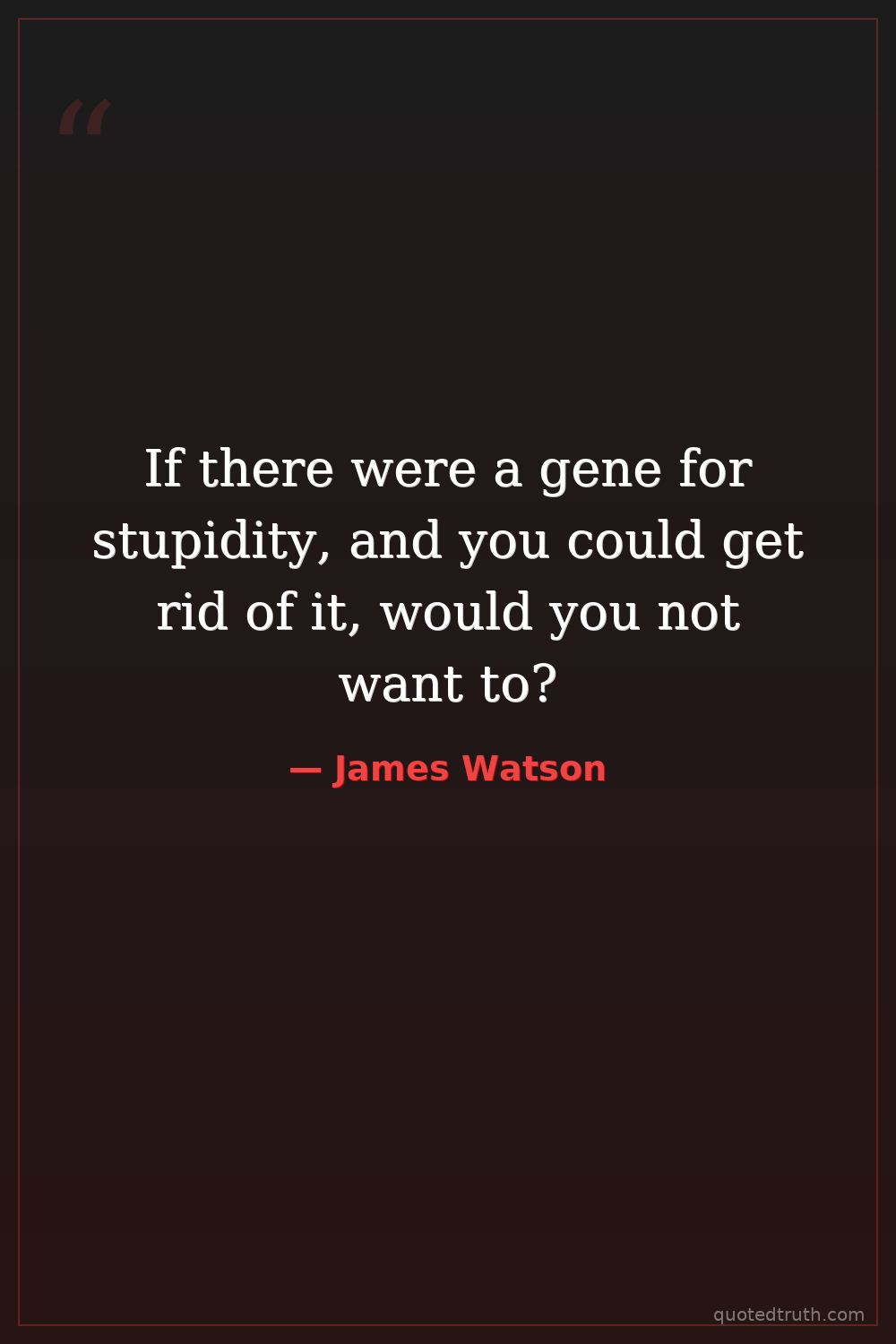
If there were a gene for stupidity, and you could get rid of it, would you not want to?
If there were a gene for stupidity, and you could get rid of it, would you not want to?
Click any product to generate a realistic preview. Up to 3 at a time.
* Initial load can take up to 90 seconds — revising the preview in another color is nearly instant.
"I've always been interested in what makes people tick."
"The only way to do great work is to love what you do."
"I'm not going to be politically correct."
"I am inherently gloomy about the prospect of Africa because all our social policies are based on the assumption that their intelligence is the same as ours — whereas all the testing says not really."
"There are people who don't want to admit that there are differences between races."
Found in 1 providers: grok
1 source checked
Watson challenges us to consider whether eliminating genetic predispositions toward low intelligence would be morally desirable, framing genetic intervention as obvious common sense. He implies that if technology allows removal of harmful traits, refusing to use it is irrational sentimentality. The rhetorical question assumes the listener agrees, pushing back against bioethical hesitation around genetic engineering and designer babies.
Watson co-discovered DNA's double helix structure in 1953, work that laid the foundation for modern genetics. He later led the Human Genome Project and consistently advocated controversial eugenics-adjacent positions throughout his career. This quote reflects his lifelong belief that genetic science should be applied boldly to improve humanity, a view that ultimately cost him his honorary titles at Cold Spring Harbor Laboratory in 2019.
Watson made such remarks during the late 20th and early 21st century, when the Human Genome Project (completed 2003) made gene mapping a reality and CRISPR editing emerged as a practical tool. Society was actively debating designer babies, genetic discrimination, and bioethics. His comments provoked fierce backlash during an era increasingly sensitized to eugenics history and disability rights advocacy.
AI-generated insights based on extensive research and information for context. Factual errors? Email [email protected].
Your cart is empty