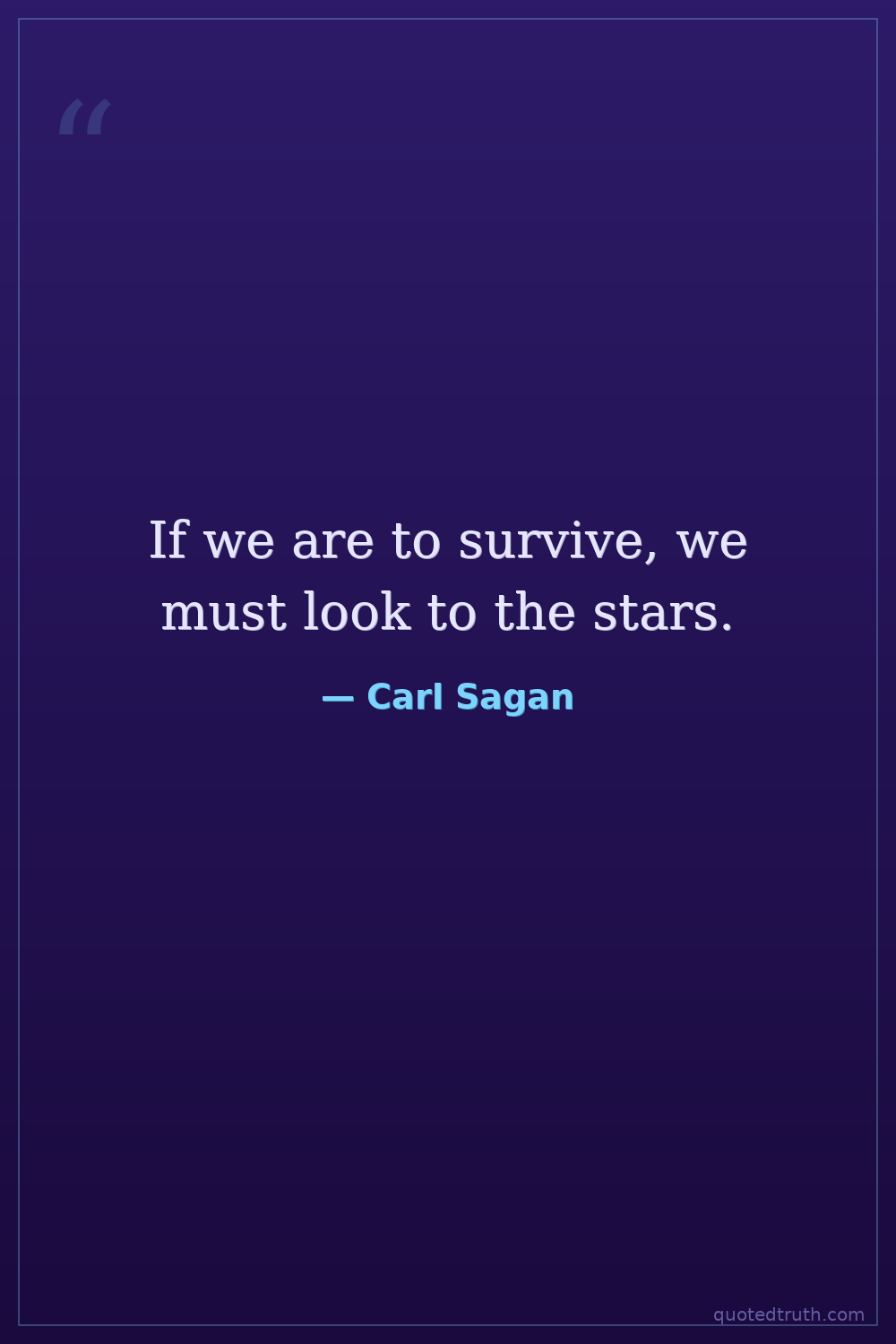
Carl Sagan — "If we are to survive, we must look to the stars."
If we are to survive, we must look to the stars.
If we are to survive, we must look to the stars.
Click any product to generate a realistic preview. Up to 3 at a time.
* Initial load can take up to 90 seconds — revising the preview in another color is nearly instant.
"The universe is a pretty big place. If it's just us, it seems like an awful waste of space."
"We are travelers on a cosmic journey, stardust, swirling and dancing in the eddies and whirlpools of infinity. Life is eternal. We have stopped for a moment to encounter each other, to meet, to love, …"
"We are like butterflies who flutter for a day and think it is forever."
"The price we pay for the suppression of doubt is that we can never be sure of anything."
"We are star stuff which has taken its destiny into its own hands."
Often cited in discussions about space exploration and humanity's future.
Date: Unknown, but consistent with his themes
WisdomFound in 1 providers: grok
1 source checked
Humanity's long-term survival requires expanding beyond Earth — exploring space, understanding the cosmos, and eventually becoming a multi-planetary species. Looking to the stars means both literal space exploration and adopting a wider perspective that shifts priorities away from short-term earthly conflicts toward shared human continuity. The quote frames space not as an optional pursuit of curiosity, but as a fundamental requirement for the species to endure.
Sagan devoted his career to making space exploration feel urgent rather than aspirational. His 1994 book Pale Blue Dot argued Earth's fragility demands a multi-planetary future. The Cosmos television series he created pushed public support for NASA funding. He co-founded SETI to ask whether any intelligence survives long enough to reach the stars. His nuclear winter research in 1983 deepened his conviction that Earth alone was a death sentence.
Sagan lived through the Cold War, when nuclear arsenals made civilizational collapse a credible near-term threat. In 1983 he co-authored the nuclear winter papers, showing a nuclear exchange could extinguish human life on Earth. Simultaneously, the Apollo program had proven interplanetary travel achievable, and NASA's Voyager probes were reaching the outer solar system. These twin realities — existential fragility and unprecedented reach — made looking to the stars feel both necessary and possible.
AI-generated insights based on extensive research and information for context. Factual errors? Email [email protected].
Your cart is empty