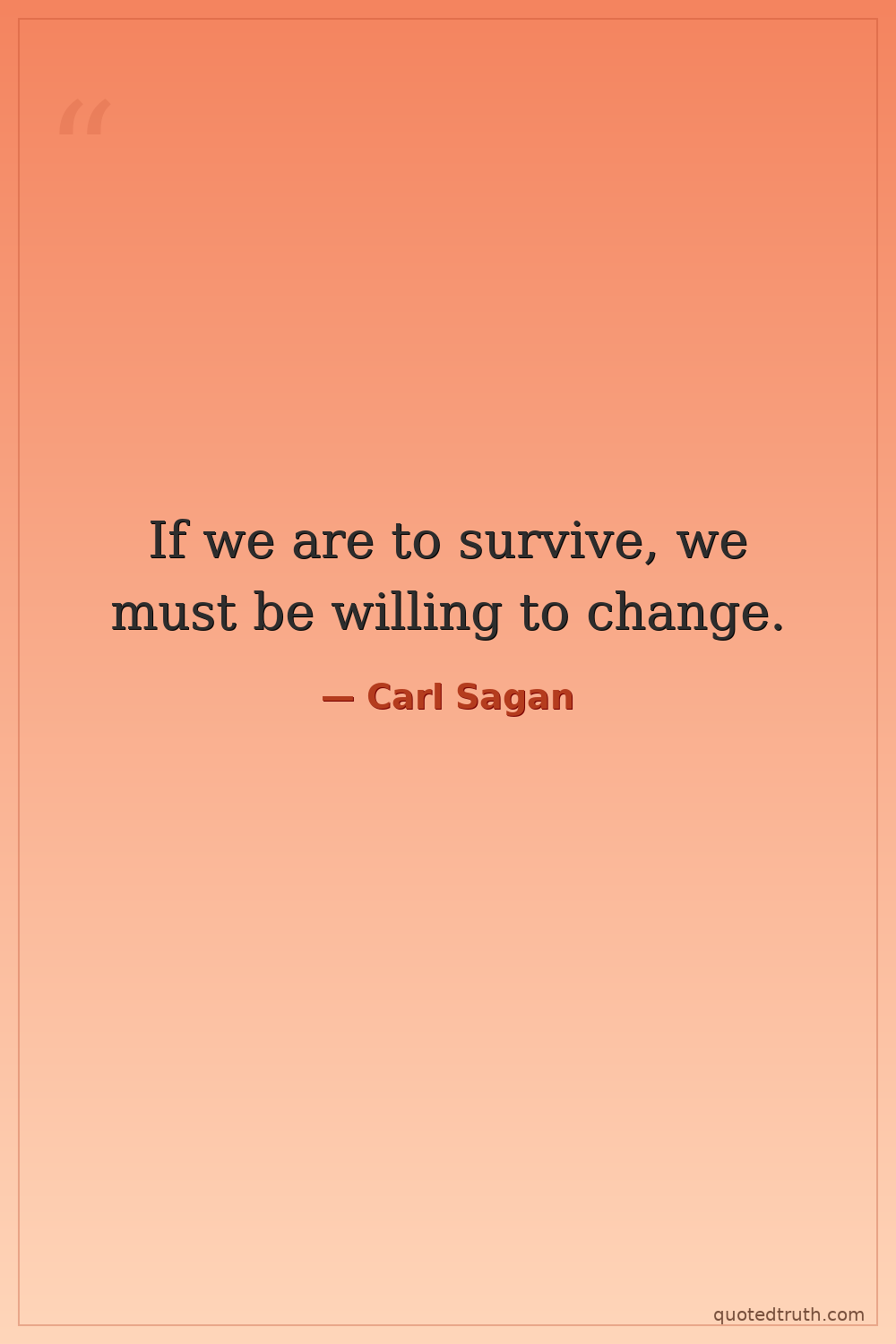
Carl Sagan — "If we are to survive, we must be willing to change."
If we are to survive, we must be willing to change.
If we are to survive, we must be willing to change.
Click any product to generate a realistic preview. Up to 3 at a time.
* Initial load can take up to 90 seconds — revising the preview in another color is nearly instant.
"The universe is not required to be in perfect harmony with human ambition."
"The beauty of a living thing is not the atoms that go into it, but the way those atoms are put together."
"The cosmos is also within us. We are made of star-stuff. We are a way for the universe to know itself."
"Imagination will often carry us to worlds that never were. But without it, we go nowhere."
"We are the local embodiment of a cosmos grown to self-awareness."
Found in 1 providers: grok
1 source checked
Survival demands adaptability. When circumstances shift — environmentally, socially, technologically — those who refuse to change their thinking, behaviors, or systems put themselves at risk of collapse. This isn't about change for its own sake but about recognizing that the world moves whether we do or not. Individuals, institutions, and civilizations that can't evolve in response to new realities eventually face extinction. Flexibility isn't weakness — it's the biological and cultural requirement for endurance.
Sagan spent decades warning that humanity's most dangerous habits — nuclear weapons stockpiling, environmental destruction, tribal thinking — were self-defeating on a cosmic scale. He co-developed the nuclear winter hypothesis in 1983, showing atomic war could end civilization. His Pale Blue Dot speech urged humans to transcend ego and conflict. Change, for Sagan, meant evolving beyond instincts that made sense on the savanna but were lethal for a species holding civilization-ending technology.
Sagan lived through the Cold War's peak, when the U.S. and Soviet Union possessed enough nuclear warheads to destroy civilization dozens of times. In 1983, he co-authored the landmark nuclear winter study, warning that any large nuclear exchange would block sunlight and trigger mass extinction. Simultaneously, scientists were documenting the ozone hole and early climate disruption. This was a civilization at the height of its power and the edge of its own destruction.
AI-generated insights based on extensive research and information for context. Factual errors? Email [email protected].
Your cart is empty