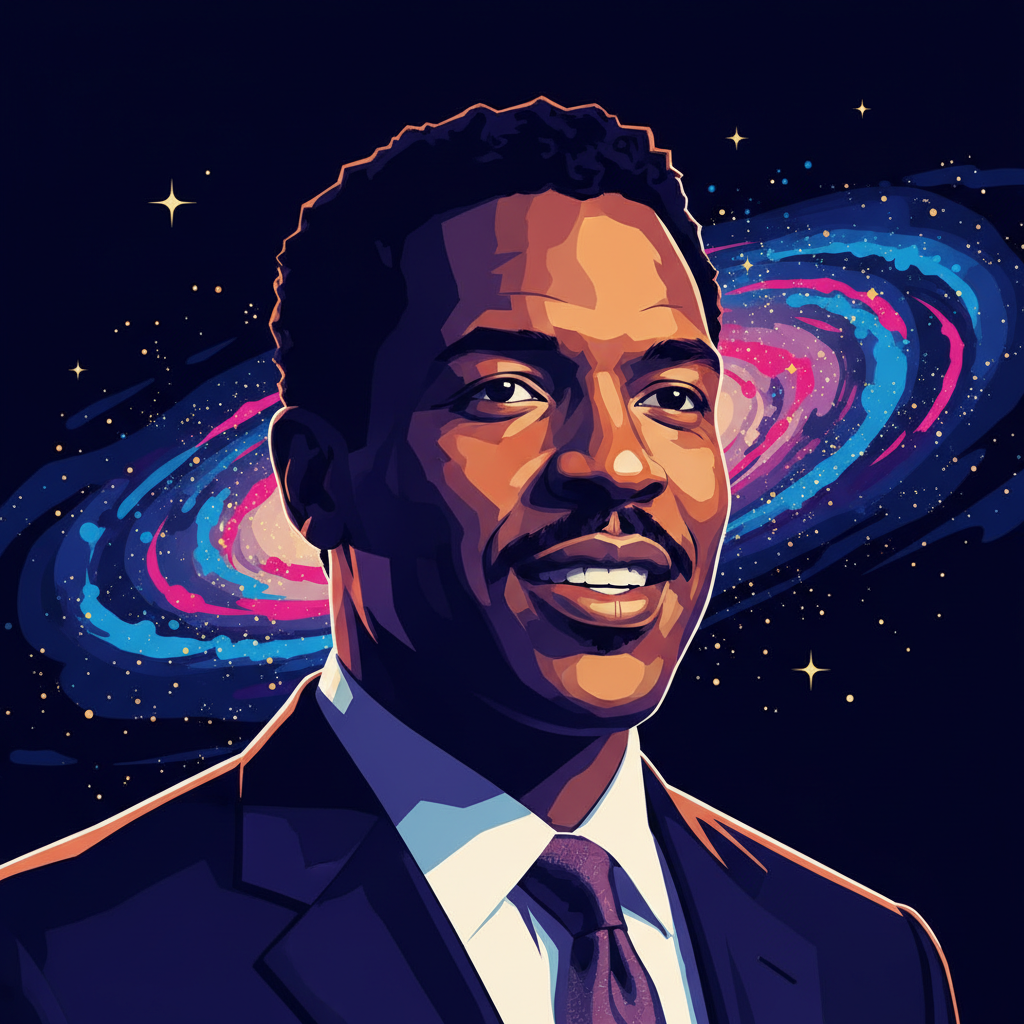
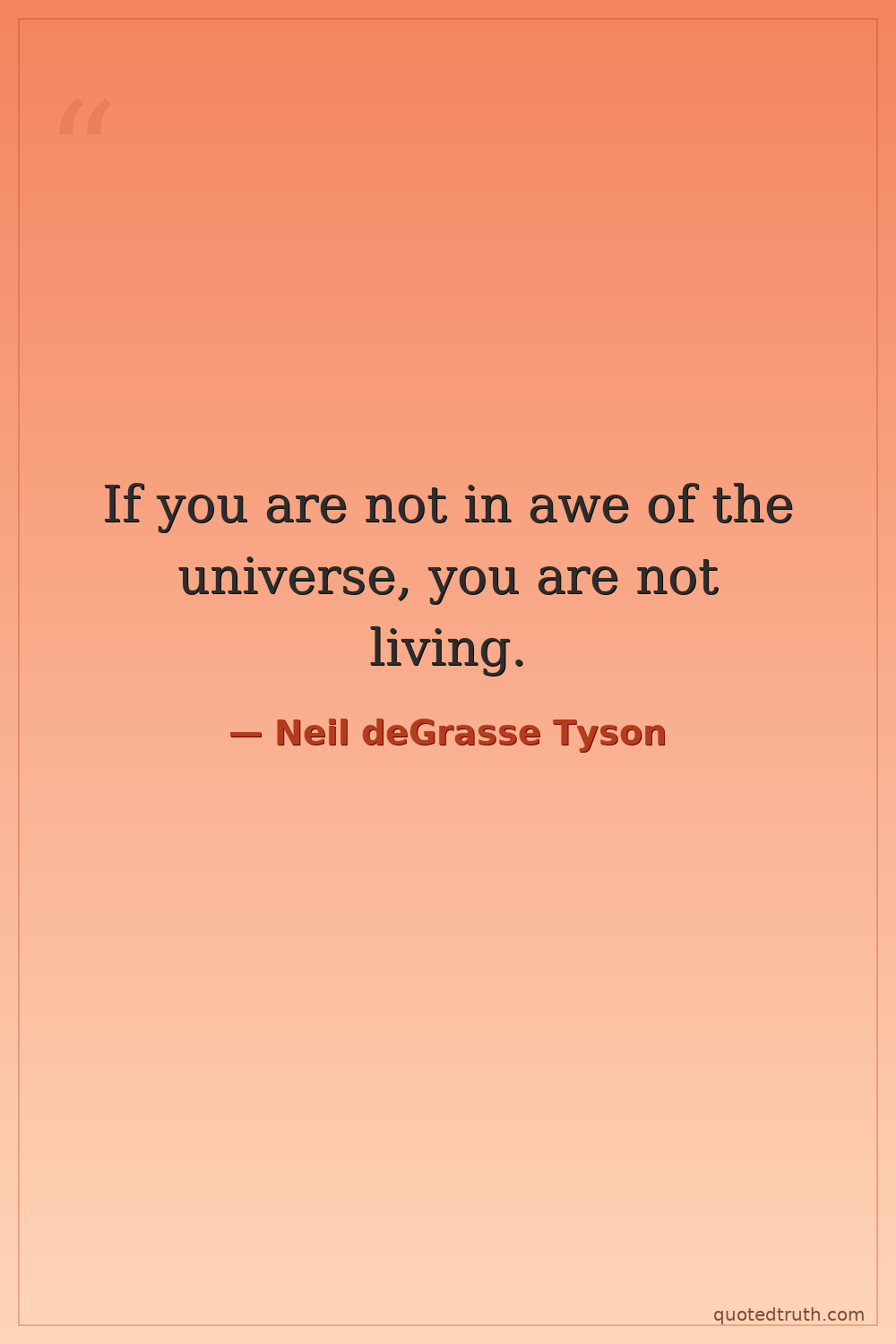
Neil deGrasse Tyson — "If you are not in awe of the universe, you are not living."
If you are not in awe of the universe, you are not living.
If you are not in awe of the universe, you are not living.
Click any product to generate a realistic preview. Up to 3 at a time.
* Initial load can take up to 90 seconds — revising the preview in another color is nearly instant.
"The greatest discovery in science is the discovery of ignorance."
"If I had a superpower, it would be to make everyone scientifically literate. Imagine the world we'd live in."
"The most important thing about science is that it's self-correcting. Religion is not."
"The universe is a dangerous place. But it's also a beautiful place."
"I'm not afraid of death. I'm afraid of dying without having lived a full life."
American astrophysicist, Hayden Planetarium director, and Cosmos: A Spacetime Odyssey host who carries the Carl Sagan public-science mantle. Closely associated with Bill Nye (fellow science communicator) and Brian Greene (theoretical physicist and string-theory popularizer). For an intellectual contrast, see Ken Ham, founder of Answers in Genesis and the Creation Museum — Ham's career has been organized around defending biblical 6-day creationism — exactly the science-education position Tyson's mainstream-science communication is structured to refute.
Found in 1 providers: grok
1 source checked
Wonder and curiosity are not optional extras — they are what it means to be fully alive. A person who moves through existence without stopping to feel overwhelmed by the scale, complexity, and strangeness of reality is missing the core experience of being human. Awe is not a luxury emotion; it is the appropriate response to honest attention paid to the world around us.
Tyson built his career on translating cosmic scale into visceral wonder — from hosting Cosmos to his StarTalk podcast. He grew up in New York City, found the universe through the Hayden Planetarium at age nine, and describes that moment as a calling. His entire public mission is making people feel small in the best possible way, insisting that the universe's indifference is humbling rather than terrifying.
Tyson rose to prominence during a period of renewed science skepticism — climate denial, anti-vaccine movements, and declining STEM engagement in public life. His era also brought the James Webb Space Telescope, gravitational wave detection, and exoplanet discoveries that revealed thousands of potentially habitable worlds. Awe became a counter-cultural act, a push against incuriosity at a moment when distrust of evidence-based thinking was politically organized.
AI-generated insights based on extensive research and information for context. Factual errors? Email [email protected].
Your cart is empty