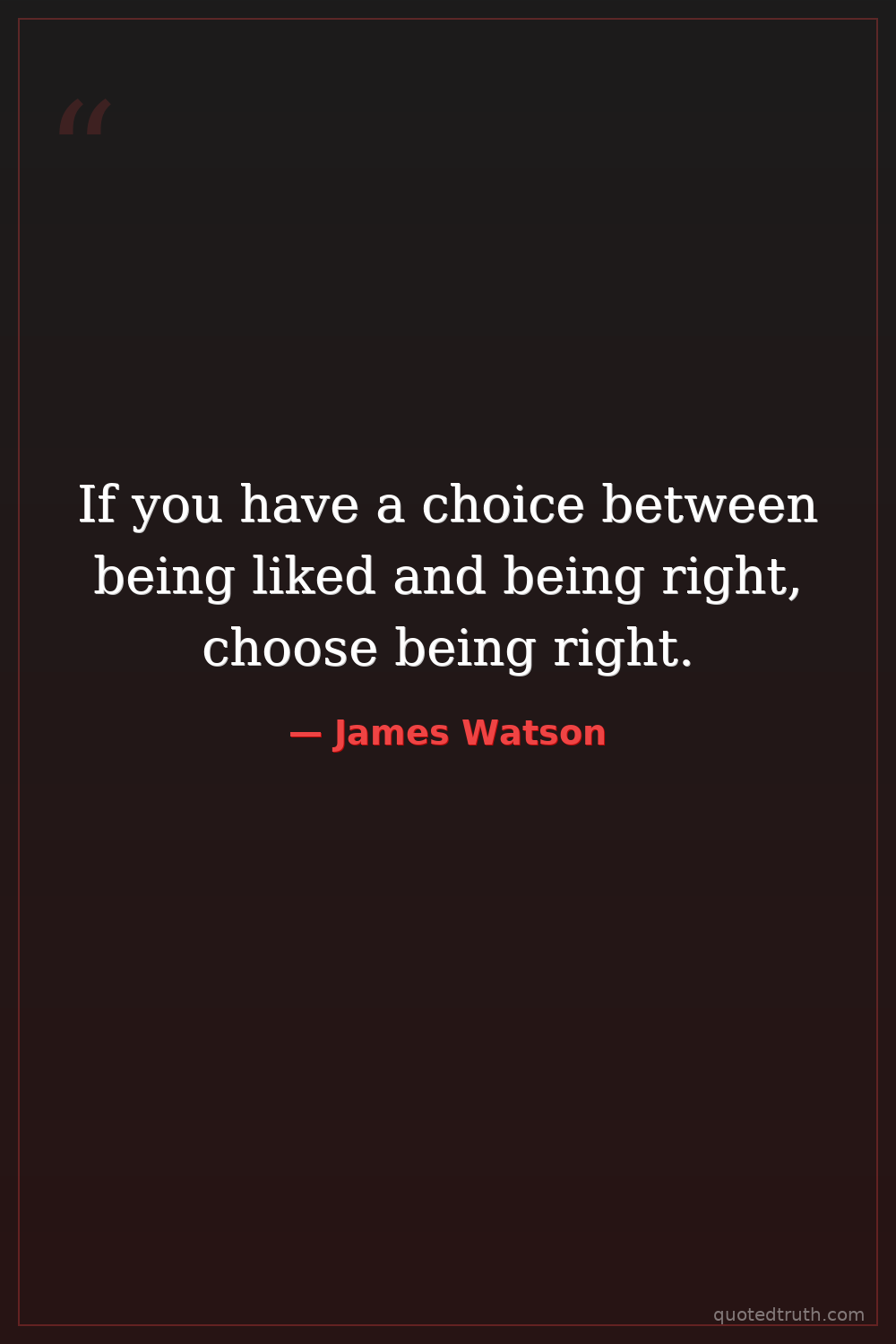
James Watson — "If you have a choice between being liked and being right, choose being right."
If you have a choice between being liked and being right, choose being right.
If you have a choice between being liked and being right, choose being right.
Click any product to generate a realistic preview. Up to 3 at a time.
* Initial load can take up to 90 seconds — revising the preview in another color is nearly instant.
"I'm not a very good speaker."
"I'm not going to be politically correct."
"I am inherently gloomy about the prospect of Africa because all our social policies are based on the assumption that their intelligence is the same as ours — whereas all the testing says not really."
"Some people think that if you talk about race, you're a racist. I don't think so."
"The truth is often unpopular."
Found in 1 providers: grok
1 source checked
Prioritize truth over social approval. When the popular position conflicts with the correct one, hold to what the evidence supports rather than softening your stance to keep people comfortable. Likability is fleeting and often rewards conformity, while being right has lasting value because reality eventually surfaces. The advice accepts a tradeoff: standing on accurate ground frequently costs friendships, reputation, or invitations, but those costs are worth paying.
Watson built his career on being first and being right, racing Pauling and others to the double helix in 1953 and sharing the 1962 Nobel Prize with Crick and Wilkins. He was famously blunt, willing to publish controversial claims about intelligence, race, and genetics that cost him his Cold Spring Harbor leadership and most of his standing in the scientific community. He defended his statements as evidence-based even as colleagues distanced themselves, embodying the tradeoff this quote describes.
Watson worked through the postwar molecular biology boom, when reputations were forged by priority disputes and bold structural claims rather than consensus building. By the 2000s and 2010s, however, public science had shifted toward inclusivity, peer accountability, and reputational consequences for inflammatory speech. Watson's later remarks on race and IQ landed in that changed climate, triggering honors being stripped in 2019. His insistence on bluntness clashed with an era demanding both rigor and social care.
AI-generated insights based on extensive research and information for context. Factual errors? Email [email protected].
Your cart is empty