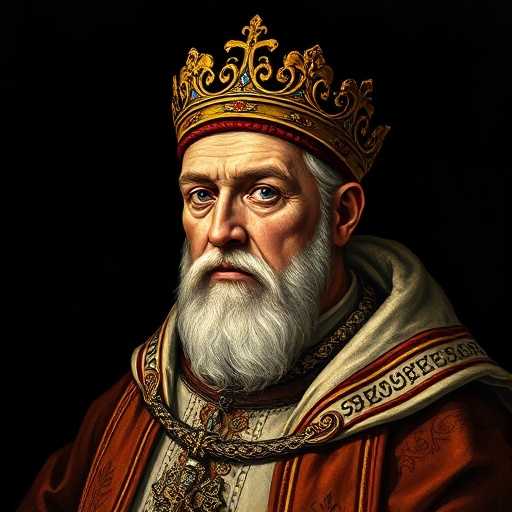
Pope Urban II — "If you must have blood, bathe in the blood of the infidels."
If you must have blood, bathe in the blood of the infidels.
If you must have blood, bathe in the blood of the infidels.
Click any product to generate a realistic preview. Up to 3 at a time.
* Initial load can take up to 90 seconds — revising the preview in another color is nearly instant.
"Let those who have been serving as mercenaries for small pay now obtain the eternal reward."
"The time has now come when you should show your zeal for Christ."
"They violate the women of the Christians."
"Oh, race of Franks, race from across the mountains, race chosen and beloved by God as shines forth in very many of your works... We wish you to know what a grievous cause has led us to your country, w…"
"Let our lives be stronger than death to fight against the enemies of the Christian people."
Pope (1088-1099) whose Council of Clermont speech (November 1095) launched the First Crusade — the founding event of nine centuries of Christian-Muslim military conflict. Closely associated with Pope Gregory VII (his predecessor on papal-imperial reform). For an intellectual contrast, see Saladin, Kurdish-Muslim Sultan of Egypt and Syria (1138-1193) — Saladin recaptured Jerusalem in 1187, undoing the First Crusade Urban II launched 92 years earlier. Saladin's chivalrous treatment of Christian prisoners became the canonical Muslim counter-image to Crusader brutality. The cleanest before/after pairing of the Crusades' moral arc.
Found in 1 providers: deepseek
1 source checked
Redirects violent impulses toward a declared religious enemy rather than against fellow Christians. The quote acknowledges raw human bloodlust without apology, then frames holy war as its proper outlet. It's a brutal piece of persuasion: if killing is inevitable, make it spiritually sanctioned by targeting those the Church has designated enemies of Christendom.
Urban II was a master ecclesiastical politician who understood feudal knights lived by violence. At Clermont in 1095, he needed to unify fractious European nobility behind a single cause. As a Cluniac reformer appalled by Christians killing Christians in private wars, redirecting martial energy toward Jerusalem was both strategic diplomacy and genuine theological conviction about purifying Christendom.
In 1095, Seljuk Turks controlled Jerusalem and had crushed Byzantine forces at Manzikert in 1071. Europe's feudal knights fought constant private wars with no overarching purpose. The Peace of God movement had failed to curb noble violence. A papacy asserting supremacy over secular rulers needed a unifying holy cause—and the First Crusade became that instrument, reshaping medieval Europe's self-understanding for centuries.
AI-generated insights based on extensive research and information for context. Factual errors? Email [email protected].
Your cart is empty