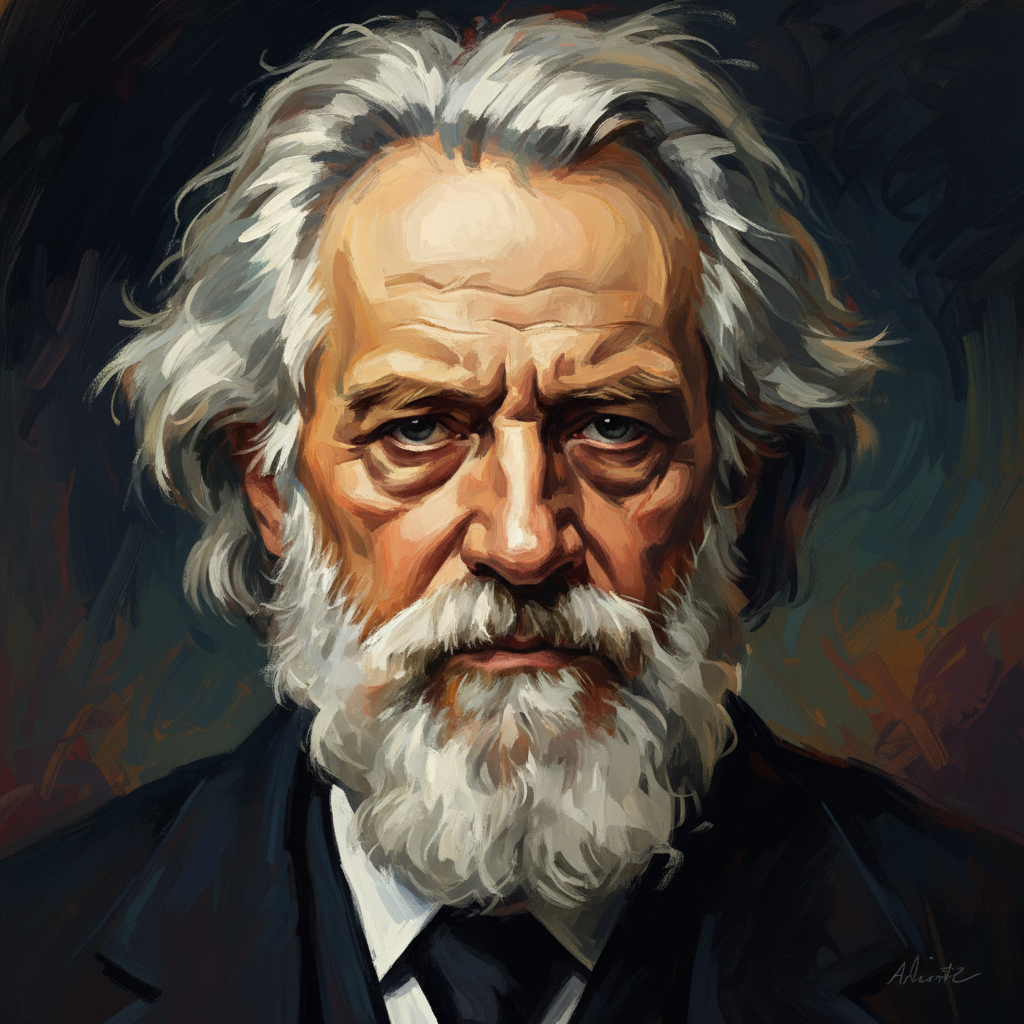
Arthur Schopenhauer — "If you want to know your true opinion of someone, watch the effect produced in y…"
If you want to know your true opinion of someone, watch the effect produced in you by the first sight of a letter from him.
If you want to know your true opinion of someone, watch the effect produced in you by the first sight of a letter from him.
Click any product to generate a realistic preview. Up to 3 at a time.
* Initial load can take up to 90 seconds — revising the preview in another color is nearly instant.
"Just as the female ant after coition loses her wings, which then become superfluous, nay, dangerous for breeding purposes, so for the most part does a woman lose her beauty after giving birth to one o…"
"Human life must be some kind of mistake."
"The world is a collection of unhappy beings."
"The more you leave a man to his own will, the more he will feel his own weakness."
"The only true evil is existence."
German philosopher of pessimism whose The World as Will and Representation (1819) defined the suffering-and-renunciation tradition. Closely associated with Immanuel Kant (the system Schopenhauer built on and revised). For an intellectual contrast, see G.W.F. Hegel, German Idealist of the rational unfolding of Spirit — Schopenhauer scheduled his Berlin lectures opposite Hegel's and spent decades attacking Hegel's optimistic system as deliberately mystifying nonsense — the foundational rivalry of 19th-century German philosophy.
The standard scholarly entry points to Arthur Schopenhauer's work: Bryan Magee (Oxford, populariser-philosopher) — The Philosophy of Schopenhauer (1983); Christopher Janaway (Southampton, Schopenhauer specialist) — Self and World in Schopenhauer's Philosophy (1989); David E. Cartwright (Wisconsin–Whitewater) — Schopenhauer: A Biography (2010). These are the works graduate seminars cite when teaching Arthur Schopenhauer.
Your cart is empty