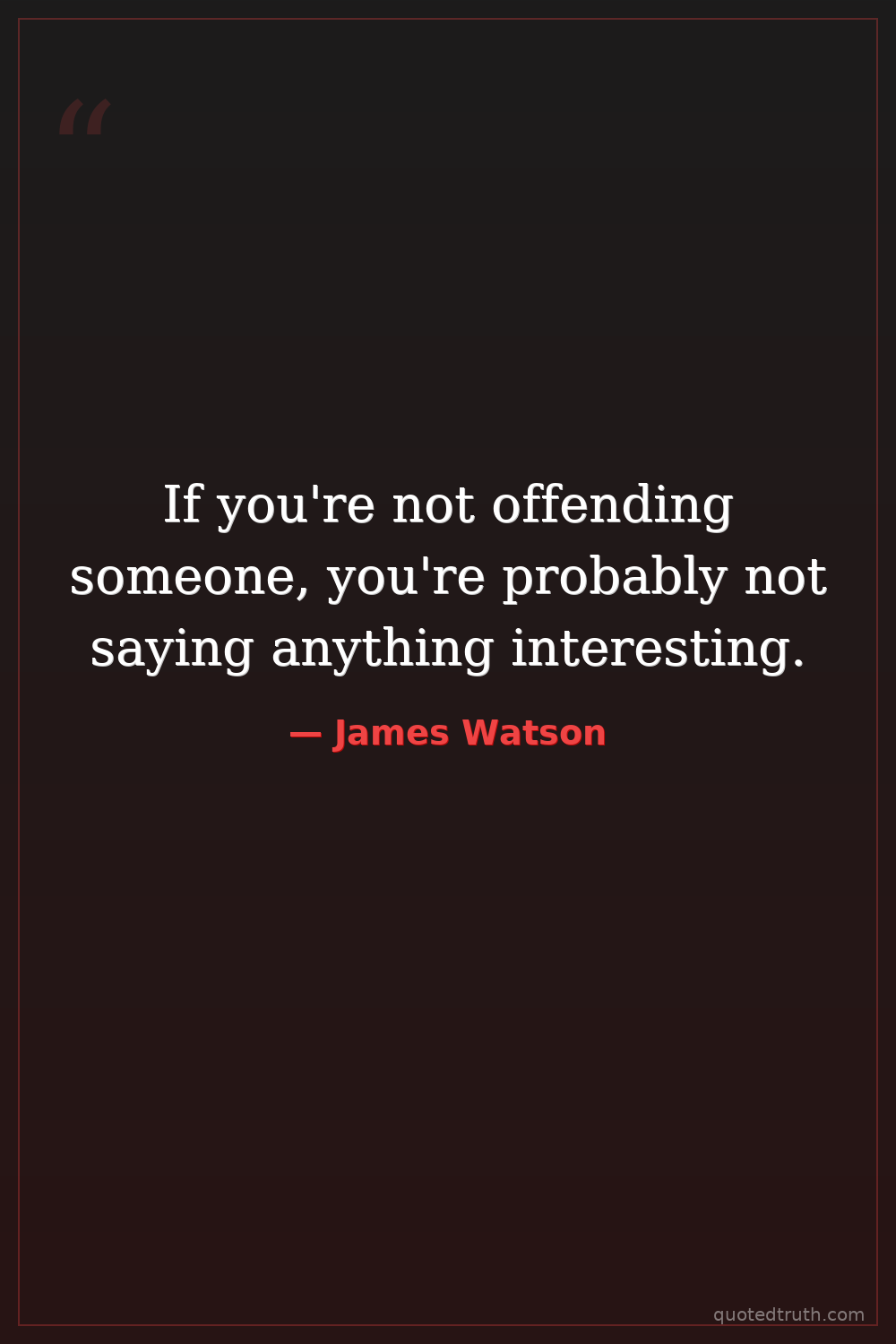
James Watson — "If you're not offending someone, you're probably not saying anything interesting…"
If you're not offending someone, you're probably not saying anything interesting.
If you're not offending someone, you're probably not saying anything interesting.
Click any product to generate a realistic preview. Up to 3 at a time.
* Initial load can take up to 90 seconds — revising the preview in another color is nearly instant.
"I'm a very impatient person."
"I don't care about being liked."
"Some anti-Semitism is justified. Just like some anti-Irish sentiment is justified."
"If we could make all women beautiful, it would be a good thing."
"I am not a racist. I am a realist."
Found in 1 providers: grok
1 source checked
Provocative ideas inevitably upset someone — that's a feature, not a flaw. Real intellectual contribution requires challenging comfortable assumptions, and universally palatable speech is usually trivial. If your idea disturbs no one's worldview, it probably adds nothing new. Controversy signals you've said something worth disagreeing with. The aphorism treats offense as a rough proxy for originality and courage — the listener's discomfort is evidence the speaker has done something genuinely worthwhile.
Watson embodies this maxim literally. Beyond co-discovering DNA's double helix in 1953 with Francis Crick — work grounded heavily on Rosalind Franklin's X-ray data — he spent decades making inflammatory public statements: claiming racial differences in intelligence, dismissing women's scientific productivity, and speculating provocatively about genetics and human behavior. Cold Spring Harbor Laboratory stripped him of his honorary titles in 2019. He is a scientist who consistently prioritized saying what he believed over social consequences.
Watson's career spans an era of enormous scientific ambition and intensifying cultural sensitivity. The 1950s–60s saw biology's molecular revolution redefine human identity itself. By the 2000s, genomics unlocked data on human variation while society debated the ethics of that knowledge. Academia simultaneously grew more attuned to harm in public speech. Watson became a flashpoint in the collision between old-guard scientific bluntness and modern expectations of responsible public discourse from prominent researchers.
AI-generated insights based on extensive research and information for context. Factual errors? Email [email protected].
Your cart is empty