What it means
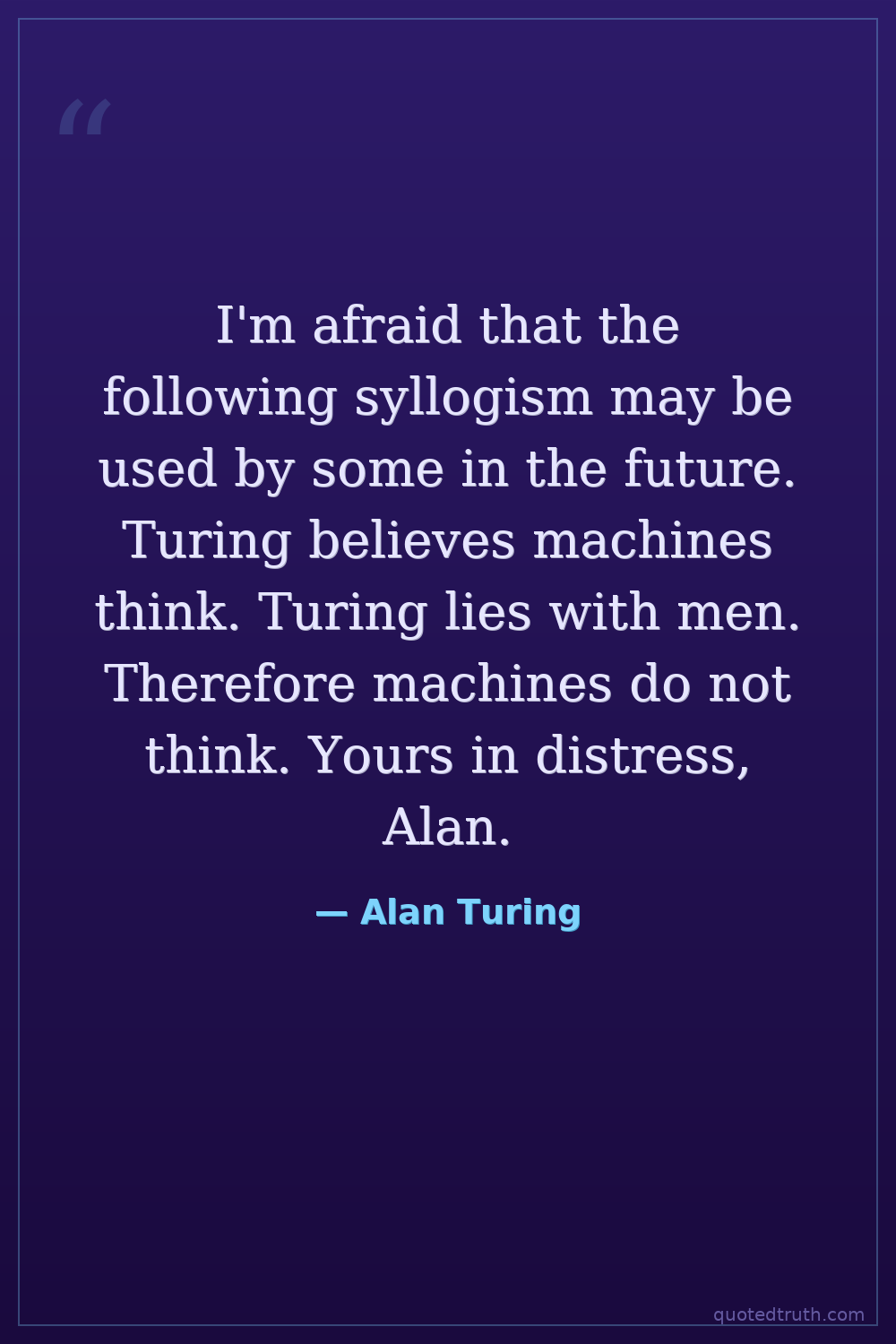
Turing fears his homosexuality will be weaponized as a logical fallacy to invalidate his scientific work: because he believes machines think, and because he is gay, therefore machines cannot think. He anticipates ad hominem reasoning — attacking the person to dismiss the argument. He recognizes that prejudice could poison his intellectual legacy, reducing a monumental scientific question to a smear against his character. The formal syllogism structure makes the absurdity and injustice explicit.
Relevance to Alan Turing
Turing was prosecuted in 1952 for gross indecency after admitting a relationship with a man, subjected to chemical castration, and stripped of his security clearance. He wrote this knowing the society that owed him enormously — his Enigma codebreaking helped win WWII — could legally destroy him. The quote reveals acute self-awareness: the father of modern computing feared his life's work on machine intelligence would be dismissed not on its merits but because of whom he loved.
The era
Britain in the early 1950s criminalized male homosexuality under Victorian-era laws, and Cold War paranoia cast gay men as security risks susceptible to blackmail. Artificial intelligence was a nascent, fragile field needing public and institutional credibility. Turing wrote this shortly after his 1952 prosecution and before his 1954 death — an era when a man's private life could legally and socially erase his professional contributions entirely, regardless of their scale or civilization-altering importance.
AI-generated insights based on extensive research and information for context. Factual errors? Email [email protected].