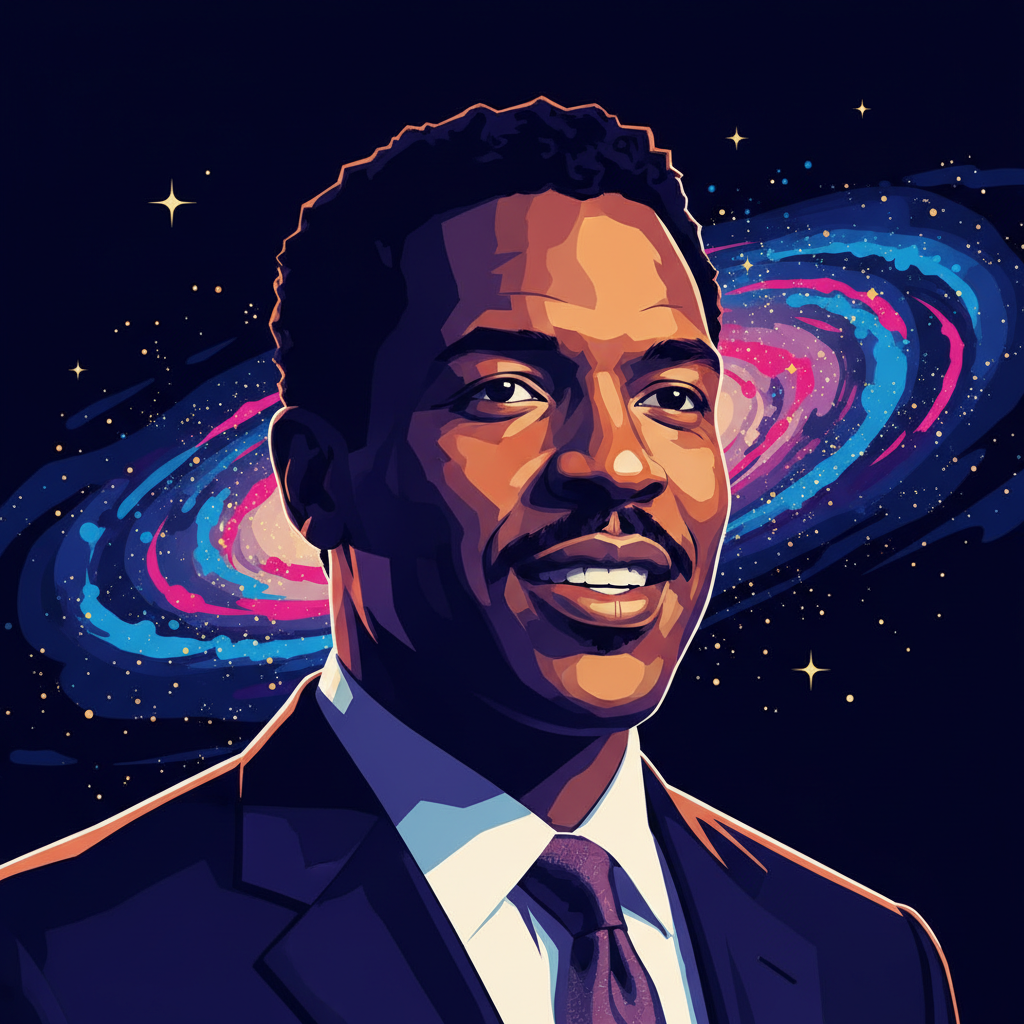
Neil deGrasse Tyson — "I'm not saying I'm smarter than anyone. I'm just saying I've read more books."
I'm not saying I'm smarter than anyone. I'm just saying I've read more books.
I'm not saying I'm smarter than anyone. I'm just saying I've read more books.
Click any product to generate a realistic preview. Up to 3 at a time.
* Initial load can take up to 90 seconds — revising the preview in another color is nearly instant.
"I think the universe is trying to tell us something, and we're just not listening."
"I'm not a fan of people who say, 'I believe in science.' Science is not a belief system. Science is a method."
"If you are a scientist, you are a scientist. You don't have to be a 'black scientist' or a 'woman scientist.'"
"The universe is a beautiful place, and it's full of wonders."
"I'm not saying I'm Batman. I'm just saying no one has ever seen me and Batman in the same room."
American astrophysicist, Hayden Planetarium director, and Cosmos: A Spacetime Odyssey host who carries the Carl Sagan public-science mantle. Closely associated with Bill Nye (fellow science communicator) and Brian Greene (theoretical physicist and string-theory popularizer). For an intellectual contrast, see Ken Ham, founder of Answers in Genesis and the Creation Museum — Ham's career has been organized around defending biblical 6-day creationism — exactly the science-education position Tyson's mainstream-science communication is structured to refute.
Found in 1 providers: grok
1 source checked
The quote separates raw intelligence from acquired knowledge. It deflects any claim of being innately smarter while proudly asserting breadth of reading. The underlying message: expertise is earned through sustained effort, not born. Anyone willing to pick up a book can close the gap. It reframes intellectual authority as a product of curiosity and discipline rather than genetic advantage — a democratic view of how knowledge is built.
Tyson grew up in the Bronx, not from privilege, yet became director of the Hayden Planetarium through relentless self-education. He has described in interviews how books — from Carl Sagan to physics texts he sought as a child — shaped his worldview. His career as a science communicator is built on translating vast reading into accessible ideas. He frequently cites specific authors as pivotal, consistently treating libraries as the great equalizer.
Tyson rose to prominence during an era of rising anti-intellectualism, social media misinformation, and mainstream science skepticism. His peak years coincide with climate change denial debates, vaccine hesitancy movements, and the viral spread of pseudoscience. Championing books as the foundation of expertise pushes back against the cultural notion that all opinions carry equal weight, asserting that sustained engagement with accumulated knowledge has irreplaceable, earned authority.
AI-generated insights based on extensive research and information for context. Factual errors? Email [email protected].
Your cart is empty