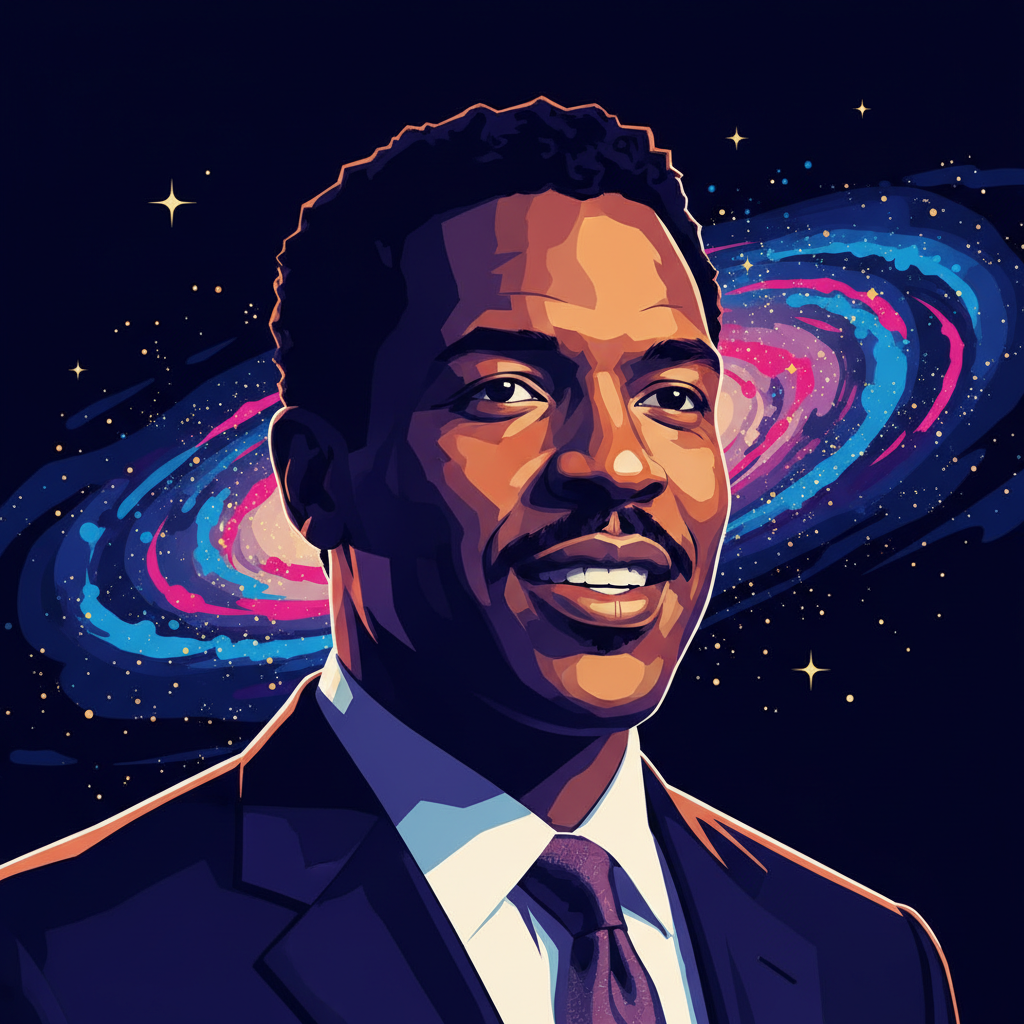
Neil deGrasse Tyson — "I'm not saying there's no God. I'm saying if there is a God, he's an absentee la…"
I'm not saying there's no God. I'm saying if there is a God, he's an absentee landlord.
I'm not saying there's no God. I'm saying if there is a God, he's an absentee landlord.
Click any product to generate a realistic preview. Up to 3 at a time.
* Initial load can take up to 90 seconds — revising the preview in another color is nearly instant.
"The universe is not a toy. It's a laboratory."
"I think the greatest gift you can give someone is the gift of knowledge."
"The universe is not just big. It's vast."
"The universe is a dangerous place. It's full of black holes and gamma-ray bursts."
"The universe is not obliged to be beautiful."
American astrophysicist, Hayden Planetarium director, and Cosmos: A Spacetime Odyssey host who carries the Carl Sagan public-science mantle. Closely associated with Bill Nye (fellow science communicator) and Brian Greene (theoretical physicist and string-theory popularizer). For an intellectual contrast, see Ken Ham, founder of Answers in Genesis and the Creation Museum — Ham's career has been organized around defending biblical 6-day creationism — exactly the science-education position Tyson's mainstream-science communication is structured to refute.
Found in 1 providers: grok
1 source checked
The universe operates by physical laws that function whether or not a creator exists. God, if real, doesn't intervene in daily events, natural disasters, or human suffering. This sidesteps atheism while rejecting active divine intervention—a middle position acknowledging theological uncertainty while demanding the universe be understood through observable evidence rather than appeals to divine action.
Tyson built his career explaining cosmic indifference—supernovae, black holes, and extinction events operate without moral consideration. As director of the Hayden Planetarium and host of Cosmos, he consistently pushed science over supernaturalism without alienating religious audiences. This landlord metaphor perfectly captures his careful rhetorical style: provocative enough to challenge, diplomatic enough to avoid culture-war positioning.
Tyson rose to prominence during the New Atheism wave of the 2000s-2010s when Dawkins, Hitchens, and Harris were aggressively confrontational. Meanwhile, intelligent design battles were being fought in school boards nationally. Tyson's absentee-landlord framing offered a third path—scientifically rigorous but culturally accessible—during a period of intense public friction between religious belief and evolutionary science.
AI-generated insights based on extensive research and information for context. Factual errors? Email [email protected].
Your cart is empty