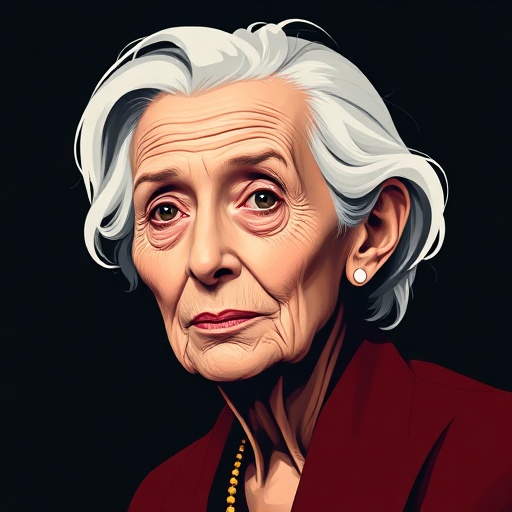
Jane Goodall — "I'm often asked if I'm an optimist or a pessimist. I say I'm a 'possibilist.'"
I'm often asked if I'm an optimist or a pessimist. I say I'm a 'possibilist.'
I'm often asked if I'm an optimist or a pessimist. I say I'm a 'possibilist.'
Click any product to generate a realistic preview. Up to 3 at a time.
* Initial load can take up to 90 seconds — revising the preview in another color is nearly instant.
"We need to be voices for the voiceless, and advocates for those who cannot speak for themselves."
"Every single day, we make choices that impact the planet. We can choose to make a difference."
"Hope is what keeps us going. Hope is what drives us to make a difference."
"We need to teach our children to be compassionate, and to care about all living things."
"We need to teach our children to be good stewards of the Earth, and to protect its resources."
British primatologist who in 1960 began the longest-running wild primate study at Gombe Stream, transforming our understanding of chimpanzees. Closely associated with Dian Fossey (mountain-gorilla researcher) and Birutė Galdikas (orangutan researcher; together with Goodall and Fossey one of Louis Leakey's 'Trimates'). For an intellectual contrast, see Walter Palmer, American dentist who killed Cecil the Lion in Zimbabwe in 2015 — Palmer represents the trophy-hunting tradition Goodall's life's work has been organized against — the colonial-era hunter-naturalist worldview that treated primates and big game as specimens or trophies, which Goodall's Roots & Shoots and Jane Goodall Institute exist specifically to displace.
Found in 1 providers: grok
1 source checked
When asked to choose between hope and despair, Goodall refuses both extremes. A possibilist acknowledges real problems without surrendering to hopelessness, and recognizes real dangers without blind optimism. It means staying grounded in what is actually achievable given current conditions, human capacity, and natural resilience — a stance that demands engagement rather than either cheerleading or resignation.
Goodall spent decades watching chimpanzee habitats vanish and species decline, facts that would justify pessimism. Yet her Roots & Shoots program, founded 1991, mobilized millions of young people globally. Having witnessed both destruction and recovery firsthand in Gombe, she earned a framework beyond binary thinking — her fieldwork showed ecosystems can rebound when humans choose differently.
Goodall speaks into an era of climate anxiety, biodiversity collapse, and political polarization where public discourse demands you pick a side. The late 20th and early 21st centuries saw environmental crises accelerate while youth movements like Fridays for Future emerged simultaneously — a tension between catastrophe and agency that makes 'possibilist' a precise, necessary third position beyond the tired optimist-pessimist binary.
AI-generated insights based on extensive research and information for context. Factual errors? Email [email protected].
Your cart is empty