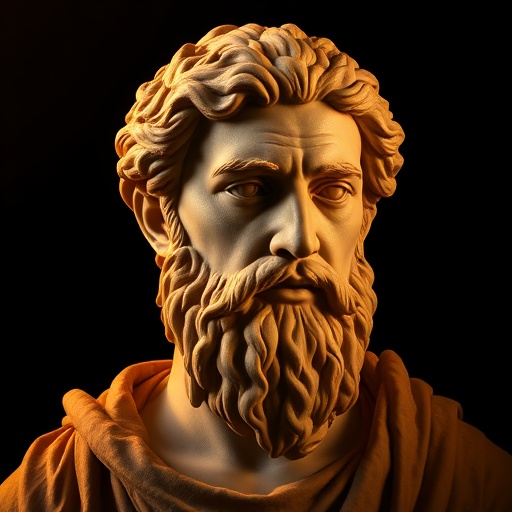
Euclid — "In any right-angled triangle, the square on the side subtending the right angle …"
In any right-angled triangle, the square on the side subtending the right angle is equal to the squares on the sides containing the right angle.
In any right-angled triangle, the square on the side subtending the right angle is equal to the squares on the sides containing the right angle.
Click any product to generate a realistic preview. Up to 3 at a time.
* Initial load can take up to 90 seconds — revising the preview in another color is nearly instant.
"Give him threepence, since he must make a gain out of what he learns."
"What do I gain by learning these things?"
"A point is that which has no part."
"The laws of nature are but the mathematical thoughts of God."
"When a straight line set up on a straight line makes the adjacent angles equal to one another, each of the equal angles is right, and the straight line standing on the other is called a perpendicular …"
Found in 1 providers: grok
1 source checked
In any right triangle, the area of the square drawn on the hypotenuse — the longest side opposite the right angle — exactly equals the combined areas of squares drawn on the other two sides. Expressed simply: a² + b² = c². This is an absolute geometric truth, not an approximation. It underpins distance calculation, architecture, navigation, physics, and nearly all spatial reasoning humans rely on today.
Euclid presented this as Proposition 47 in his Elements (~300 BCE), the most influential mathematics textbook in history. Though Pythagoras predated him, Euclid's contribution was constructing an airtight deductive proof from axioms alone — no measurement, no assumption. This embodies his defining character: mathematics as pure logical necessity. He believed truth must be proven, not observed. This theorem is the supreme demonstration of his axiomatic method.
Around 300 BCE, Alexandria under Ptolemy I was becoming the Mediterranean's intellectual capital. Greek thinkers were radically shifting mathematics from practical Babylonian-style calculation toward abstract proof. Babylonians had known Pythagorean triples empirically for over a millennium, yet demanded no logical justification. Euclid's era insisted that universal geometric truths required deductive proof — elevating mathematics to philosophy's equal and establishing a standard of rigor that defined Western science for two thousand years.
AI-generated insights based on extensive research and information for context. Factual errors? Email [email protected].
Your cart is empty