Alexander Fleming — "It is a popular misconception that I was a brilliant chemist, but I was not. I w…"
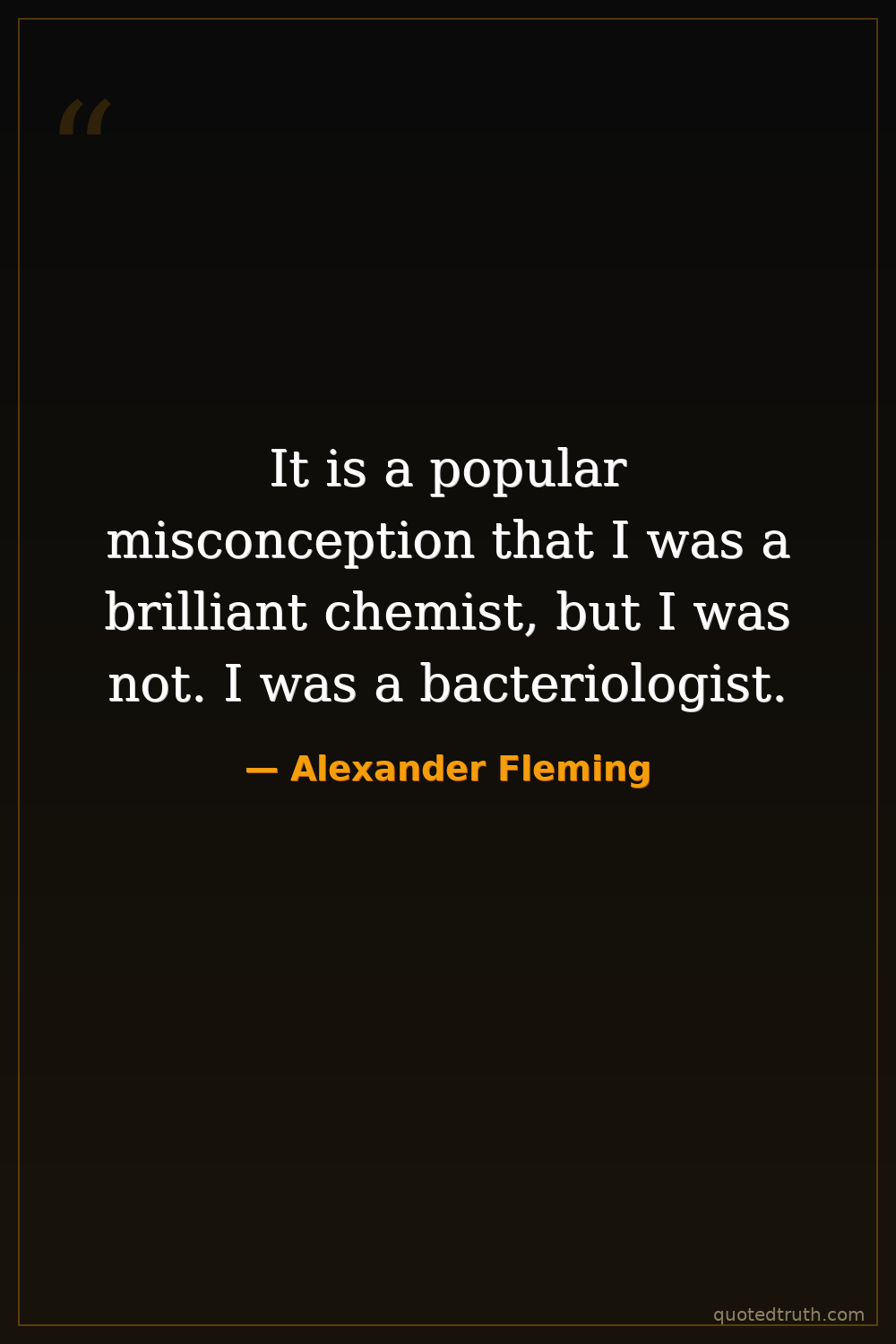
It is a popular misconception that I was a brilliant chemist, but I was not. I was a bacteriologist.
It is a popular misconception that I was a brilliant chemist, but I was not. I was a bacteriologist.
Click any product to generate a realistic preview. Up to 3 at a time.
* Initial load can take up to 90 seconds — revising the preview in another color is nearly instant.
"It is not the man who first sees a thing who is the discoverer, but he who sees into a thing."
"It is a matter of great satisfaction to see penicillin saving so many lives."
"Some people have been very enthusiastic about penicillin, others less so."
"I never thought of myself as a genius. I just kept looking."
"The mould grew, and then I saw the clear space around it."
Found in 1 providers: grok
1 source checked
Fleming pushes back against a widespread assumption about his expertise. People assumed his groundbreaking discovery meant he was a master chemist, but he corrects them by noting his actual specialty was bacteriology, the study of bacteria. He's clarifying his scientific identity, refusing credit for skills he did not possess, and gently insisting that accurate labels matter even when admiration is well-intentioned. Recognition should match reality.
Fleming truly was a bacteriologist at St. Mary's Hospital in London, not a chemist. His 1928 penicillin discovery came from observing mold contaminating a Petri dish of Staphylococcus, classic bacteriological work. The actual chemical isolation and purification of penicillin was achieved later by Howard Florey and Ernst Chain at Oxford, who shared his 1945 Nobel Prize. This humble correction reflects Fleming's lifelong honesty about the limits of his contribution to the drug.
Fleming worked during the early-to-mid twentieth century, an era when antibiotics did not exist and bacterial infections like pneumonia, sepsis, and wound infections routinely killed patients. Two world wars amplified demand for infection treatment. As penicillin saved countless soldiers in WWII, Fleming became a global celebrity, frequently miscredited as the lone genius behind the wonder drug. Public science journalism often blurred specialties, lumping all lab researchers together as chemists, prompting his repeated clarification.
AI-generated insights based on extensive research and information for context. Factual errors? Email [email protected].
Your cart is empty