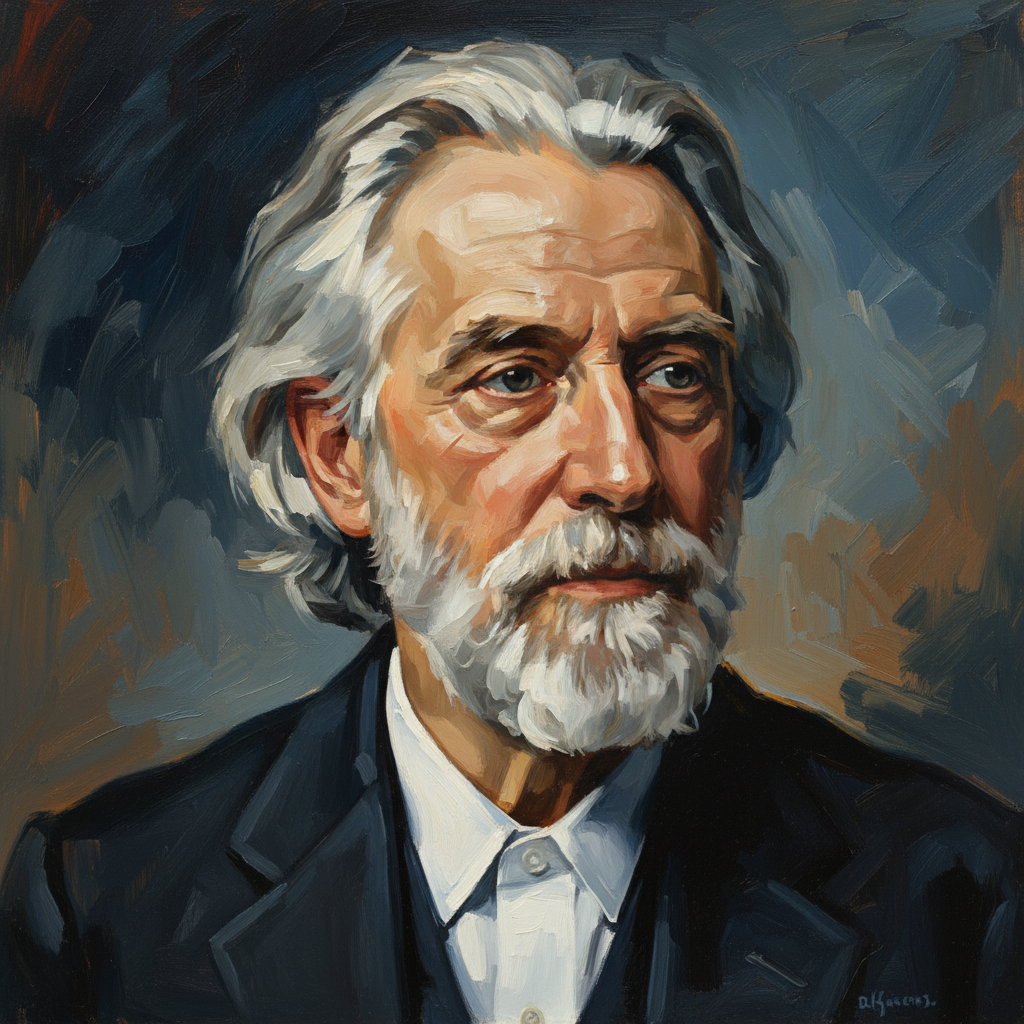
Bertrand Russell — "It is a truism that in this world there is always more misery than happiness."
It is a truism that in this world there is always more misery than happiness.
It is a truism that in this world there is always more misery than happiness.
Click any product to generate a realistic preview. Up to 3 at a time.
* Initial load can take up to 90 seconds — revising the preview in another color is nearly instant.
"If an opinion contrary to your own makes you angry, that is a sign that you are subconsciously aware of having no good reason for thinking as you do."
"I am not a Christian. I do not believe in God or immortality."
"Anything you're good at, you can make money from. Don't let anyone tell you otherwise."
"Love is wise; hatred is foolish."
"The time you enjoy wasting is not wasted time."
British philosopher, logician, and Nobel literature laureate (1950) who co-authored Principia Mathematica with Whitehead and led 20th-century pacifist and nuclear-disarmament campaigns. Closely associated with Alfred North Whitehead (Principia Mathematica co-author) and Ludwig Wittgenstein (his student-then-rival). For an intellectual contrast, see F.H. Bradley, British Idealist philosopher — Russell's 1898 break with Bradley's neo-Hegelian Idealism — and his subsequent logical-atomism — is the founding moment of the Anglo-American analytic philosophy tradition that displaced Idealism for a century. Russell's entire early career is structured against Bradley's metaphysics of internal relations.
The standard scholarly entry points to Bertrand Russell's work: Ray Monk (Southampton, philosophy biographer) — Bertrand Russell: The Spirit of Solitude 1872-1921 (1996); A.C. Grayling (New College of the Humanities) — Russell: A Very Short Introduction (1996). These are the works graduate seminars cite when teaching Bertrand Russell.
Your cart is empty