What it means
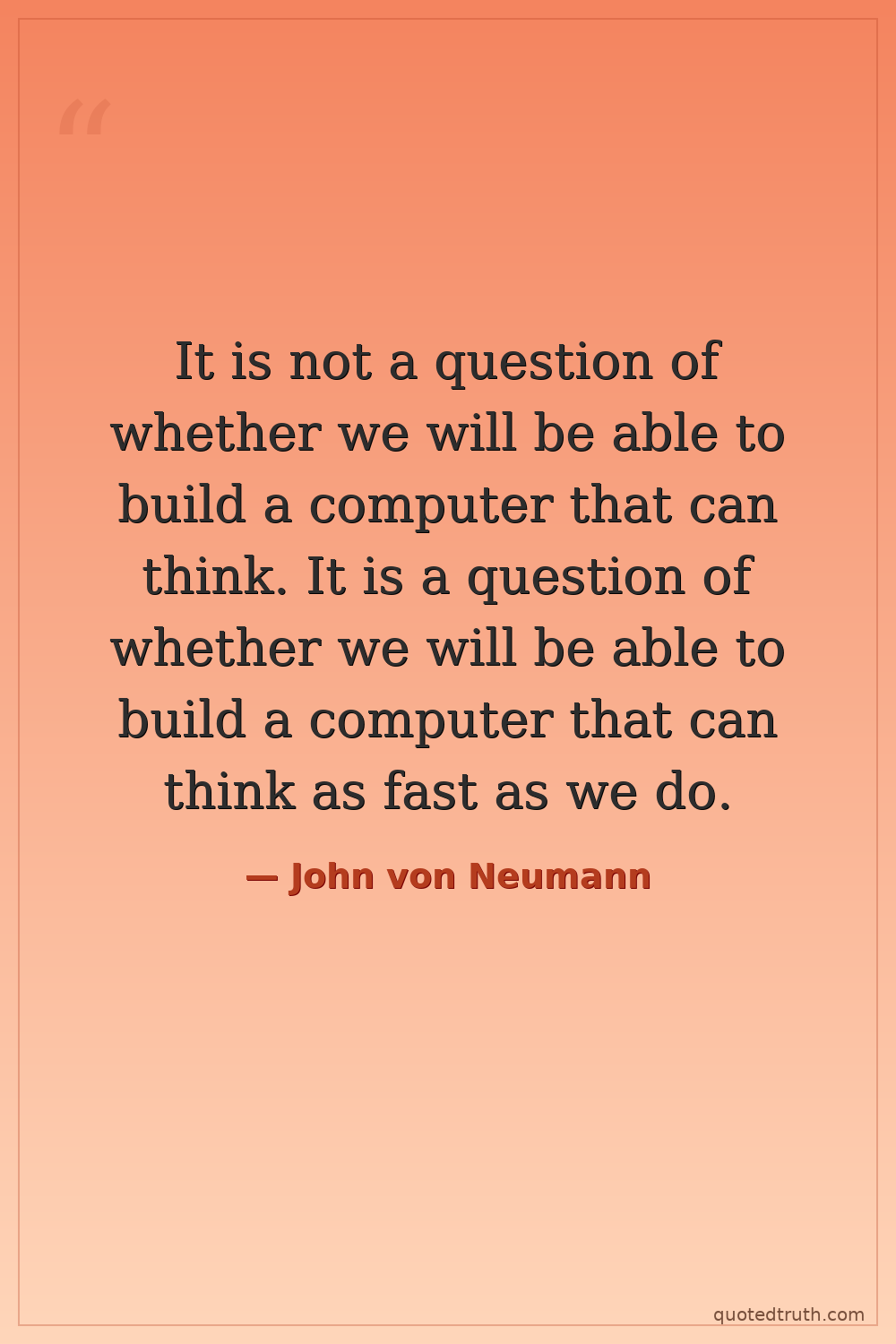
The real challenge in artificial intelligence isn't achieving machine thought—that's assumed achievable. The harder problem is matching human processing speed. Intelligence without adequate speed is practically useless. A thinking machine that deliberates too slowly cannot keep pace with the demands of real-world decisions, rendering its cognition functionally irrelevant regardless of accuracy or depth.
Relevance to John von Neumann
Von Neumann designed the stored-program computer architecture still used today, obsessing over computational speed and efficiency. He worked on early machines like ENIAC and EDVAC, where clock speeds and processing bottlenecks were daily engineering realities. His game theory work also demanded rapid strategic calculation, making speed—not just logical capability—central to his vision of useful computation.
The era
In the mid-20th century, early computers filled entire rooms yet performed calculations slower than skilled human mathematicians. The Cold War and nuclear weapons programs demanded faster computation for ballistics and simulations. Von Neumann witnessed firsthand how processing bottlenecks crippled otherwise sound machines, making speed the defining practical constraint of the nascent computing era rather than theoretical capability.
AI-generated insights based on extensive research and information for context. Factual errors? Email [email protected].