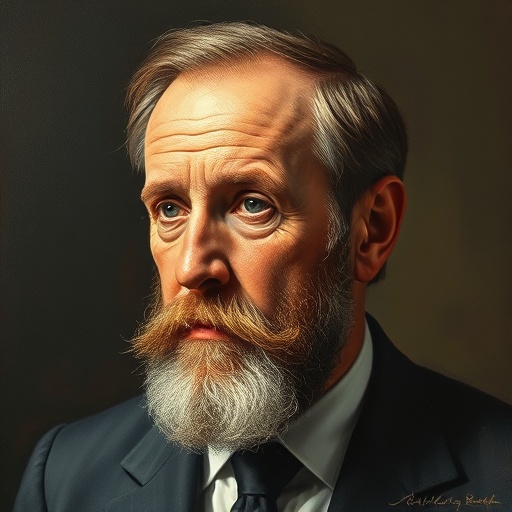
Niels Bohr — "It is not possible to describe the world without describing ourselves."
It is not possible to describe the world without describing ourselves.
It is not possible to describe the world without describing ourselves.
Click any product to generate a realistic preview. Up to 3 at a time.
* Initial load can take up to 90 seconds — revising the preview in another color is nearly instant.
"The very act of observing changes the observed."
"When we speak of the electron, we are not speaking of something that really exists, but of something that we have imagined."
"The great thing is to be able to make a mistake without knowing it."
"The meaning of life does not consist in the mere fact of existing, but in the power of perceiving and making known our existence, and that of others."
"The great challenge of quantum theory is not to understand how it works, but to accept that it works."
Found in 1 providers: grok
1 source checked
We cannot observe or understand reality objectively because every description of the world is filtered through human perception, language, and measurement. The observer is always entangled with what is observed. Any account of nature necessarily includes assumptions, frameworks, and limitations of the person doing the describing. Knowledge is never purely external—it always carries the imprint of the knower.
Bohr developed the Copenhagen interpretation of quantum mechanics, which holds that a particle has no definite state until measured. His foundational work on atomic structure forced physics to confront how observation affects physical systems. This quote directly mirrors his lifelong argument that physics must account for the observer's role—measurement collapses possibility into actuality, making the physicist inseparable from the phenomenon.
The early 20th century shattered classical physics. Einstein's relativity and quantum mechanics dismantled Newtonian certainty, revealing that space, time, and matter behaved strangely at extreme scales. Scientists debated whether physics described reality or only human experience of it. The observer problem became central—especially during Bohr's famous debates with Einstein in the 1920s-30s—reshaping philosophy of science permanently.
AI-generated insights based on extensive research and information for context. Factual errors? Email [email protected].
Your cart is empty