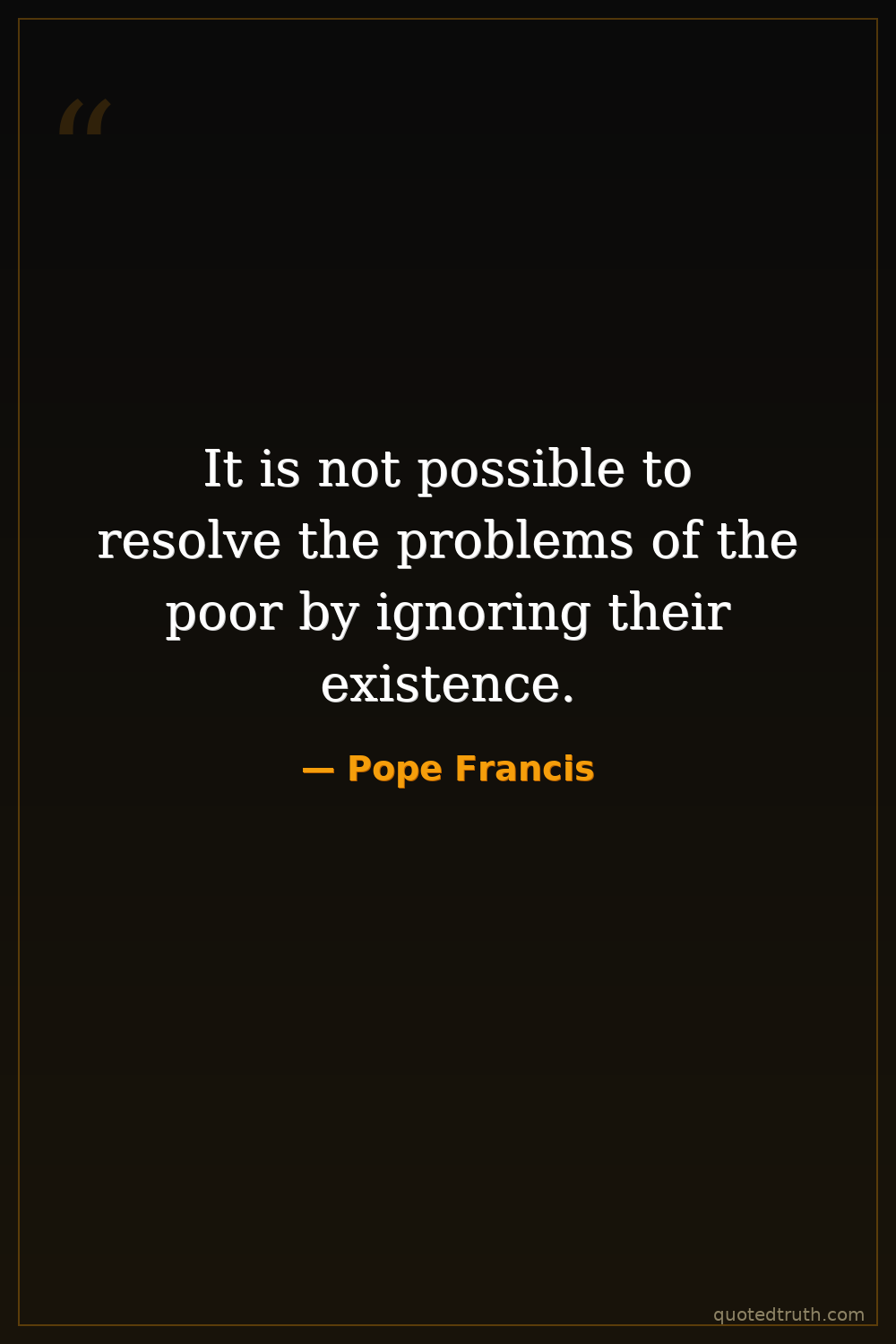
Pope Francis — "It is not possible to resolve the problems of the poor by ignoring their existen…"
It is not possible to resolve the problems of the poor by ignoring their existence.
It is not possible to resolve the problems of the poor by ignoring their existence.
Click any product to generate a realistic preview. Up to 3 at a time.
* Initial load can take up to 90 seconds — revising the preview in another color is nearly instant.
"The death penalty is an inhumane measure that humiliates human dignity. There is no justification for it, and it is unacceptable."
"The culture of waste has made us insensitive to waste and to the disposed of."
"The gossip is a terrorist."
"A world without women would be a sterile world."
"A Christian without joy is not a Christian."
First Latin American and Jesuit pope (2013-), who has steered the Catholic Church toward pastoral inclusion on LGBTQ pastoral care, divorced Catholics, and climate. Closely associated with Pope John XXIII (the Vatican II reformer pope) and Cardinal Walter Kasper (his theological ally on pastoral reform). For an intellectual contrast, see Cardinal Raymond Burke, American traditionalist cardinal, former head of the Vatican Apostolic Signatura — Burke is the public face of Catholic traditionalism that views Francis's pastoral approach as doctrinally dangerous — he has formally challenged Amoris Laetitia and other Francis reforms.
Found in 1 providers: grok
1 source checked
Poverty cannot be solved by pretending it doesn't exist. Turning away from the poor—through policy, comfortable indifference, or social invisibility—guarantees their suffering continues. Before any practical solution is possible, society must first acknowledge that impoverished people exist, that their struggles are real, and that their lives matter. Visibility is the precondition for action. Willful blindness is not neutrality; it is a choice that perpetuates harm.
Jorge Mario Bergoglio grew up in working-class Buenos Aires, rode public buses as Archbishop rather than a car, and spent decades working in Argentina's poorest slums. He chose the name Francis after St. Francis of Assisi, patron of the poor—a deliberate signal of priorities. His encyclical Laudato Si' frames poverty as inseparable from justice, and he repeatedly condemns what he calls the globalization of indifference.
Francis became pope in 2013 as inequality reached historic highs following the 2008 financial crisis. Oxfam documented that the wealthiest one percent held more wealth than the rest of humanity combined by 2016. Europe's refugee crisis, urban homelessness surges, and austerity politics made the poor systemically invisible in public discourse. His papacy directly challenged neoliberal frameworks that treated poverty as individual failure rather than a structural, collective responsibility requiring urgent acknowledgment.
AI-generated insights based on extensive research and information for context. Factual errors? Email [email protected].
Your cart is empty