What it means
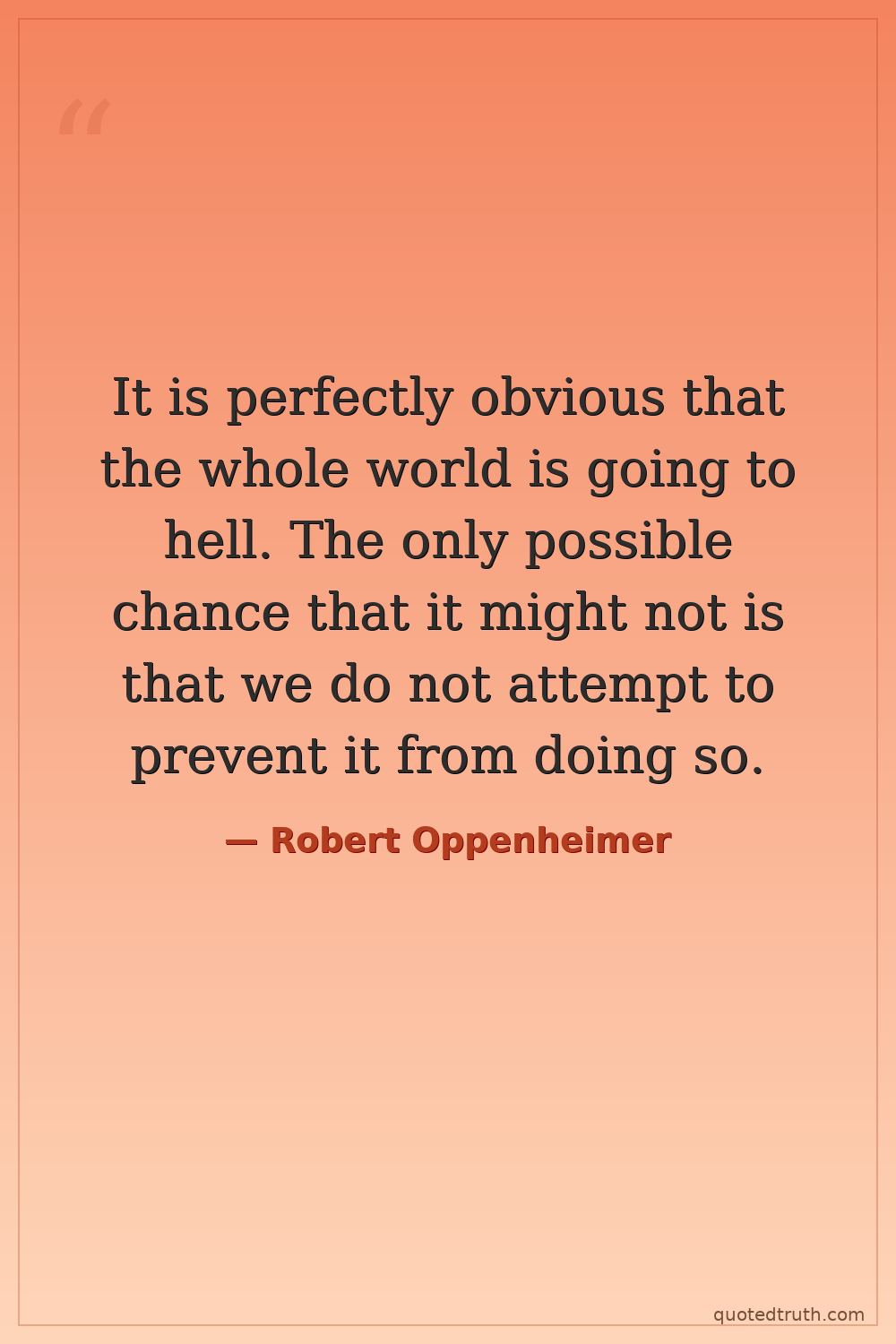
The quote expresses a profound paradox: the world appears destined for catastrophe, yet humanity's desperate attempts to avert it may be the very thing that guarantees it. Restraint—not intervention—offers the only real chance of survival. It warns against the hubris of those who believe they can engineer outcomes in complex systems, suggesting that aggressive "solutions" often accelerate the very disasters they aim to prevent.
Relevance to Robert Oppenheimer
Oppenheimer built the weapon he knew could end civilization, then spent the rest of his life trying to contain what he'd unleashed. He opposed the hydrogen bomb program, believing escalation would doom humanity. His security clearance was stripped in 1954 for resisting that very arms buildup. This quote captures his core torment: America's frantic drive to "prevent" Soviet nuclear dominance was itself the path toward annihilation—a trap he saw clearly but could not stop.
The era
The early Cold War (late 1940s–mid 1950s) saw both superpowers racing to build larger nuclear arsenals under the logic that dominance prevents war. Mutually Assured Destruction was being formalized as doctrine. McCarthyism punished dissent. Oppenheimer watched policymakers accelerate the arms race in the name of security, each escalation justified as prevention. His quote cuts against that entire framework—the era's defining paradox made flesh by the man who started it.
AI-generated insights based on extensive research and information for context. Factual errors? Email [email protected].