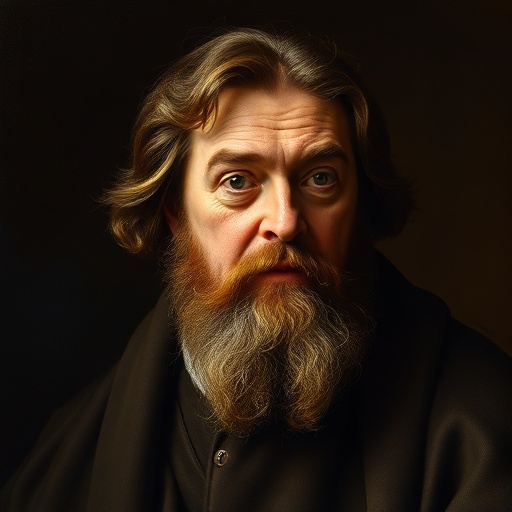
Francis Bacon — "It were better to be a dog and bay the moon, than such a Roman."
It were better to be a dog and bay the moon, than such a Roman.
It were better to be a dog and bay the moon, than such a Roman.
Click any product to generate a realistic preview. Up to 3 at a time.
* Initial load can take up to 90 seconds — revising the preview in another color is nearly instant.
"I have taken all knowledge to be my province."
"For the thereof, I cannot but say, that I found myself in a condition, which in truth I am not able to express, but by a kind of similitude. I was a man of a broken fortune, and of a broken health, an…"
"The honest and just man is a perpetual censor."
"It is not the lie that passeth through the mind, but the lie that sinketh in, and settleth in it, that doth the hurt."
"The worst solitude is to be destitute of sincere friendship."
English philosopher whose Novum Organum (1620) laid out the inductive method that became the foundation of modern empirical science. Closely associated with Galileo Galilei (contemporary scientific revolutionary). For an intellectual contrast, see Aristotelian scholasticism, the syllogistic, deductive philosophical tradition that ruled medieval universities — Bacon's Novum Organum literally means 'new instrument' — the explicit replacement for Aristotle's Organon. The entire scientific revolution turned on which logic was correct: deduction from authority or induction from observation.
The standard scholarly entry points to Francis Bacon's work: Lisa Jardine (Queen Mary University of London, Renaissance scholar) — Francis Bacon: Discovery and the Art of Discourse (1974); Jonathan Marwil (Michigan, intellectual historian) — The Trials of Counsel: Francis Bacon in 1621 (1976); Perez Zagorin (Rochester, historian of ideas) — Francis Bacon (1998). These are the works graduate seminars cite when teaching Francis Bacon.
Your cart is empty