What it means
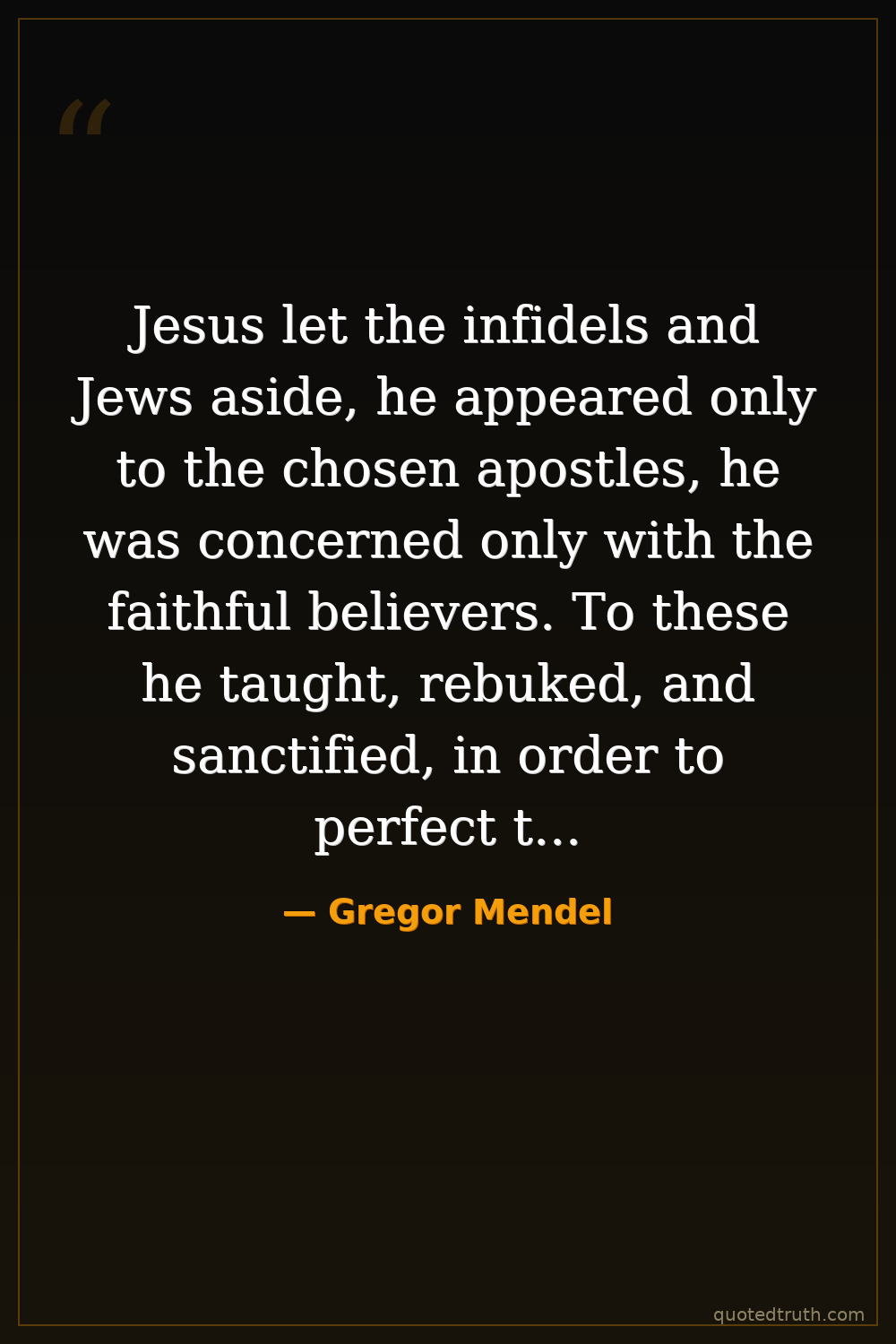
The quote argues Christ after his resurrection appeared exclusively to faithful apostles—not to Jews or non-believers—deliberately restricting his presence to those already committed to him. Through this chosen circle, Jesus taught, corrected, and sanctified them toward spiritual perfection. The theological point: the resurrection accomplished two distinct things—universally removing sin and death, and specifically obtaining divine grace for the community of the faithful.
Relevance to Gregor Mendel
Mendel was an Augustinian friar ordained Catholic priest in 1847, later becoming abbot of St. Thomas' Abbey in Brno. His identity was rooted in monastic life before and alongside his genetics work. This theological reflection fits his priestly vocation precisely. Intriguingly, his scientific fascination with selective inheritance—certain traits passing only to chosen offspring—parallels this theological framework of divine grace conferred selectively upon a distinguished, receptive community.
The era
Mendel lived in Habsburg Catholic Austria (1822–1884), amid rising tension between institutional Christianity and Enlightenment skepticism. Darwin's 1859 evolutionary theory directly challenged biblical creation narratives. The Catholic Church actively defended orthodox doctrine against liberal theology and scientific materialism. Emphasizing Christ's resurrection as historically real and grace as exclusive to believers was a concrete assertion of orthodox Catholic identity against secularism and Protestant challenges spreading across nineteenth-century Europe.
AI-generated insights based on extensive research and information for context. Factual errors? Email [email protected].