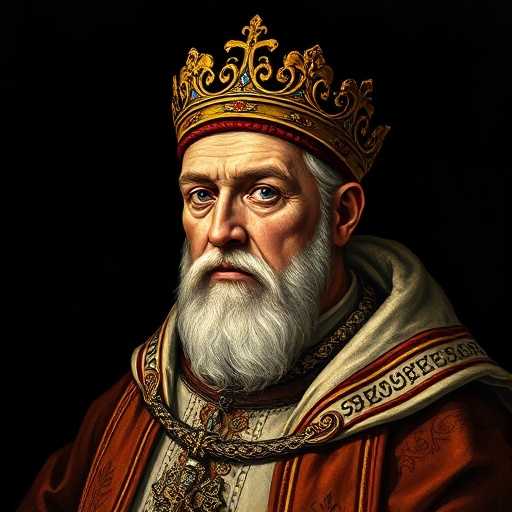
Pope Urban II — "Let no property, no labors detain you, for this land of yours, which is so ferti…"
Let no property, no labors detain you, for this land of yours, which is so fertile, has hardly enough to support its cultivators.
Let no property, no labors detain you, for this land of yours, which is so fertile, has hardly enough to support its cultivators.
Click any product to generate a realistic preview. Up to 3 at a time.
* Initial load can take up to 90 seconds — revising the preview in another color is nearly instant.
"Let no delay postpone the journey, but let all, having leased their lands and collected money, when winter has ended and spring has begun, zealously set out on the road with God as their guide."
"It is Christ who commands it."
"Let your arms be stained with the blood of the infidels."
"Let those who have been exhausting themselves to the detriment both of body and soul now strive for a twofold reward."
"The royal city, situated at the center of the world, is now held captive by His enemies, and is enslaved by peoples who do not know God."
Pope (1088-1099) whose Council of Clermont speech (November 1095) launched the First Crusade — the founding event of nine centuries of Christian-Muslim military conflict. Closely associated with Pope Gregory VII (his predecessor on papal-imperial reform). For an intellectual contrast, see Saladin, Kurdish-Muslim Sultan of Egypt and Syria (1138-1193) — Saladin recaptured Jerusalem in 1187, undoing the First Crusade Urban II launched 92 years earlier. Saladin's chivalrous treatment of Christian prisoners became the canonical Muslim counter-image to Crusader brutality. The cleanest before/after pairing of the Crusades' moral arc.
Found in 1 providers: grok
1 source checked
Urban II is urging would-be crusaders to abandon their property and daily obligations without regret. His argument: even Europe's fertile farmland barely feeds the people who work it, so nothing worth keeping is being left behind. He weaponizes economic hardship as motivation — don't grieve what you're surrendering; it was already insufficient. Leaving becomes not sacrifice but rational escape from scarcity toward something greater.
Urban II was a French nobleman turned Cluniac monk turned pope — he knew feudal land pressures firsthand. His 1095 Clermont speech was deliberately engineered to move multiple audiences: landless younger sons, struggling peasants, restless knights. A shrewd political operator, he consistently tied spiritual duty to material incentive. This line reveals his core method: harness secular grievance — land hunger, overpopulation, economic frustration — and redirect it toward sacred military conquest.
Western Europe in 1095 faced genuine demographic strain: population had surged since 1000 AD, farmland was subdivided under feudal inheritance customs, and primogeniture left younger noble sons landless and volatile. Feudal violence among competing lords was endemic. Simultaneously, Seljuk Turks had seized Anatolia from Byzantium and disrupted Christian pilgrimage to Jerusalem. Urban exploited this convergence — overpopulation and scarcity at home, sacred territory contested abroad — framing the crusade as both spiritual salvation and economic escape valve.
AI-generated insights based on extensive research and information for context. Factual errors? Email [email protected].
Your cart is empty