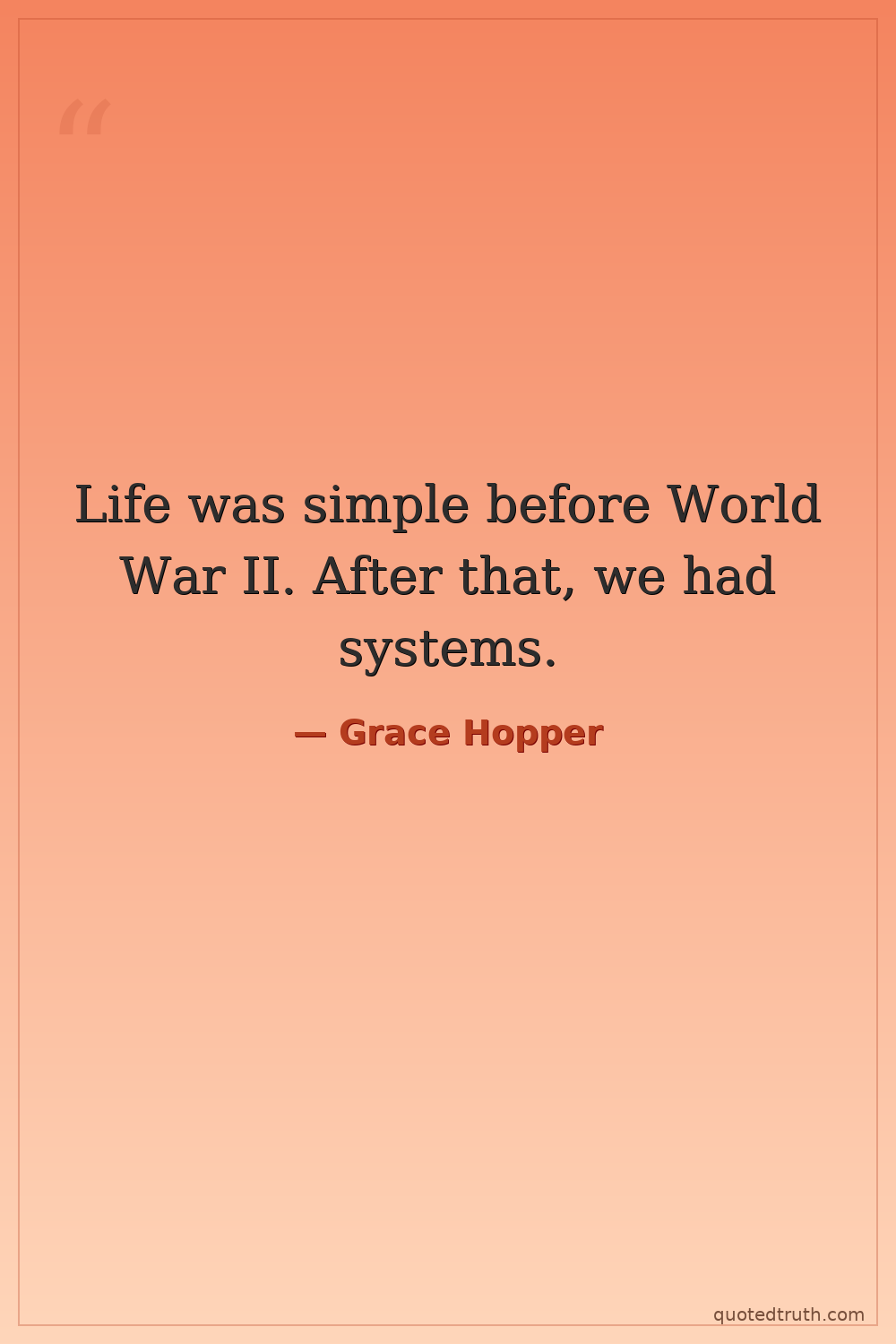
Grace Hopper — "Life was simple before World War II. After that, we had systems."
Life was simple before World War II. After that, we had systems.
Life was simple before World War II. After that, we had systems.
Click any product to generate a realistic preview. Up to 3 at a time.
* Initial load can take up to 90 seconds — revising the preview in another color is nearly instant.
"The only way to learn a new language is to try to program in it."
"I have a theory that a quarter of the people in the world are creative, a quarter are destructive, and half are just plain dumb."
"The difficulty lies, not in the new ideas, but in escaping from the old ones."
"Why do you sit there and ask me questions? Why don't you get up and do something?"
"I love to teach. I love to talk to young people."
A concise and witty observation on the increasing complexity of the world and the rise of systemic thinking post-WWII.
Date: 1987 (Speech at Ohio State University, Feb 5)
Life & AgingFound in 1 providers: gemini
1 source checked
Before WWII, life operated on smaller, more predictable scales — local economies, manual processes, face-to-face coordination. The war forced humanity to build something new: vast, interconnected systems of logistics, computation, communication, and governance too complex for any individual to fully grasp. "Systems" captures everything that followed — bureaucracies, computers, networks, supply chains. The quote acknowledges that this complexity solved enormous problems but permanently changed how humanity organizes itself.
Hopper enlisted in the Navy in 1943 and was assigned to the Harvard Mark I — one of the first programmable computers, built specifically for wartime calculations. She spent her career creating the systems the quote references: inventing the first compiler, co-developing COBOL, and championing machine-readable programming languages. As someone who literally built postwar computing infrastructure, she spoke from the inside — she was one of the architects of the complexity she described.
WWII demanded unprecedented complexity: the Manhattan Project, industrial mobilization, cryptographic machines like Colossus, and logistics coordinating millions across multiple continents. The postwar decades amplified this — Cold War arms races, mainframe computing, NASA's space program, and ARPANET all required systems thinking at scales humanity had never managed. The 1950s–1970s saw systems engineering emerge as a formal discipline, reflecting a world that had crossed a threshold from manageable to fundamentally, irreversibly complex.
AI-generated insights based on extensive research and information for context. Factual errors? Email [email protected].
Your cart is empty