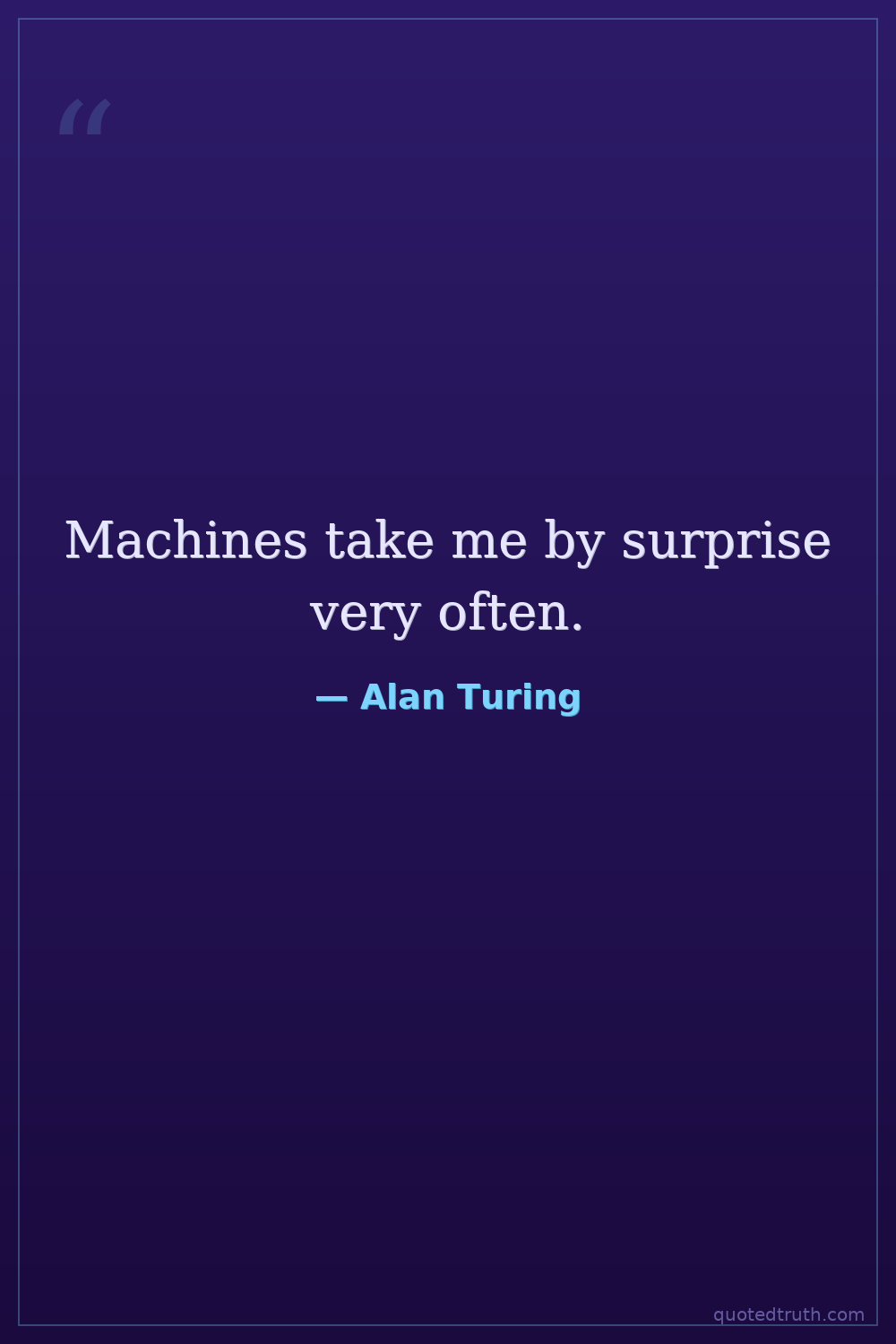
Alan Turing — "Machines take me by surprise very often."
Machines take me by surprise very often.
Machines take me by surprise very often.
Click any product to generate a realistic preview. Up to 3 at a time.
* Initial load can take up to 90 seconds — revising the preview in another color is nearly instant.
"The more we learn about the brain, the more we realize that it is a very complex machine."
"The human mind is capable of doing many things that a machine cannot, but a machine can do many things that a human cannot."
"The future belongs to those who believe in the beauty of their dreams."
"I am enough of an artist to draw freely upon my imagination."
"The future of computing lies in the development of intelligent machines."
Found in 1 providers: grok
1 source checked
Even experts are caught off guard by what machines do. This quote admits that complex systems don't always behave as expected — they produce outputs that surprise even their builders. It's a humble recognition that understanding a machine's design doesn't mean you can predict every result it generates. Today this resonates deeply: AI systems routinely produce outputs their creators didn't anticipate, validating Turing's early intuition about the unpredictability of intelligent machines.
Turing published this in his landmark 1950 paper Computing Machinery and Intelligence, where he proposed the Turing Test. As the architect of theoretical computing and a Bletchley Park codebreaker who watched mechanical bombes crack Nazi Enigma, he understood machines intimately yet remained genuinely open to their capacity to surprise. This humility drove his belief that machines could learn and eventually think, making him AI's earliest and most visionary advocate.
In 1950, computers were massive room-filling machines viewed strictly as calculators — deterministic tools that did exactly what programmers told them. The idea that a machine could surprise its operator was considered absurd by mainstream science. Turing's era predated transistors dominating computing, the Cold War was beginning, and Britain's wartime codebreaking legacy was still classified. His willingness to treat machine unpredictability as a feature rather than a flaw was genuinely radical for its time.
AI-generated insights based on extensive research and information for context. Factual errors? Email [email protected].
Your cart is empty