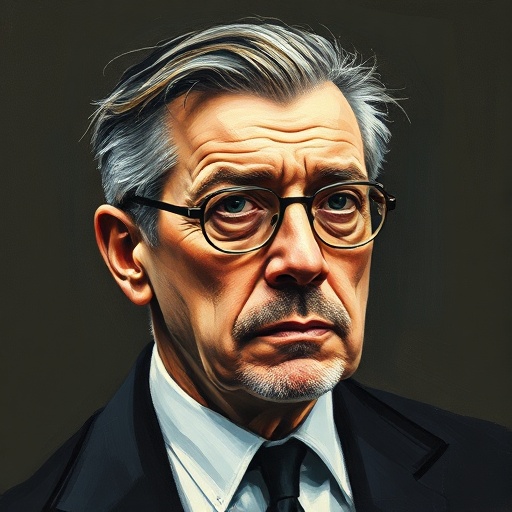
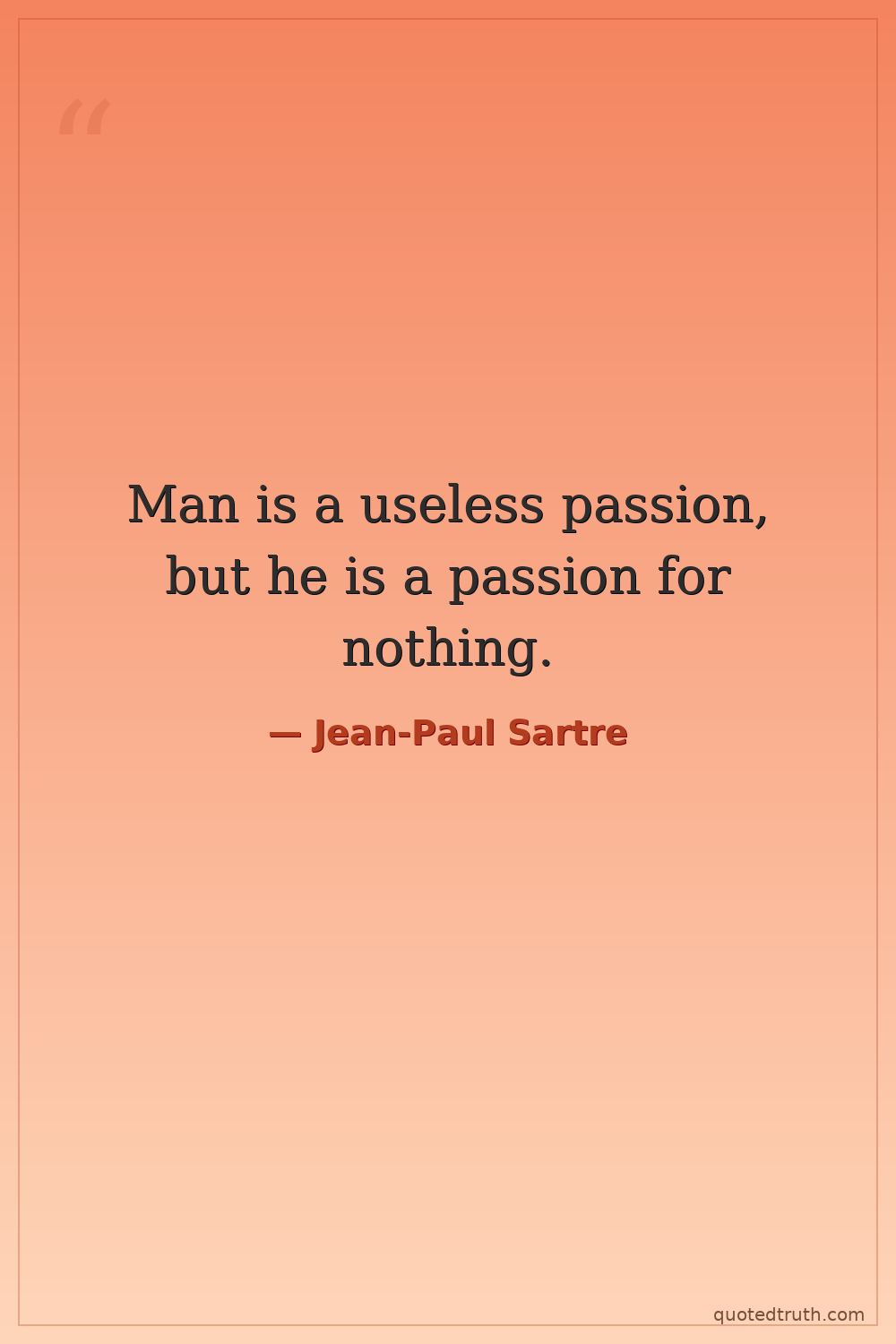
Jean-Paul Sartre — "Man is a useless passion, but he is a passion for nothing."
Man is a useless passion, but he is a passion for nothing.
Man is a useless passion, but he is a passion for nothing.
Click any product to generate a realistic preview. Up to 3 at a time.
* Initial load can take up to 90 seconds — revising the preview in another color is nearly instant.
"We do not know what we want and yet we are responsible for what we are."
"Absurd, irreducible; nothing--not even a profound and secret delirium of nature--could explain [a tree root]."
"Man is defined by his actions and by his refusal to act."
"The greatest effort is not to make oneself understood, but to understand."
"We are born alone, we live alone, we die alone."
French existentialist philosopher (Being and Nothingness, 1943) and Nobel literature laureate (refused, 1964) who shaped postwar French intellectual culture. Closely associated with Simone de Beauvoir (lifetime partner and existentialist co-founder) and Maurice Merleau-Ponty (phenomenologist contemporary and Les Temps Modernes co-editor). For an intellectual contrast, see Albert Camus, Algerian-French novelist and philosopher — Once Sartre's closest collaborator, Camus broke with him publicly in 1952 over Soviet communism; Camus's moral-resistance liberalism and Sartre's revolutionary commitment became the two postwar French Left poles. The Sartre-Camus break is the canonical postwar French intellectual rupture — they argued whether revolutionary violence is ever justified, and never reconciled.
The standard scholarly entry points to Jean-Paul Sartre's work: Annie Cohen-Solal (French biographer, NYU) — Sartre: A Life (1985); Ronald Aronson (Wayne State University, philosophy) — Camus and Sartre: The Story of a Friendship (2004); Bernard-Henri Lévy (French public philosopher) — Sartre: The Philosopher of the Twentieth Century (2003). These are the works graduate seminars cite when teaching Jean-Paul Sartre.
Your cart is empty