What it means
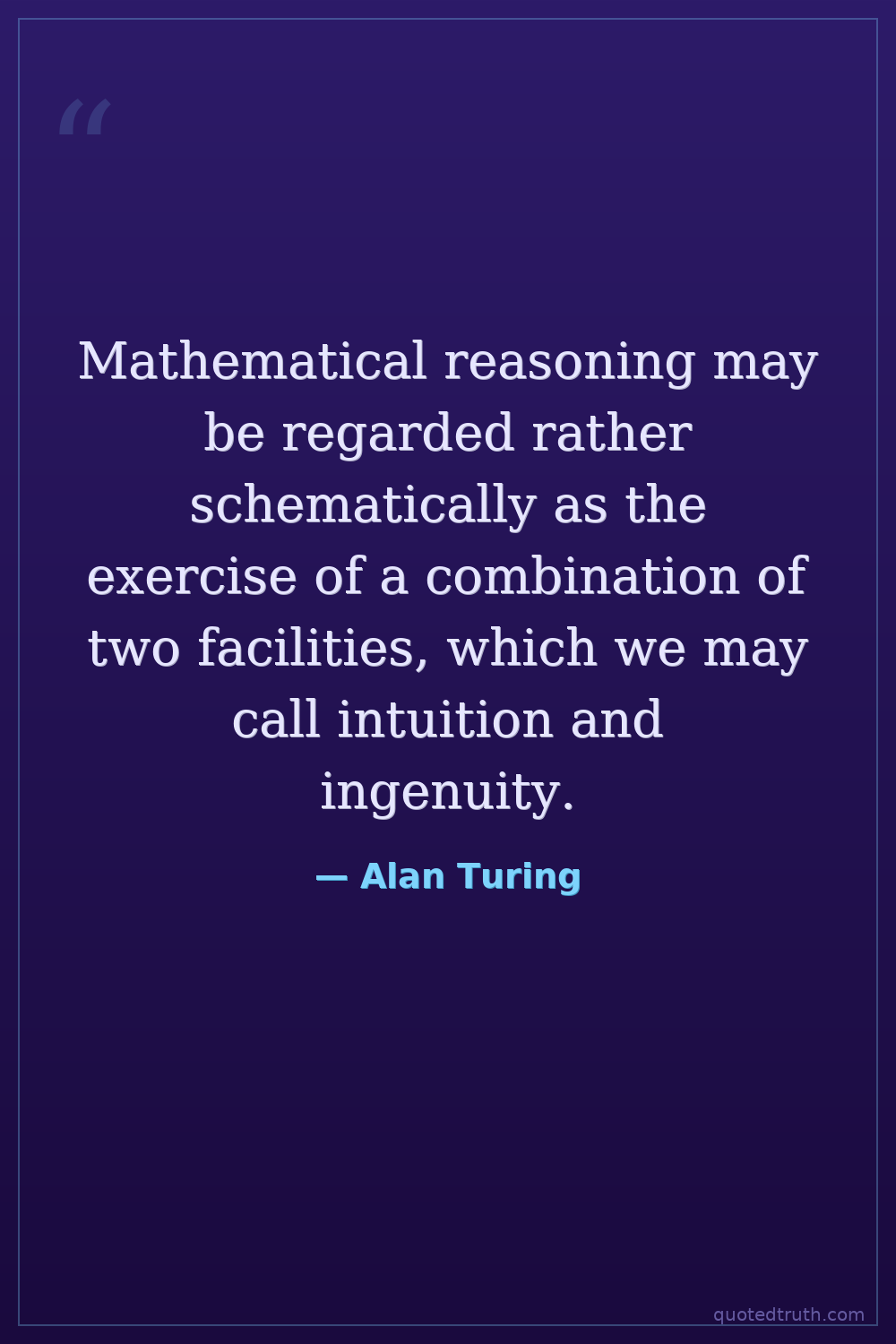
Mathematical thinking works through two distinct mental gears: intuition, the direct grasp of whether a statement is true without formal proof, and ingenuity, the clever construction of logical steps that bridge known truths to new conclusions. Neither alone suffices. Real mathematical work requires sensing where truth lies and then engineering the rigorous path to demonstrate it.
Relevance to Alan Turing
Turing embodied both faculties simultaneously. His intuition produced the conceptual leap of the universal Turing machine before formal computing existed. His ingenuity built the Bombe at Bletchley Park, systematically cracking Enigma through mechanical logical elimination. This distinction reflects how Turing approached problems: visionary insight paired with ruthless, precise technical execution that translated abstract ideas into working systems.
The era
Turing wrote this in 1939, as formalism in mathematics was under intense scrutiny following Gödel's incompleteness theorems and Hilbert's program collapse. The question of what machines could compute, what humans could intuit, and whether mathematical truth exceeded formal proof was live and urgent. World War II was beginning, making the gap between conceptual insight and engineered solutions immediately, devastatingly consequential.
AI-generated insights based on extensive research and information for context. Factual errors? Email [email protected].