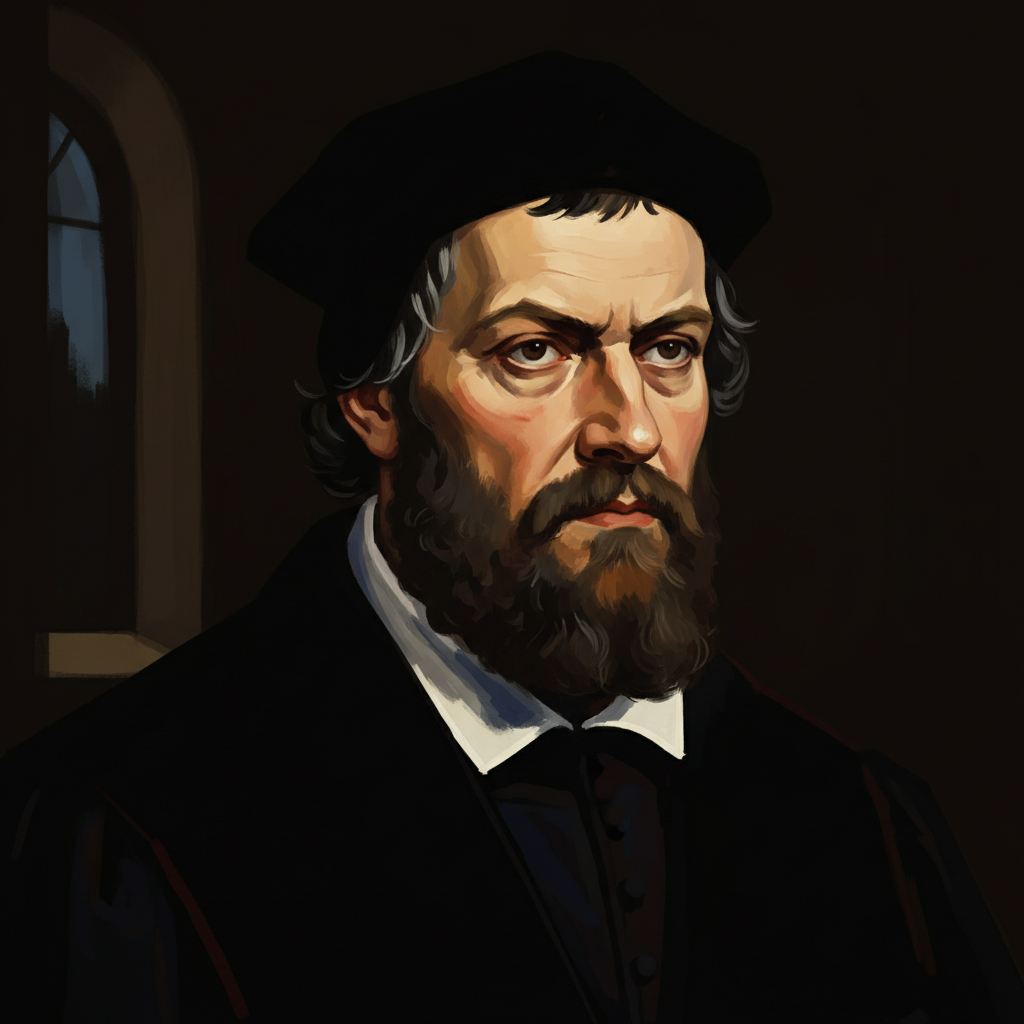
Martin Luther — "Melanchthon is a miserable little worm of a man."
Melanchthon is a miserable little worm of a man.
Melanchthon is a miserable little worm of a man.
Click any product to generate a realistic preview. Up to 3 at a time.
* Initial load can take up to 90 seconds — revising the preview in another color is nearly instant.
"If you want to change the world, pick up your pen."
"The more you read the Bible, the more you will understand it."
"I am but a man prone to let himself be swept off his feet by society, drunkenness, and the movements of the flesh."
"After the devil himself, there is no worse folk than the pope and his followers."
"I cannot pray without cursing."
German theologian whose 95 Theses (1517) launched the Protestant Reformation and broke the Catholic Church's monopoly on Western Christianity. Closely associated with Philipp Melanchthon (Lutheran systematizer) and John Calvin (later Reformer who built on Luther's break). For an intellectual contrast, see Pope Leo X, Renaissance pope (1513-1521) — Leo X's indulgence sales triggered Luther's break and Leo excommunicated him in 1521 — Luther's entire Reformation is structured as a direct answer to the indulgence-funded Vatican Leo represented.
Found in 1 providers: grok
1 source checked
Luther is bluntly insulting Melanchthon, calling him physically slight and pitifully weak. In modern terms, it reads as a crude jab at someone's small stature and timid nature, dismissing them as insignificant. It's the kind of cutting, personal remark a forceful personality throws at a mild-mannered colleague, mixing affection and frustration into a single belittling phrase about the man's frail body and meek disposition.
Luther was famously coarse-tongued, hurling brutal invective at popes, princes, and friends alike. Philipp Melanchthon was his closest Reformation ally, the soft-spoken scholar who drafted the Augsburg Confession while Luther thundered. Luther, a heavyset ex-monk with a peasant's bluntness, often mocked Melanchthon's thin frame and anxious temperament, even as he depended on his intellect. The quote captures Luther's habit of wrapping genuine affection in savage mockery toward the gentler partner in their lifelong theological partnership.
In early-modern Wittenberg, the 1520s-40s Reformation was waged through pamphlets, sermons, and table talk recorded by disciples. Personal invective was standard rhetorical currency; reformers and Catholics traded scatological abuse freely. Luther's offhand remarks at meals were transcribed as Tischreden and circulated widely. Intellectual combat over sola fide, the sacraments, and papal authority intertwined with deeply personal relationships, so a casual insult toward Melanchthon sits inside a culture where theology, friendship, and verbal brutality coexisted without contradiction.
AI-generated insights based on extensive research and information for context. Factual errors? Email [email protected].
Your cart is empty