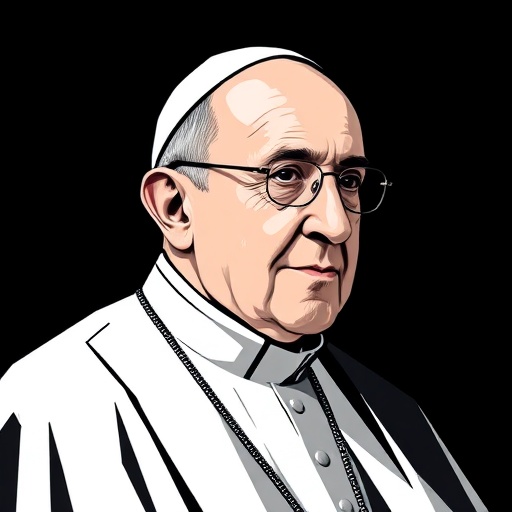
Pope Francis — "Money must serve, not rule."
Money must serve, not rule.
Money must serve, not rule.
Click any product to generate a realistic preview. Up to 3 at a time.
* Initial load can take up to 90 seconds — revising the preview in another color is nearly instant.
"The Lord is a good cook. He always prepares good food for us."
"A good Catholic doesn't interfere in politics, but a good Christian does."
"The victims of abuse must be protected above all else."
"A priest who is a saint told me: 'Women are the ones who move history forward.'"
"Please, I ask you, be shepherds with the smell of sheep, be shepherds in the midst of your flock, fishers of men."
First Latin American and Jesuit pope (2013-), who has steered the Catholic Church toward pastoral inclusion on LGBTQ pastoral care, divorced Catholics, and climate. Closely associated with Pope John XXIII (the Vatican II reformer pope) and Cardinal Walter Kasper (his theological ally on pastoral reform). For an intellectual contrast, see Cardinal Raymond Burke, American traditionalist cardinal, former head of the Vatican Apostolic Signatura — Burke is the public face of Catholic traditionalism that views Francis's pastoral approach as doctrinally dangerous — he has formally challenged Amoris Laetitia and other Francis reforms.
Found in 1 providers: grok
1 source checked
Wealth and financial systems should be tools that serve human needs and dignity, not ends in themselves that dominate people's choices and lives. When money becomes the primary goal rather than a means, it distorts priorities, corrupts institutions, and leaves the vulnerable behind. True value lies in people, not profit.
Jorge Bergoglio grew up in working-class Buenos Aires, witnessed Argentina's economic collapses, and built his ministry among the poor in the slums of the city. As Pope, he consistently challenged global capitalism and financial elites, writing Laudato Si and Evangelii Gaudium explicitly critiquing trickle-down economics and the 'throwaway culture' created by unchecked markets.
Francis made this declaration amid the post-2008 financial crisis recovery, rising global inequality, and austerity debates tearing through Europe. The 2010s saw the 1% versus 99% discourse, Occupy movements, and growing anger at bank bailouts while ordinary citizens suffered. His papacy began in 2013, directly challenging the era's dominant neoliberal consensus.
AI-generated insights based on extensive research and information for context. Factual errors? Email [email protected].
Your cart is empty