What it means
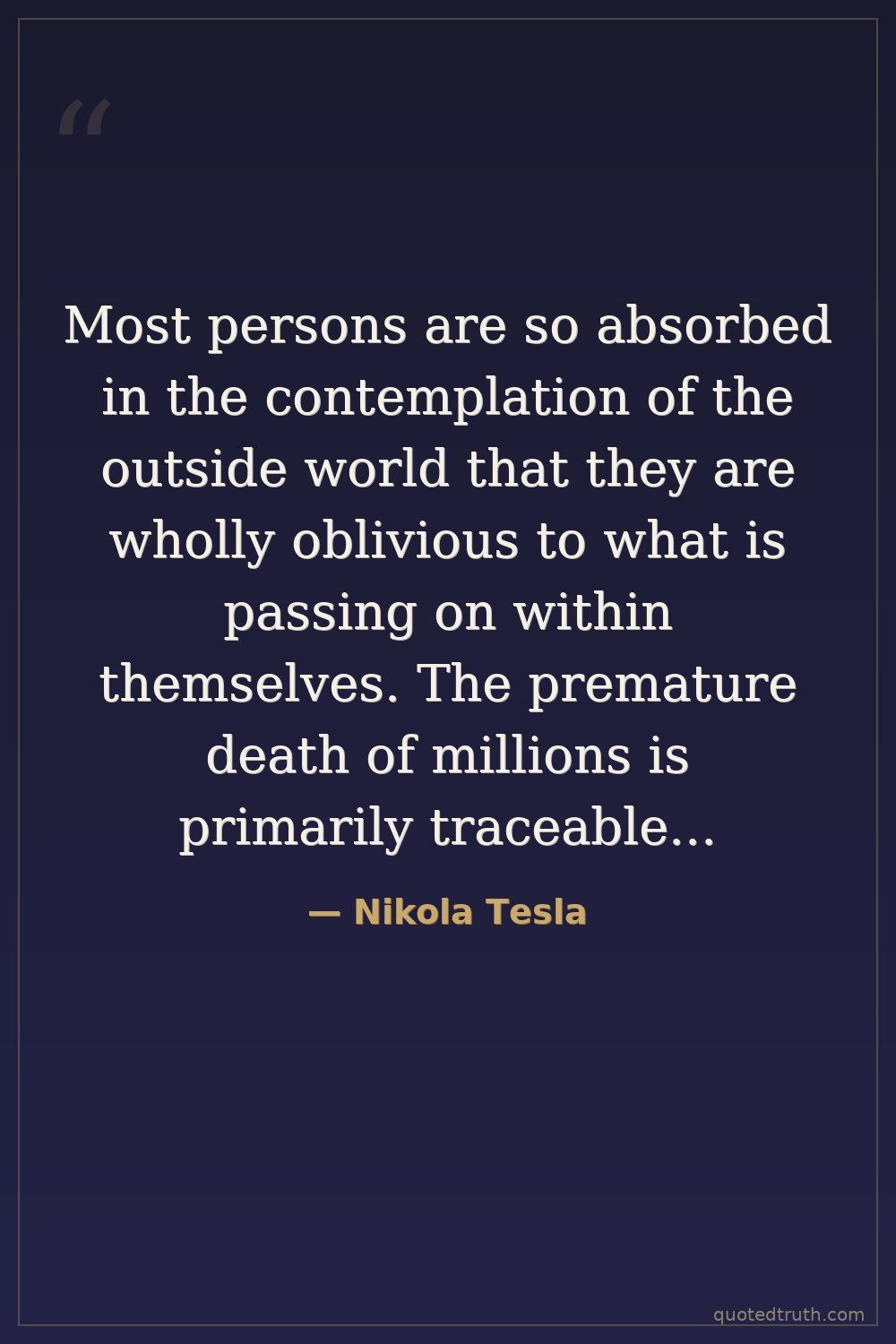
People pour all their attention into the external world—events, others, circumstances—while completely ignoring their own internal states: their health, mental signals, and bodily warnings. This self-neglect, Tesla argues, is a primary driver of early death. Even careful people get it backwards, worrying about unlikely threats while dismissing real ones. And this blindness isn't just personal—it scales up to entire societies making the same collective mistake.
Relevance to Nikola Tesla
Tesla was profoundly introspective—he visualized complete inventions in his mind before touching a workbench, treating mental clarity as an engineering prerequisite. He kept strict personal habits, was intensely attentive to diet, rest, and hygiene, and wrote explicitly about human longevity in 'The Problem of Increasing Human Energy.' For Tesla, inward awareness wasn't philosophy—it was the discipline that sustained his extraordinary output. This quote reflects how he actually lived, not just what he believed.
The era
Tesla wrote during America's industrial explosion—cities swelled, mass spectacle dominated, and outward progress consumed public attention. Meanwhile, tuberculosis was endemic, the 1918 influenza pandemic killed tens of millions, and occupational hazards from factories and pollution went normalized. Germ theory was newly established but poorly grasped publicly. Patent medicines exploited imagined ailments while real dangers—overwork, industrial toxins, ignored symptoms—went unaddressed. The gap between feared and actual risk was vast, and it was genuinely killing people.
AI-generated insights based on extensive research and information for context. Factual errors? Email [email protected].