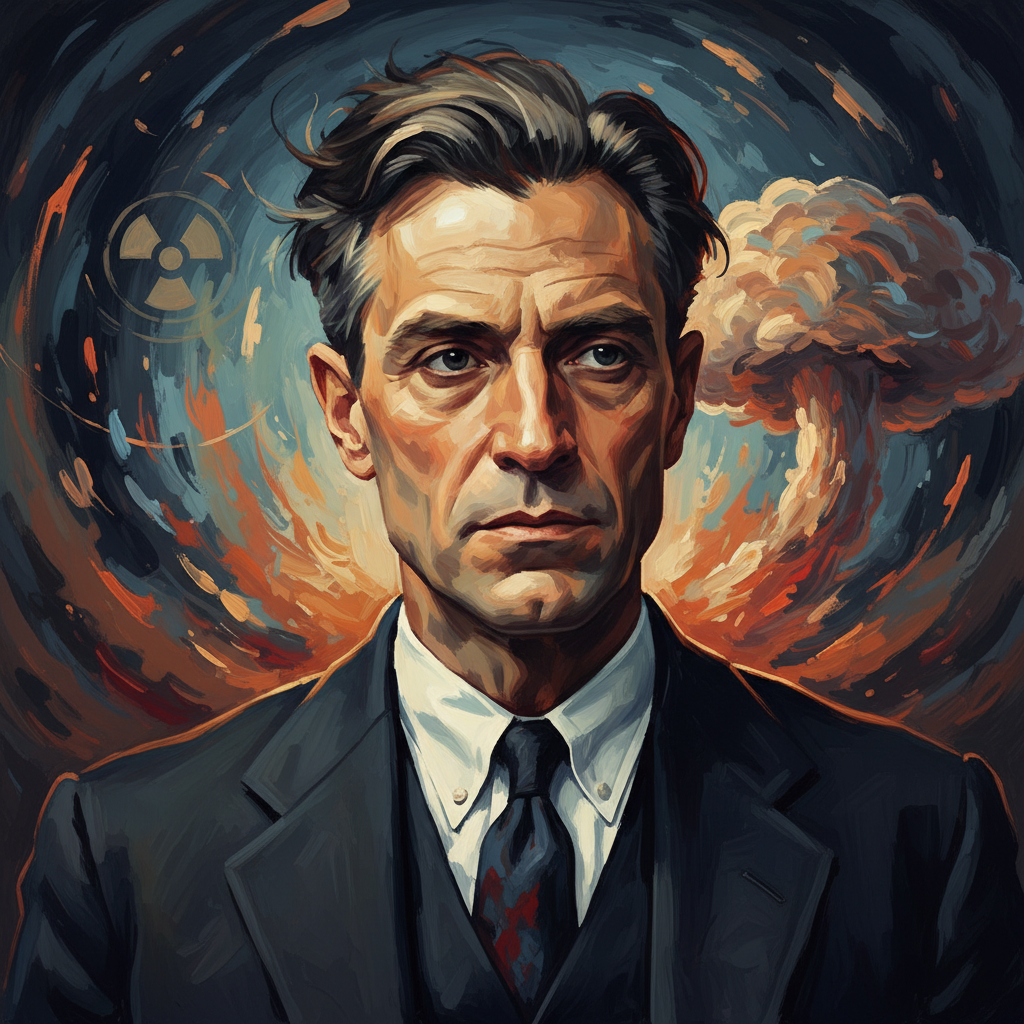
Robert Oppenheimer — "My childhood did not prepare me for the fact that the world is full of cruel and…"
My childhood did not prepare me for the fact that the world is full of cruel and bitter things.
My childhood did not prepare me for the fact that the world is full of cruel and bitter things.
Click any product to generate a realistic preview. Up to 3 at a time.
* Initial load can take up to 90 seconds — revising the preview in another color is nearly instant.
"There are no experts on the future."
"The people of this world must unite or they will perish."
"I find myself in a world in which the physicists have known sin."
"The most beautiful philosophical song existing in any known tongue."
"The atomic bomb is a stark reminder that we are living in a new era, an era of unprecedented power and unprecedented danger."
American theoretical physicist who directed the Manhattan Project's Los Alamos Laboratory and oversaw the atomic bombs; lost his security clearance in 1954. Closely associated with Niels Bohr (Manhattan Project consultant and atomic-policy advisor) and Hans Bethe (Los Alamos theoretical-division chief). For an intellectual contrast, see Edward Teller, Hungarian-American physicist and 'father of the H-bomb' — Teller pushed the H-bomb against Oppenheimer's objections and testified against him at his 1954 security hearing — the precise moment that ended Oppenheimer's career. The canonical 'physicist-of-conscience vs physicist-of-state' pairing in nuclear-age ethics; Christopher Nolan's Oppenheimer (2023) dramatized this rivalry for a mass audience.
Found in 1 providers: gemini
1 source checked
This quote captures the rude awakening many experience when childhood's protective bubble bursts against adult reality. It acknowledges that upbringing—however loving or sheltered—often fails to equip us for the genuine cruelty, moral ambiguity, and suffering the world contains. There is no self-pity here, only honest reckoning: the world does not soften itself for those unprepared, and innocence is no shield against encountering its darkest dimensions.
Oppenheimer grew up in a wealthy, culturally refined Manhattan household, attending elite schools and Harvard—a privileged, intellectually stimulating world far removed from hardship. Yet he directed the Manhattan Project, overseeing weapons that killed over 200,000 people in Hiroshima and Nagasaki. That catastrophic gap between his sheltered formation and the mass death he helped engineer makes this deeply autobiographical. His subsequent persecution in McCarthy-era security hearings stripped him of his clearance and added bitter personal disillusionment.
Oppenheimer lived through events that shattered Western optimism at its foundations: two world wars, the Holocaust, totalitarianism's rise, and the dawn of the atomic age. His generation witnessed industrial-scale slaughter that 19th-century progressivism never anticipated. Scientists who believed knowledge was inherently liberating found themselves architects of civilization-ending weapons. The 1950s McCarthy purges then demonstrated that even celebrated national heroes were vulnerable to political cruelty and institutional betrayal.
AI-generated insights based on extensive research and information for context. Factual errors? Email [email protected].
Your cart is empty