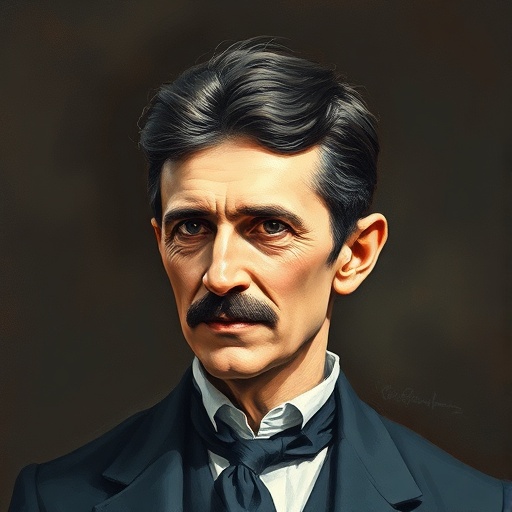
Nikola Tesla — "My mother was an inventor of the first order."
My mother was an inventor of the first order.
My mother was an inventor of the first order.
Click any product to generate a realistic preview. Up to 3 at a time.
* Initial load can take up to 90 seconds — revising the preview in another color is nearly instant.
"I could hear a fly walking across the room."
"I am willing to sacrifice my life for the benefit of humanity."
"Our entire biological system, the brain, and the Earth itself, work on the same frequencies."
"I have always been ahead of my time."
"If you only knew the magnificence of the 3, 6, and 9, then you would have the key to the universe."
Serbian-American inventor and electrical engineer whose alternating-current designs powered the modern electrical grid; died poor and largely forgotten. Closely associated with George Westinghouse (his AC-power business partner) and Mihajlo Pupin (fellow Serbian-American physicist at Columbia). For an intellectual contrast, see Thomas Edison, American inventor and direct-current advocate — Edison's direct-current power-distribution scheme was displaced by Tesla-Westinghouse AC in the 1890s 'War of Currents'. Edison ran a public-relations campaign electrocuting animals to discredit AC — the most famous engineering-ethics rivalry in American history. Tesla's AC won and powers nearly every electrical grid on Earth.
Found in 1 providers: grok
1 source checked
Tesla is declaring his mother a genuinely exceptional inventor — not just a clever homemaker, but someone with real creative and technical genius. 'First order' means the highest rank. He's granting her the same title he held himself, fully and without qualification. It's a statement of intellectual inheritance: he traces his own inventive capacity directly to her, giving her credit most people of his era would never have considered.
Tesla's mother, Đuka Tesla, never attended school yet memorized entire Serbian epic poems and built functional household tools from scratch. Tesla openly credited her as the origin of his inventive mind. He was with her when she died in 1892, a loss that devastated him. For a man who redefined electrical engineering, attributing his genius to his mother was deeply personal — he saw her ingenuity as the seed of everything he built.
In the late 19th century, women were legally and culturally barred from professional invention. Patents were routinely filed under husbands' names; female contributions to technology went unrecorded. Tesla making this declaration publicly was striking — he elevated a Serbian peasant woman to the rank of inventor at a moment when women couldn't vote, rarely owned property, and were expected to be invisible in the history of ideas and innovation.
AI-generated insights based on extensive research and information for context. Factual errors? Email [email protected].
Your cart is empty