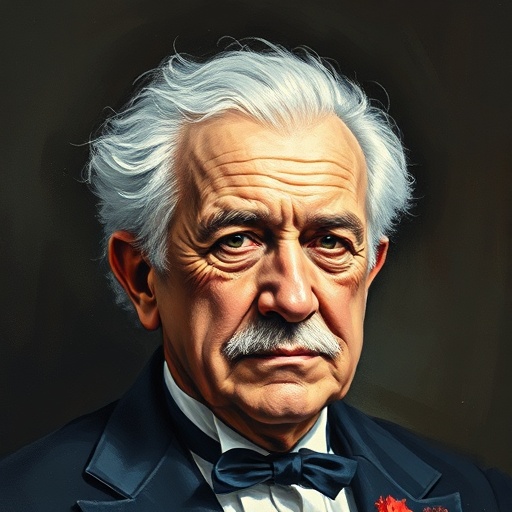
Thomas Edison — "My success is due to the fact that I never went to school and was never forced t…"
My success is due to the fact that I never went to school and was never forced to learn anything but what I wanted to know.
My success is due to the fact that I never went to school and was never forced to learn anything but what I wanted to know.
Click any product to generate a realistic preview. Up to 3 at a time.
* Initial load can take up to 90 seconds — revising the preview in another color is nearly instant.
"Show me a thoroughly satisfied man and I will show you failure."
"I have friends in the other world. I have had very pleasant conversations with them. I am rather unorthodox in this matter."
"Hell, there are no rules here—we're trying to accomplish something."
"The first thing is to find out what the world needs; then proceed to invent it."
"I am not discouraged, because every wrong attempt discarded is another step forward."
Found in 1 providers: grok
1 source checked
Edison credits his achievements to avoiding formal schooling, which let him pursue only subjects that genuinely interested him. He is arguing that self-directed curiosity beats a rigid curriculum: when you chase what grips you, you dig deeper and retain more. Required learning, by contrast, breeds compliance rather than mastery. In short, passion-driven study produced his results, not classroom obligation or credentials handed down by teachers.
Edison had only about three months of formal schooling before his mother pulled him out; he taught himself chemistry, telegraphy, and electrical theory by reading and tinkering. His Menlo Park lab ran on relentless trial-and-error, not academic theory, yielding 1,093 US patents including the phonograph and practical incandescent bulb. He famously clashed with university-trained engineers like Tesla, trusting hands-on experimentation over textbook reasoning throughout his career.
Edison worked from the 1870s through the 1920s, as America industrialized and public schooling became compulsory in most states. Universities were expanding engineering programs, and credentialed expertise was replacing the self-taught tinkerer. Yet the Gilded Age still celebrated self-made inventors and entrepreneurs like Carnegie and Ford. Edison's remark defended that vanishing tradition at the exact moment formal technical education was becoming the standard path into invention and industry.
AI-generated insights based on extensive research and information for context. Factual errors? Email [email protected].
Your cart is empty