What it means
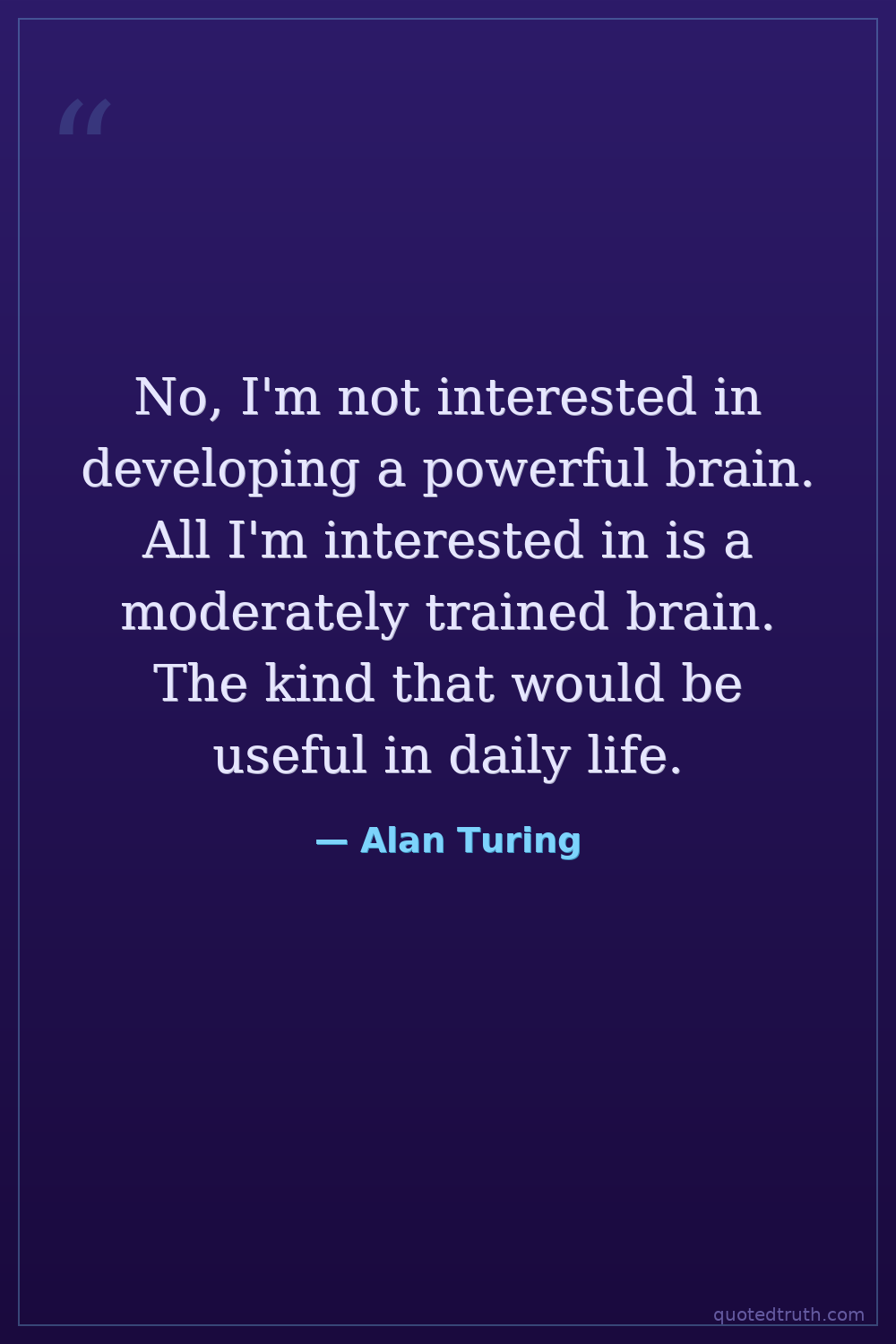
The quote argues against chasing raw cognitive power or superhuman intellect. It makes a pragmatist's case: a brain — human or artificial — that handles everyday tasks reliably is more valuable than one of extraordinary but impractical brilliance. True utility comes from competence matched to real needs, not from maximal capability. Moderate, functional intelligence beats spectacular intelligence that serves no practical purpose in ordinary life.
Relevance to Alan Turing
Turing's landmark 1950 paper proposed the Imitation Game — later called the Turing Test — to judge machine intelligence not by solving transcendent problems but by passing as a competent conversationalist. His wartime codebreaking at Bletchley Park demanded practical, timely results under pressure, not theoretical perfection. Despite his own genius, Turing believed AI's purpose was human-level usefulness in daily tasks — this quote directly expresses that founding conviction.
The era
In the late 1940s and 1950s, computing was confined to universities and military labs, and AI was a nascent concept inspiring equal parts wonder and alarm. Philosophers hotly debated whether machines could truly 'think.' Writing amid Cold War anxiety about technology outpacing humanity, Turing's insistence on modest, practical intelligence was a deliberate corrective — grounding the emerging field in human utility rather than science-fiction fantasies of godlike machine minds.
AI-generated insights based on extensive research and information for context. Factual errors? Email [email protected].