Robert Oppenheimer — "No man should escape our universities without knowing how little he knows."
No man should escape our universities without knowing how little he knows.
No man should escape our universities without knowing how little he knows.
Click any product to generate a realistic preview. Up to 3 at a time.
* Initial load can take up to 90 seconds — revising the preview in another color is nearly instant.
"The atomic bomb made the prospect of future war unendurable. It has led us up those last few steps to the mountain pass; and beyond there is a different country."
"The atomic bomb is a terrible weapon. But it is also a symbol of hope."
"The atomic bomb is a symbol of man's mastery over nature, but also of his potential for self-destruction."
"If I had to choose between the two evils, I would rather have a world with no nuclear weapons than a world with nuclear weapons."
"We have opened a new age, and it is an age of terror."
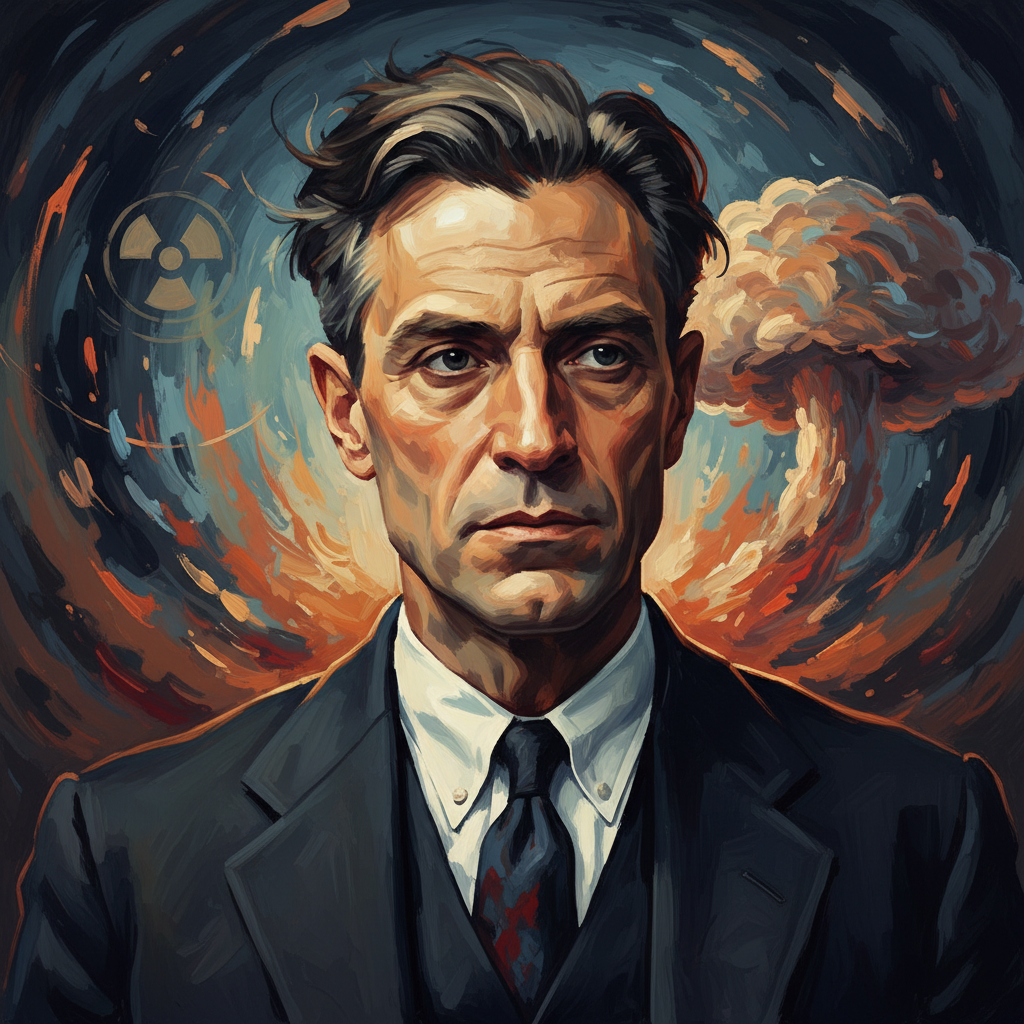
American theoretical physicist who directed the Manhattan Project's Los Alamos Laboratory and oversaw the atomic bombs; lost his security clearance in 1954. Closely associated with Niels Bohr (Manhattan Project consultant and atomic-policy advisor) and Hans Bethe (Los Alamos theoretical-division chief). For an intellectual contrast, see Edward Teller, Hungarian-American physicist and 'father of the H-bomb' — Teller pushed the H-bomb against Oppenheimer's objections and testified against him at his 1954 security hearing — the precise moment that ended Oppenheimer's career. The canonical 'physicist-of-conscience vs physicist-of-state' pairing in nuclear-age ethics; Christopher Nolan's Oppenheimer (2023) dramatized this rivalry for a mass audience.
Found in 1 providers: gemini
1 source checked
True education isn't about filling students with facts—it's about revealing how much remains unknown. The more deeply you study any subject, the more you perceive its complexity and the edges of human understanding. Universities succeed not when graduates feel they've mastered everything, but when they leave genuinely aware of their own ignorance. Knowing your limits is not weakness; it's the foundation of serious intellectual work and lifelong learning.
Oppenheimer led the Manhattan Project, mastering quantum mechanics, nuclear physics, and military logistics simultaneously—yet he emerged haunted, not triumphant. After Trinity he quoted the Bhagavad Gita: 'Now I am become Death.' A devoted teacher at Berkeley before the war, he believed science education must cultivate humility alongside brilliance. His security-clearance revocation in 1954 showed even extraordinary expertise couldn't protect against the forces he'd helped unleash.
Post-WWII American universities surged in size and prestige, fueled by the GI Bill and Cold War research spending. Scientists had split the atom and were racing to build hydrogen bombs. Public faith in technology was enormous—yet Oppenheimer and peers knew how incomplete that knowledge was. The gap between what scientists could build and what they could foresee or control made intellectual humility not just virtuous but urgently necessary.
AI-generated insights based on extensive research and information for context. Factual errors? Email [email protected].
Your cart is empty