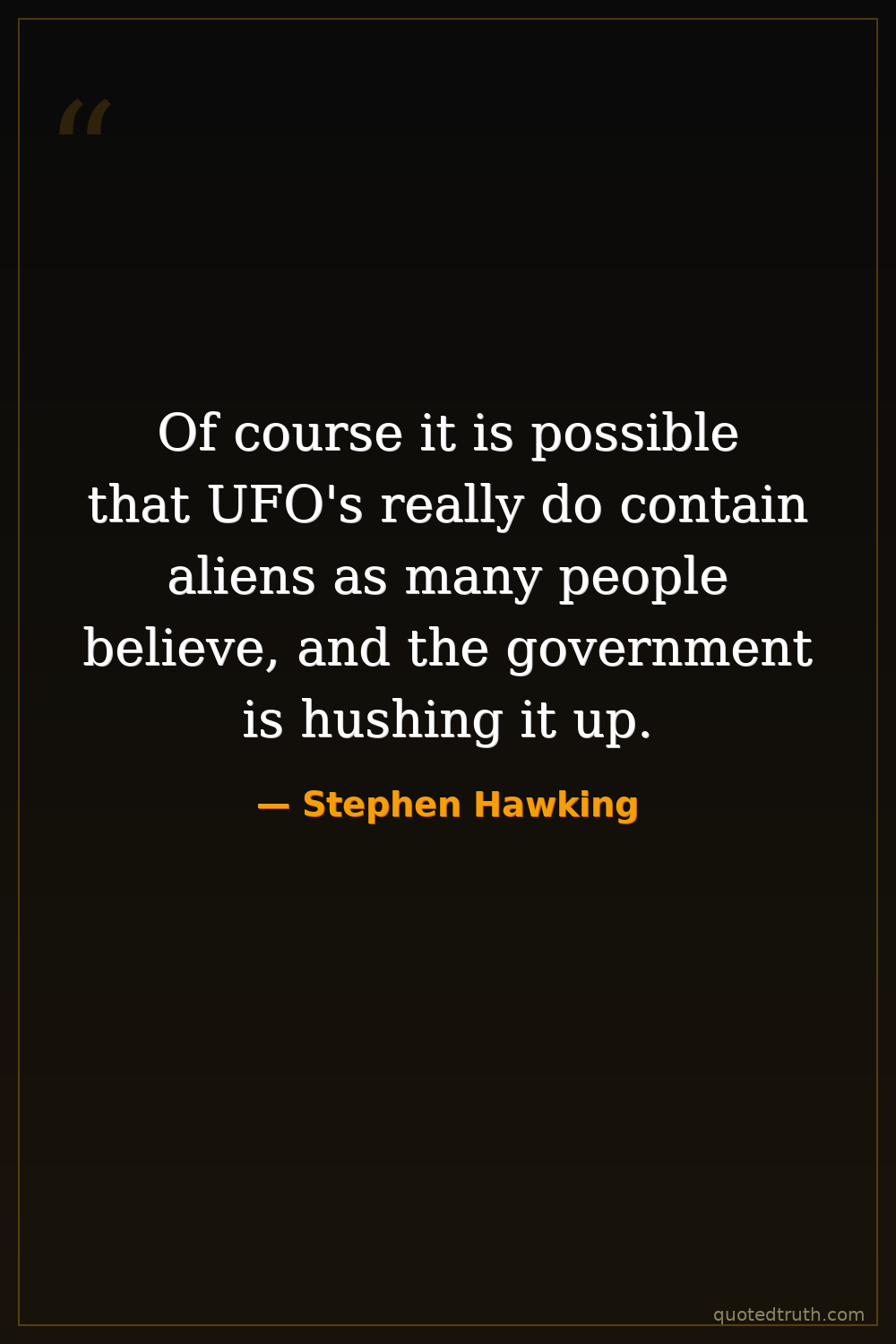
Stephen Hawking — "Of course it is possible that UFO's really do contain aliens as many people beli…"
Of course it is possible that UFO's really do contain aliens as many people believe, and the government is hushing it up.
Of course it is possible that UFO's really do contain aliens as many people believe, and the government is hushing it up.
Click any product to generate a realistic preview. Up to 3 at a time.
* Initial load can take up to 90 seconds — revising the preview in another color is nearly instant.
"The universe is a giant puzzle, and I'm trying to put the pieces together."
"I think that the human race has a destiny to explore the universe."
"I think that the human race has a great future ahead of it, if we can just learn to cooperate."
"We are in danger of destroying ourselves by our greed and stupidity."
"Life would be tragic if it weren't funny."
British theoretical physicist whose Hawking radiation work and A Brief History of Time (1988) brought black-hole physics to a mass audience while he lived with ALS for 55 years. Closely associated with Roger Penrose (his collaborator on singularity theorems) and Carl Sagan (fellow popularizer who wrote Brief History's foreword). For an intellectual contrast, see William Lane Craig, American philosopher of religion — Craig's Kalam cosmological argument depends on the Big Bang requiring a divine first cause; Hawking's no-boundary proposal was specifically designed to remove the moment that would require one — the cleanest cosmology-vs-natural-theology contrast in modern thought.
Found in 1 providers: gemini
1 source checked
The statement acknowledges, without full endorsement, the logical possibility that UFOs carry extraterrestrial beings and that governments conceal this truth. It validates public suspicion of official secrecy while remaining scientifically cautious — distinguishing between what is possible and what is proven. Hawking neither dismisses the idea as absurd nor confirms it, treating it as a live hypothesis deserving honest acknowledgment rather than reflexive ridicule.
Hawking spent his career calculating the statistical likelihood of intelligent extraterrestrial life, famously warning humanity against contact with advanced civilizations. His work on the scale and age of the universe convinced him life almost certainly exists elsewhere. This quote reflects his willingness to engage alien questions seriously, a sharp contrast to mainstream scientific culture that historically dismissed UFO discourse as fringe pseudoscience unworthy of rigorous attention.
Hawking made this remark amid post-Cold War UFO culture peaking in the 1990s–2000s, fueled by Roswell anniversaries, the X-Files phenomenon, and growing distrust of government following Vietnam and Watergate. Declassified documents hinting at official UFO investigations fed widespread belief in cover-ups. Simultaneously, SETI research was gaining scientific legitimacy, making the question of extraterrestrial life newly respectable in academic and public discourse.
AI-generated insights based on extensive research and information for context. Factual errors? Email [email protected].
Your cart is empty