What it means
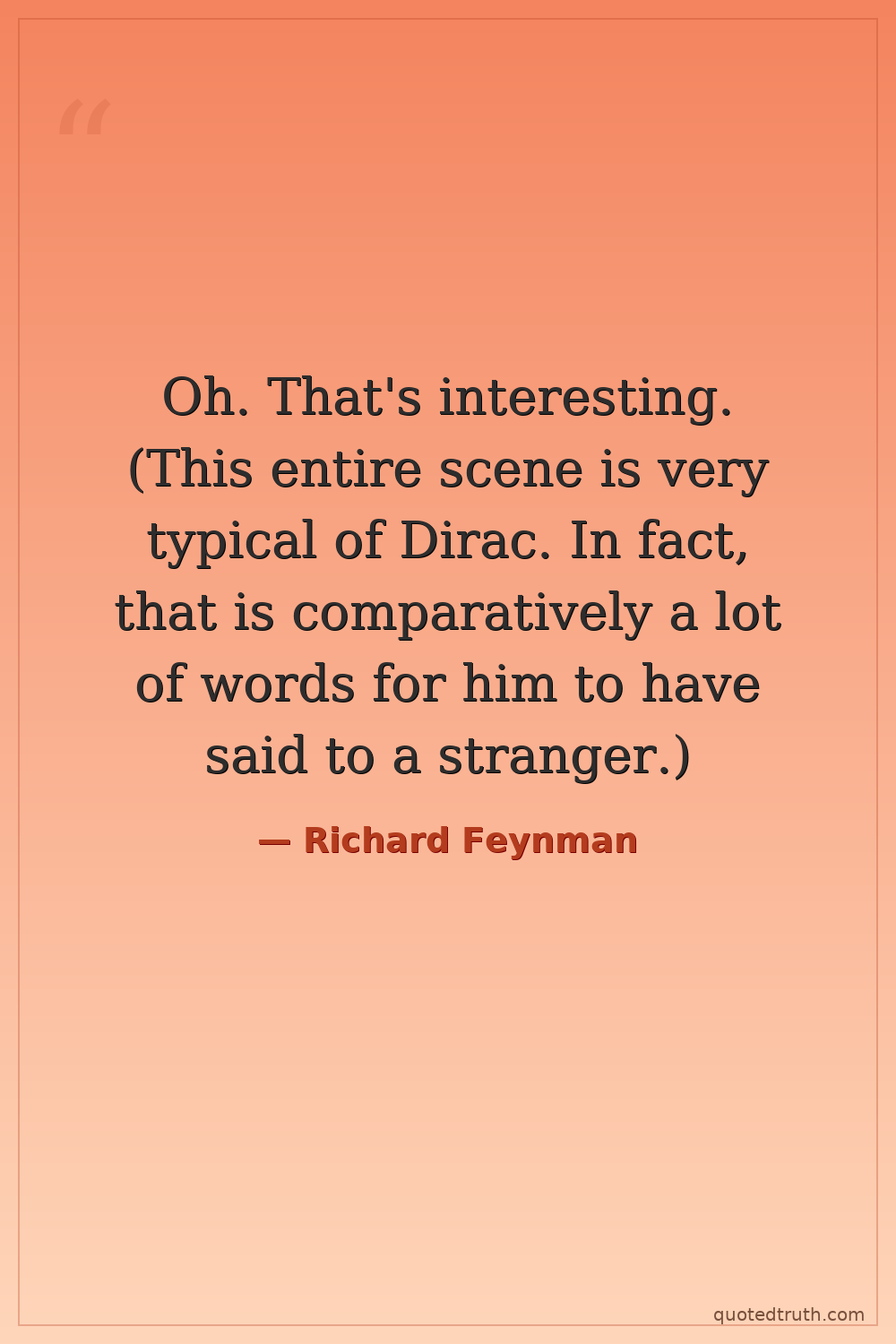
A wry, affectionate observation about someone's extreme economy of speech. The parenthetical reveals the speaker noticing not just what was said, but how unusual it was for that person to say anything at all. It captures the humor in recognizing that a brief, unremarkable exchange was actually a lengthy conversation by one person's standards — turning silence itself into a character trait worth remarking on.
Relevance to Richard Feynman
Feynman was famous for his irreverence, humor, and keen observational wit. As a physicist at Princeton and Caltech, he knew Paul Dirac personally and deeply admired his brilliance. Feynman loved puncturing the pomposity of academia with laughter. His ability to find comedy in the peculiarities of brilliant minds — including notoriously taciturn Dirac — reflects his gift for humanizing genius.
The era
Mid-20th century theoretical physics was populated by towering, eccentric intellects — Dirac, Bohr, Heisenberg, von Neumann. Paul Dirac was legendarily quiet, his reticence almost mythological among physicists. Post-WWII physics culture at conferences and institutes made these interpersonal dynamics legendary. Feynman, writing and speaking in the 1960s–80s, chronicled this era's personalities with the eye of a natural storyteller.
AI-generated insights based on extensive research and information for context. Factual errors? Email [email protected].