What it means
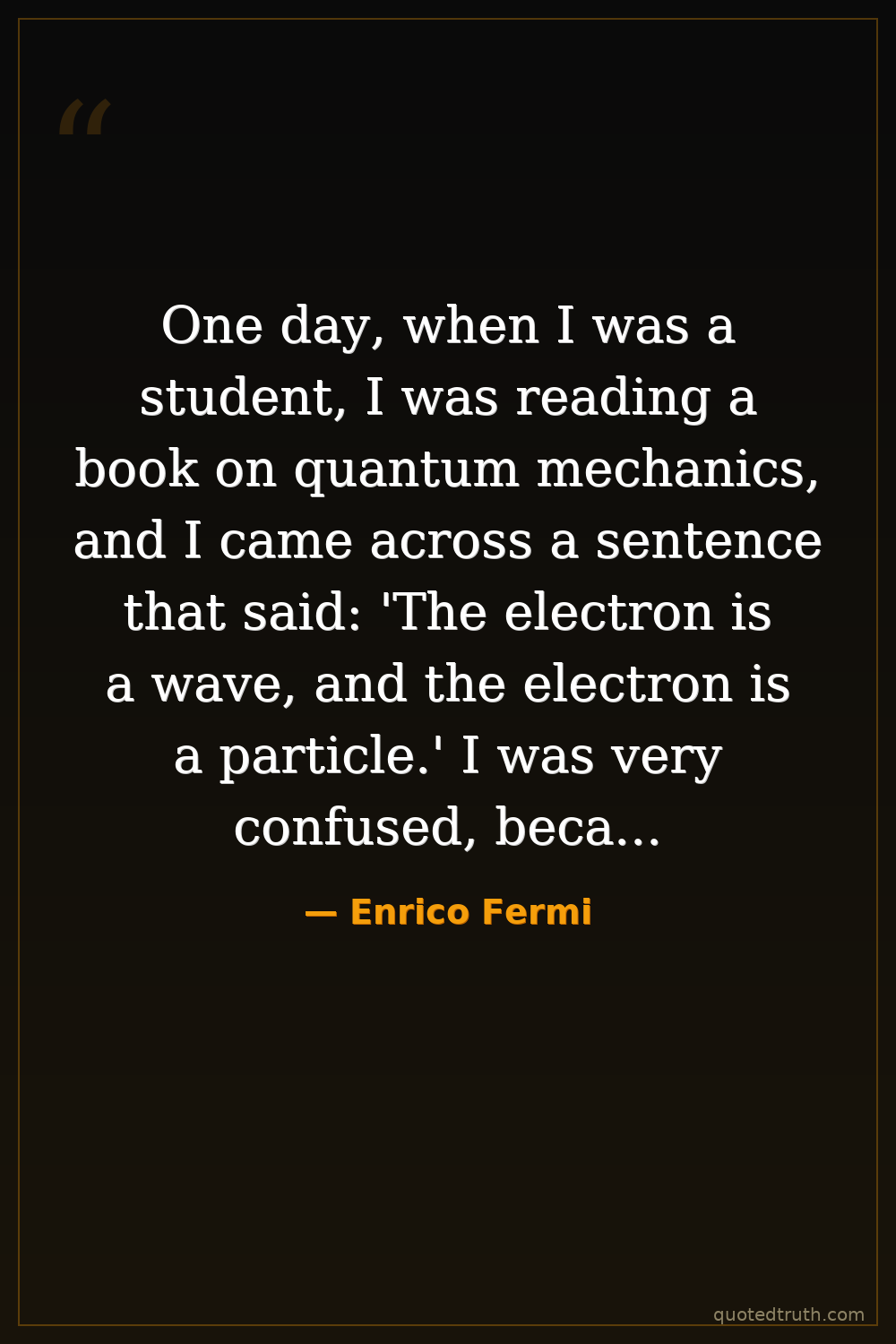
The quote captures the core paradox of quantum mechanics: electrons defy classical either/or logic, behaving as waves in some experiments and as particles in others. Rather than a contradiction, this is a fundamental feature of nature at the quantum scale. Accepting that two seemingly incompatible descriptions can both be true — depending on how you look — is the conceptual leap quantum physics demands of every student encountering it for the first time.
Relevance to Enrico Fermi
Fermi mastered quantum theory during its founding decades, earning his Nobel Prize in 1938 for neutron-induced radioactivity — work that required deep fluency in quantum particle behavior. Building Chicago Pile-1 in 1942, the world's first nuclear reactor, depended on applying quantum mechanics to real materials. The reflection mirrors his legendary trait: accepting mathematically counterintuitive results because experiment and theory together left no other honest conclusion.
The era
Fermi came of age during quantum mechanics' birth in the 1920s and 30s. De Broglie's 1924 wave hypothesis, Heisenberg's 1927 uncertainty principle, and Bohr's complementarity principle overturned centuries of Newtonian certainty. Physicists worldwide struggled to abandon classical intuition. This intellectual upheaval ran parallel to Fermi's career in Fascist Italy, his emigration after accepting the Nobel Prize, and his pivotal role in the Manhattan Project — all shaped by this radical rethinking of physical reality.
AI-generated insights based on extensive research and information for context. Factual errors? Email [email protected].